


You spent the money. You did the work. The kitchen looks exactly like the one you screenshotted from a design account at 11 p.m.
Then a buyer walks through and does the math in their head.
That’s the part nobody warns you about. Plenty of “upgrades” photograph beautifully and still knock a real number off your sale price — because a buyer isn’t looking at your taste. They’re looking at what it’ll cost to undo it.
Some of these are trendy. Some are expensive. A few are things sellers genuinely believe are premium features. All of them can quietly work against you when it’s time to list.
Here are 28 kitchen upgrades that tend to make your home harder to sell — and why buyers flinch.
1. Ripping Out All Your Upper Cabinets

The single-window, wall-of-nothing look is everywhere right now. Calm. Airy. Gallery-quiet.
It also deletes half your storage.
Buyers don’t see serenity. They see nowhere to put the glasses, and a contractor’s bill for putting cabinets back where they used to be. According to FinanceBuzz, this reads as calm in a listing photo and as a cost the moment someone imagines actually cooking there.
The trendiest move on this list carries the clearest penalty.
2. Open Shelving Instead of Cabinets

It looks styled for about a week.
Then grease from the stove settles on the mugs. Dust films the plates you don’t use daily. Everything needs wiping before guests arrive.
Designers keep flagging the same thing — open shelving turns into visible clutter fast, and buyers read it as a chore, not a look. If any of your dishes don’t match, that’s on display too.
Closed doors hide the chaos of daily life. That’s the whole point of them.
3. The Waterfall-Edge Island

Owners think of it as the splurge piece. The thing that makes the kitchen feel expensive.
The problem is timing.
Generic quartz waterfall islands got mass-produced so hard and so fast that they now date-stamp a kitchen straight to the mid-2020s. A feature meant to read as timeless has become a calendar. Buyers who’ve toured a dozen homes have seen the exact same slab a dozen times.
Distinctive today. Instantly datable tomorrow.
4. Barn Doors on the Pantry

Sliding a barn door across a pantry felt fresh around 2019.
It doesn’t now.
Buyers clock them instantly and file them under “2020, replace.” They also don’t seal sound or smell well, and they eat wall space a swinging door wouldn’t. Cheap to install, cheap to remove — which is exactly how a buyer sees them.
5. Peel-and-Stick Backsplash

Marketed as a weekend refresh. Priced like one, too.
The trouble is that a kitchen is a hot, wet, greasy place, and adhesive vinyl was not built for it. Edges lift. Steam gets behind it. It yellows over the stove.
Worse than looking cheap, it signals cheap — a buyer about to spend real money sees corners cut and starts wondering where else. There are small upgrades that lift a kitchen without telegraphing a tight budget. This isn’t one of them.
6. The Weekend-Tutorial Tile Job

Real tile beats vinyl. A bad tile job beats nothing.
Crooked lines and uneven grout get spotted in seconds. And buyers extrapolate — if the work they can see is sloppy, what about the work they can’t?
That’s the real damage. A wonky backsplash makes people question the plumbing behind the wall and the wiring above it. One visible shortcut poisons trust in the whole house.
Hire it out or level every row. There’s no cheap middle.
7. Dark or High-Contrast Painted Cabinets

Moody kitchens shot up over the last few years. Deep green, charcoal, near-black.
Going dark is a one-way door.
Reversing it means priming over saturated color coat after coat, and stark two-tone contrast dates faster than almost anything. Light, classic cabinetry keeps the widest pool of buyers interested — and a wide pool is what drives the price up. If you’re weighing how trend-forward to go on finishes, resale is the argument for restraint.
8. A Bold Statement Paint Color

Fire-engine red. Deep navy. That mustard you loved on the swatch.
Paint is cheap to change and still scares buyers off. Bold color reads as personal, and personal reads as “not mine.” Most people walk into a strong wall color and immediately budget a repaint instead of seeing a feature.
You’ll never win them all with a color. You lose fewer with a neutral.
9. Marble Countertops

The classic. The luxury pick. The one that supposedly never goes out of style.
Also the one that etches when you look at it wrong.
One splash of lemon juice or tomato sauce leaves a dull mark in the polish, because marble is calcium carbonate and acid eats it. Buyers who know that don’t see luxury — they see a lifetime of babying a surface. FinanceBuzz lists it among the upgrades that quietly work against resale for exactly this reason.
Gorgeous in a magazine. A maintenance contract in a real house.
10. Butcher Block Countertops

Warm, cabin-cozy, and a flipper favorite because it costs less than stone while reading as “custom.” That’s the appeal. Here’s the catch.
Butcher block scars. Knife marks, scorch rings from a hot pan, dark stains where something acidic sat too long. Some owners love the patina. Most buyers see a surface that’s already worn out.
The real problem lives around the sink.
Wood and a constant water source are a bad marriage. If the seal around the sink cutout fails — and on a DIY install it often does — water wicks into the end grain and stays there. Wood swells. The finish clouds and lifts. Given a few months of that cycle, you get soft spots, black staining, and eventually rot creeping under the countertop where nobody looks until it’s a real repair.
A home inspector will press on the wood next to the faucet. Soft means water damage, and water damage means renegotiation. That single spot can turn a cosmetic feature into a line item on the buyer’s demand list.
If you keep butcher block, the sink perimeter needs a real waterproof seal and re-oiling on a schedule, not a one-time coat and hope. Sealing tightly around the sink is the difference between charming and rotting — and buyers can tell which one they’re looking at.
11. Tile Countertops

Retro is having a moment. Tile counters are not part of it.
Zillow research pegged homes with tile countertops at selling for roughly 0.9% less than expected. On a $400,000 home, that’s real money for a surface most buyers already dislike.
The grout is the villain. It stains, it harbors gunk, and it turns meal prep into a scrubbing session. Buyers see rows of little seams and mentally start ripping them out.
12. Laminate Everything

Modern laminate is genuinely better than the stuff from decades past. Doesn’t matter much at resale.
The word itself drags. Zillow found listings mentioning laminate often sold for around 0.9% below expectation, and Heller Coley Reed notes buyers still read it as low-end no matter how it’s improved.
It also can’t take heat, and it chips at the edges once it does. A hot pan leaves a mark you can’t sand out.
13. Switching to a Different Kitchen Floor

Tiling only the kitchen in a newer home feels like an upgrade while you’re doing it.
From the doorway, it reads as a seam.
Continuous flooring makes a space feel bigger and calmer, and buyers respond to that flow without knowing why. A hard break at the kitchen threshold does the opposite — it chops the floor plan into boxes. In an open layout especially, one flooring change can shrink the whole room to the eye.
14. The Fully Themed Kitchen

Diner-red vinyl booths and neon. Nautical portholes and fishnet on the walls. A Tuscan mural over the range.
Commitment like that is a deal-killer.
Designers list heavily themed kitchens among the fastest ways to shrink your buyer pool, because a theme is your fantasy, not theirs. People can’t picture their own life inside someone else’s set piece. What they picture is the demolition.
Personality sells a mood board. It rarely sells a house.
15. The Built-In Kitchen Desk / Computer Nook

Every builder threw one in around 2000. A little desk, a cubby, a place for the family PC.
Nobody wants it now.
The laptop killed the reason it existed — you don’t need a hardwired station facing a wall when you can work from the island. Designers routinely rip these out for real storage, and buyers see the same wasted footprint. That’s cabinet space or pantry space sitting idle.
A charming relic. Also, dead square footage.
16. Carving Out a Breakfast Nook

Feels cozy. Costs you.
Zillow found homes advertising a breakfast nook sold for about 0.3% less, while a kitchen island commanded roughly 0.5% more. Buyers would rather have the flexible space back than a fixed bench they can’t rearrange.
A built-in nook locks the layout. An island gives them prep space, seating, and storage all at once — and they know it.
17. The Built-In Wine or Beverage Fridge

You see a premium touch. A lot of buyers see a cabinet you gave away.
That slot used to hold pots, small appliances, a trash pull-out — something useful every day. Now it’s a specialty appliance that runs constantly, hums, and will eventually need repair or replacement.
People who don’t drink wine especially do the math fast. To them it’s storage they lost plus a compressor they inherited.
18. A Recirculating Range Hood With No Outside Vent

This one hides a real problem behind a stylish grille.
A proper range hood pulls steam, grease, and cooking smell outside through ductwork. A recirculating hood does not. It sucks the air through a charcoal filter and blows it right back into the room — grease, odor, humidity and all.
The difference shows up over time. Grease that isn’t vented settles on cabinets and walls as a sticky film. Smells from last night’s fish don’t leave, they linger. And the moisture from boiling and simmering stays trapped in the kitchen instead of going outdoors — which, in a space that already fights condensation around the sink and window, gives mold more chances to take hold in exactly the spots people never think to check.
Buyers care about air quality more than they used to. A kitchen that smells faintly of every meal ever cooked in it is a hard sell, and a savvy buyer will ask where the hood vents. “It just recirculates” is not the answer they want.
It also tells them something about the renovation as a whole. Skipping real ducting is the kind of shortcut that suggests other corners got cut where they can’t see. A vent to the outside is the boring, correct choice — and the one that holds value.
19. Restaurant-Grade Ranges and Giant Refrigerators

The pandemic sold everyone on the home-chef fantasy. Six burners. A fridge you could walk into.
Then the room had to live with it.
Oversized pro appliances now read as dated and, frankly, overwhelming in a normal kitchen. They cost more to run, more to repair, and they swallow counter and cabinet space around them. In a mid-size kitchen, a commercial range dominates instead of impressing.
House Digest points out that these giants often deter the very buyers owners hoped to wow. Most people cook like people, not like a line crew.
20. A Fridge, Range and Dishwasher That Don’t Match

You replaced them one at a time, as each one died. Totally reasonable.
It photographs like a discount.
A white fridge beside a stainless range beside a black dishwasher tells a buyer the kitchen was patched together, not planned. And they immediately price in the cost of making it cohesive — which usually means replacing perfectly good appliances just to match.
That mental deduction comes straight off your offer.
21. Bold-Colored Appliances

Bright red retro fridges are back in style. Avocado and harvest gold never left some kitchens.
Either way, color scares buyers.
A red or blue range feels personal, and personal makes people assume a renovation is due even when every appliance works perfectly. The holdover shades — almond, bisque, that ’70s avocado — do worse, because they read as neglect rather than choice. House Digest ties bold appliance color directly to lower offers.
Neutral finishes disappear into the kitchen. That’s what you want them to do.
22. The Over-Teched Smart Kitchen

The fridge with a screen. The faucet you talk to. The oven you preheat from an app.
Buyers see gremlins waiting to happen.
Consumer tech ages in dog years. The touchscreen that felt futuristic at install is orphaned software in five years, and repairs on smart components can cost nearly as much as replacement. A dead screen bolted into a nice fridge is worse than no screen at all.
Convenience is fine when it’s simple. A touchless faucet is easy to swap out later. A kitchen wired around a discontinued app is a future headache with your name on it.
23. Ultra-Custom Cabinetry Built Around One Cook

A drawer sized for your exact pasta pot. A rack for the one spice you use. Cabinetry engineered around how you, specifically, cook.
Beautiful for you. Baffling for everyone else.
Buyers want flexibility, and hyper-specific storage confuses more than it impresses. Even high-end finishes lose their pull when the layout only makes sense to the person who left. The next owner sees a puzzle they have to solve.
Custom is worth paying for. Custom-to-one-person is worth less the day you list.
24. Knocking Down the Wall for Open Concept

Everyone wanted to blow out the wall for a decade. Sometimes it’s the right call. Often it’s the expensive wrong one.
Start with the structure. Plenty of kitchen walls are load-bearing, and taking one out means a beam and proper support — engineered, permitted, inspected. A wall removed on a weekend without any of that is a red flag a buyer’s inspector lives to find. Visible sag, a header that looks improvised, no permit on record: any of those can stall a sale or gut the offer.
Unpermitted structural work is the part that scares lenders and insurers, not just buyers. When there’s no paper trail, the buyer has to assume the worst and price for it. That fear costs you more than the wall ever gave you.
Then there’s what you actually lose. That wall probably held upper cabinets, so opening it up can quietly delete a big chunk of storage. And with nothing to contain them, cooking smells and grease now drift straight into the living room and up the stairs — the same venting problem from earlier, scaled to the whole house.
Open concept done right, by pros, with permits, can absolutely add value. Done as a shortcut, it’s one of the fastest ways to turn a “maybe” into a “walk away.”
25. The Luxury Remodel Your Neighborhood Can’t Support

Here’s where all of this lands.
Drop a $200,000 kitchen into a $900,000 house on a block where nothing sells past a million, and you will not get that money back. Value is anchored to comparable homes, not to your receipts. The block sets a ceiling, and no amount of imported stone lifts it.
Upscale kitchen remodels tend to return only around 30 to 60 cents on the dollar, which is why the industry’s own numbers matter here. The National Association of Realtors tracks cost recovery on projects precisely because the gap between what you spend and what you recoup is so easy to misjudge.
Renovate for the block you’re on. The best kitchen on the street rarely earns back what the best kitchen in the neighborhood does.
26. A Poorly Placed Island That Breaks the Work Triangle

An island is only an upgrade if you can walk around it.
Cram one too close to the cabinets and you’ve built a traffic jam. The sink, stove, and fridge — the working triangle a kitchen lives by — get chopped up by a slab sitting in the wrong spot.
Buyers feel it before they name it. They squeeze past on the walk-through and something registers as off. An island that fights the flow is worse than no island, because now the fix means moving a plumbed, wired, heavy object.
27. Freestanding Wine Cellars & Aquariums in the Kitchen

A glass wine cellar column. A built-in reef tank glowing beside the range.
Showpieces to you. Chores to them.
Buyers look at a kitchen aquarium and see algae, water changes, and a leak risk near cabinetry. A freestanding wine cellar reads the same as the beverage fridge — a humming, coolant-dependent appliance eating space that could’ve been storage.
Novelty rarely survives the offer stage. Nobody pays extra to inherit your hobby.
28. Complicated, Busy Granite
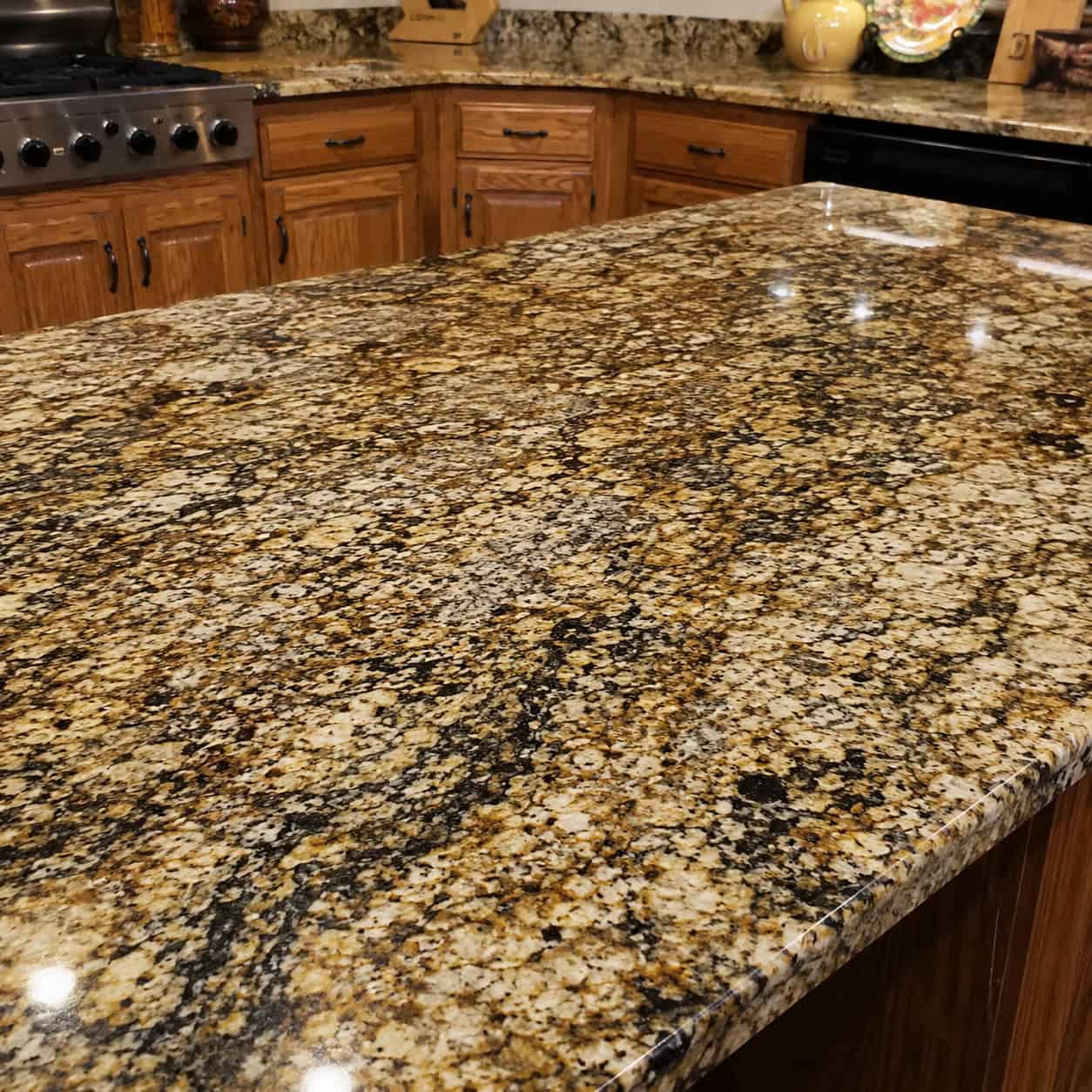
Heavy-veined, speckled, high-drama granite was the money surface in the early 2000s.
That’s exactly the problem.
Busy stone with swirling movement and contrast now reads as stuck in that era, the way a specific font dates a logo. Buyers see it and mentally place the kitchen twenty years back, whether the rest of it is fresh or not.
Calmer surfaces age slower. The louder the countertop, the tighter the window before it looks dated.
The Common Thread
None of these are “bad.” Most were somebody’s dream kitchen the week they installed them.
The problem is that a buyer prices your kitchen by what it costs to make it theirs — the storage to restore, the finish to reverse, the appliance to match, the wall to certify. Every personal choice becomes a line item in their head.
Renovate for how you actually live if you’re staying. But if a sale is anywhere on the horizon, the safest upgrades are the boring ones: neutral, cohesive, well-built, and vented to the outside. Timeless isn’t a style. It’s the absence of a reason to say no.
Always buy (plain) white appliances. They will ALWAYS match. All the others–stainless steel, black, etc. will never match. White is boring, but it will always match the other appliances.