


Your countertop didn’t crack overnight.
It dulled a little at a time. A ring here. A cloudy patch there. A faint yellow scorch you swear wasn’t there last month.
Most countertop damage isn’t an accident. It’s a habit — something you do every single day without a second thought, quietly wearing down a surface you paid thousands of dollars for.
The frustrating part is how ordinary these habits look. Wiping with a “natural” cleaner. Setting down a hot pan. Leaving a wet glass to dry. None of it feels destructive in the moment.
Here are 20 everyday kitchen habits that are slowly destroying your countertops — and exactly what to do instead.
1. Chopping straight on the surface — no cutting board

Almost everyone does it. A quick slice of lime, half an onion, a bagel — why dirty a board?
Because your knife is doing more than scratching. On sealed granite and quartzite, those fine cuts break the waterproof barrier and hand water and stains a way in.
Quartz fares no better. The manufacturer of Caesarstone flatly warns that cutting directly on the surface can scratch it and even chip the edge, and Caesarstone notes it dulls your knife blades in the process.
Laminate scratches fastest of all. Use a board. Always.
2. Parking a hot pan straight off the burner

This is the big one.
“Quartz is heat-proof” is one of the most expensive myths in any kitchen. Quartz is roughly 90% ground stone bound together with resin — and that resin is the weak link. It tolerates only about 150°F before it starts to soften, and manufacturers put the safe ceiling somewhere around 300°F.
A cast-iron skillet straight off a hot burner runs far past that. Five seconds of contact can leave a permanent yellow-brown scorch that no amount of scrubbing removes.
Laminate is worse in a different way — the plastic surface melts, blisters, and bubbles the instant real heat touches it. Butcher block burns and cracks. Even granite, which handles heat better than most, can develop thermal shock cracks when a searing pan meets a cold slab.
Here’s the part that stings. Heat damage is almost universally excluded from countertop warranties. Caesarstone spells it out in its own heat-resistance guide: use trivets and hot pads, because thermal damage isn’t covered.
And once it’s scorched, your options are grim. A resin burn on quartz can’t be sanded out the way a scratch can — the discoloration runs into the binder itself. Fabricators can sometimes swap a single damaged section if there’s a seam nearby, but you’re usually looking at replacing the slab. On a mid-range quartz counter, that’s several thousand dollars for one skillet.
Keep a couple of trivets within arm’s reach of the stove. Not in a drawer. On the counter, where you’ll actually use them.
3. Wiping down with vinegar and lemon “natural” cleaners

This one feels virtuous, which is exactly why it’s so sneaky.
Vinegar and lemon are acids. Wipe them across natural stone every day and they slowly eat through the sealer on granite and quartzite. On quartz, repeated acid contact dulls the resin surface into a haze.
On marble the damage is instant — acid etches calcite-based stone on contact, no waiting required.
The Natural Stone Institute recommends skipping acidic and abrasive cleaners entirely in favor of a pH-neutral stone soap. Green doesn’t always mean gentle. Skip the vinegar.
4. Scrubbing with steel wool and scouring powder

The abrasive cleaner under your sink was made for a bathtub, not your counter.
Scouring powders, gritty creams, and steel wool all work the same way — tiny scratches, thousands of them. On a polished surface that reads as a dull, hazy patch that catches the light wrong.
Once a polished finish is scratched into a matte cloud, you can’t buff it back yourself. That’s a professional re-polish, and it isn’t cheap.
A soft cloth and warm water handle 90% of kitchen messes. Save the muscle for the sink.
5. Spritzing bleach and ammonia to “disinfect”

A one-time diluted wipe won’t ruin anything. It’s the daily habit that does the damage.
Habitual bleach discolors quartz resin over time, leaving pale washed-out spots. Ammonia and other harsh disinfectants break down stone sealer, so the counter you’re trying to protect gets more porous the more you “clean” it.
The Natural Stone Institute notes that plain soap and warm water handle everyday sanitation on sealed stone. You don’t need a chemical arsenal.
Gentle wins. Every time.
6. Letting spills sit “until after dinner”

Red wine. Coffee. Tomato sauce. Beet juice. Olive oil.
Every one of those is a pigment or an acid looking for a way into your counter. Left to sit, they seep past the sealer and stain — and even granite and quartz aren’t fully immune when the spill sits for hours.
The delay is the whole problem. A drip wiped up in ten seconds does nothing. The same drip left through a two-hour dinner sinks in.
Keep a cloth handy and wipe as you go.
7. Leaving a sweating glass to dry into a ring
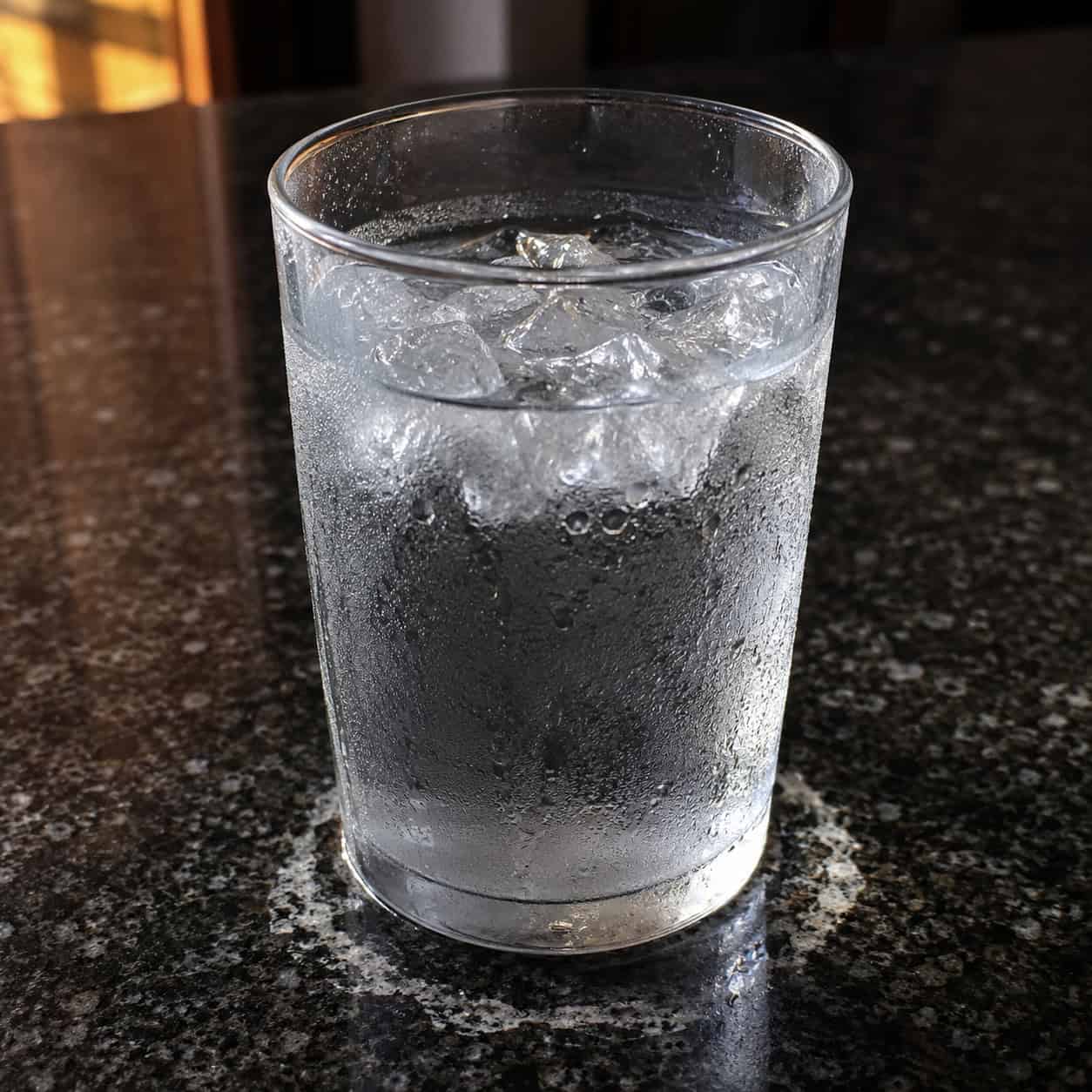
You’d think stone would laugh off a little condensation. It doesn’t always.
A cold glass sweats, the water pools underneath, and as it evaporates it leaves behind mineral deposits — a faint white ring that surprises people who assumed granite was bulletproof.
On sealed stone it’s usually cosmetic and cleans up. On stone with worn sealer, that moisture works deeper. Use a coaster, or just wipe the puddle before it dries.
8. Running the slow cooker or air fryer on bare quartz

Nobody thinks of a crockpot as dangerous. It’s not dramatic. That’s the trap.
A slow cooker left running all day radiates low heat into the same square of quartz for eight or ten hours straight. Air fryers vent hot air out the back and bottom. Neither one feels hot enough to worry about — but sustained low heat slowly cooks the resin into a localized scorch mark.
The mechanism is heat over time, not heat all at once, which is why so many people never see it coming.
Set a trivet or a wooden board under anything that runs for hours.
9. Never resealing granite and marble

Sealer isn’t permanent. Most people treat it like it is.
Natural stone is porous, and the sealer is the only thing keeping liquids on the surface instead of soaking in. It wears off — most granite and marble needs a fresh coat every one to two years.
Skip it, and one day the water you splash stops beading and starts darkening the stone instead. That’s your sign the sealer’s gone and stains are now free to set in.
Test it with a few drops of water. If it soaks in within a few minutes, it’s time. Minnesota Tile & Stone lays out the same water test in its stone-care guide.
10. Setting a cut lemon or tomato on marble

Etching isn’t a stain. That’s the part people miss.
A stain sits on top. An etch is a chemical burn that dissolves the polished surface of calcite-based stone — marble, limestone, travertine — into a dull, rough spot. And no sealer prevents it, because sealer stops absorption, not chemical reaction.
Leave a cut lemon on marble overnight and you’ll find its ghost etched into the shine the next morning. Same with a sweating glass of lemonade, a splash of wine, a slice of tomato.
On marble, treat every acidic food like it’s about to leave a mark. Because it is.
11. Using the counter as a step stool — or a seat

Stone is strong. It’s also brittle, and it has weak points you can’t see.
Seams are held together with epoxy. The cutouts around your sink and cooktop leave narrow, thin bridges of stone. Island overhangs act like cantilever beams with nothing underneath them.
Put your full body weight on any of those — standing to reach a high cabinet, sitting on the bar overhang — and you’re loading the exact spots the slab is weakest. People have cracked counters clean through and even flipped unsupported overhangs this way.
Get the step stool. It’s cheaper than a fabricator.
12. Dragging the stand mixer instead of lifting it

A stand mixer weighs 20-plus pounds, and its metal base has just enough grit on the bottom to act like sandpaper.
Drag it across the counter to plug it in and you leave fine scratches every single time. Slide heavy pots and Dutch ovens the same way and you’re also stressing the edges.
The fix is almost too simple. Lift, don’t drag. Or park heavy appliances on a mat that moves with them.
13. Ignoring the little chip near the edge

A dropped can nicks the edge. A small chip appears. You shrug it off.
That chip is now a weak point, and every future impact concentrates its force right there. One day a pot lands on the same spot and the chip becomes a crack that runs deep into the slab.
Small edge damage is fillable while it’s small. Left alone, it turns structural. Fill it — or have a pro fill it — before it grows.
14. Cracking bottle caps and leaning on laminate edges

Laminate’s whole weakness is its edges.
The surface is a thin sheet bonded to a core, and the edge is where that bond is most exposed. Pop a bottle cap against the lip of the counter, lean your weight on a corner, catch it with a dropped pan — and the laminate starts to split and peel.
Once an edge lifts, water gets under it and the peel spreads down the whole run. Use an actual bottle opener. Stop treating the edge like a tool.
15. Leaving laminate wet after every wipe-down

This is the quiet killer the title promises. Slow, invisible, and almost impossible to reverse once it starts.
Laminate looks waterproof, but only the plastic top layer is. Underneath sits an MDF or particleboard core — and that core drinks water like a sponge the moment moisture finds a way in.
Over-spray your cleaner, wipe with a soaking cloth, and leave standing water along the seams and the back edge, and moisture wicks down into the core through every gap. The board swells. The surface layer bubbles and lifts. Seams open up.
The early warning signs are easy to miss until it’s too late. A seam that feels slightly raised. A soft or spongy spot near the sink. A faint bubble in the laminate that wasn’t there before. By the time you notice, the core underneath is already swelling.
And a wet particleboard core doesn’t just fail structurally. Trapped moisture in a warm kitchen is exactly what mold needs to take hold behind the laminate — a problem that stops being a countertop issue and becomes a remediation one.
Wipe with a damp cloth, not a dripping one. Dry the surface after. Pay special attention to the strip around the sink and the seams, where the core is most exposed.
16. Never oiling your butcher block
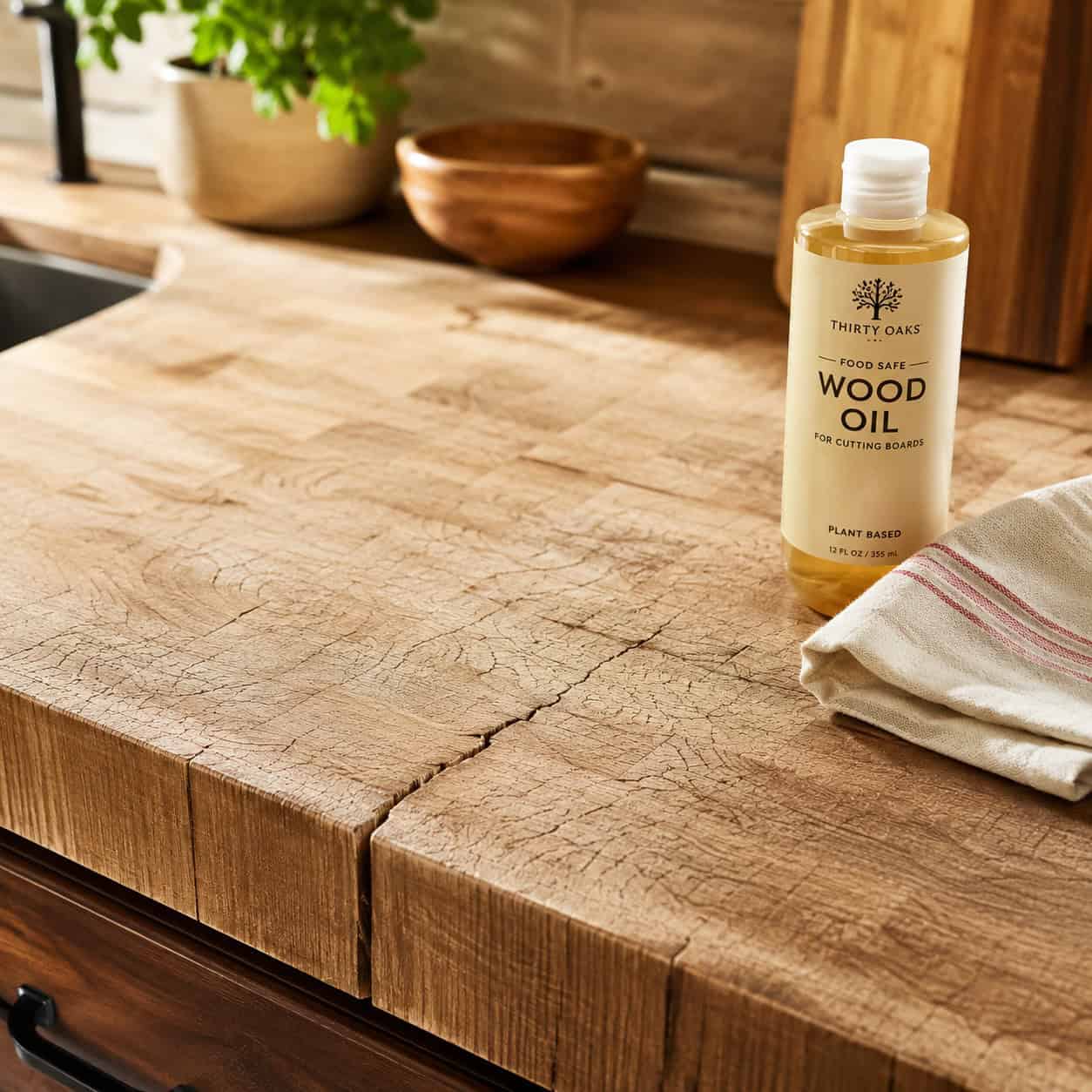
Wood is alive in a way stone isn’t. It needs feeding.
Butcher block relies on a regular coat of food-safe oil to stay sealed. Skip the schedule and the wood dries out, absorbs every spill it touches, and starts to crack along the grain.
Standing water is blamed for the majority of butcher-block splits — dry, unsealed wood soaks it up and swells, then shrinks and cracks as it dries.
Re-oil every few weeks at first, then whenever the surface stops looking rich and starts looking pale and thirsty.
17. Cleaning wood counters with disinfecting wipes

The convenient move is the harmful one here.
Disinfecting wipes are built around solvents and drying agents, and those break down the oil finish protecting your butcher block. Wipe by wipe, the seal thins out.
Strip that oil and the wood goes dull and rough, then starts absorbing water and bacteria — the exact opposite of what a “disinfecting” wipe is supposed to do. Southern Living flagged this same trap for wood counters.
Warm soapy water and a well-oiled surface do the sanitizing for you. Keep the wipes for the trash can.
18. Leaving the blinds open on a sunny counter

This one is completely passive, which is why nobody catches it.
Years of direct sunlight fade laminate, break down the sealers on granite and butcher block, and can even discolor some quartz over time. UV doesn’t announce itself — you just notice one day that the strip by the window looks a shade off from the rest.
If one run of counter gets blasted with afternoon sun, close the blinds during peak hours or add a sheer. Your counter ages slower in the shade — the same way grass holds its color out of relentless heat.
19. Using the counter as a landing pad for a rusting can or cast-iron pan

Metal plus moisture equals rust — and stone will happily hold the evidence.
Set a damp cast-iron pan or the bottom of an old can on a wet stone counter and leave it, and the metal can leave a rust ring behind. On porous or worn-sealed stone, that ring soaks in and settles.
Dry the pan. Dry the counter. Don’t let bare metal sit in a puddle on the stone.
20. Skipping a spoon rest and letting sauce drip

The stovetop zone takes the most abuse and the least attention.
Every time you rest a saucy spoon straight on the counter, you drop a little acid and oil onto porous stone or wood. One drip is nothing. A thousand drips over a year is a stained, etched patch right where you cook most.
A three-dollar spoon rest ends the whole problem. Use one.
None of these habits ruins a counter in a day. That’s exactly why they’re dangerous — the damage hides inside your normal routine, one small drip and drag and scorch at a time.
The good news is the fixes are just as small. A trivet on the counter. A cutting board out. A cloth for spills. A coaster under the glass.
Take care of the surface and it’ll outlast the kitchen it came in. Ignore it, and you’ll be paying a fabricator to undo a habit you never noticed you had.