
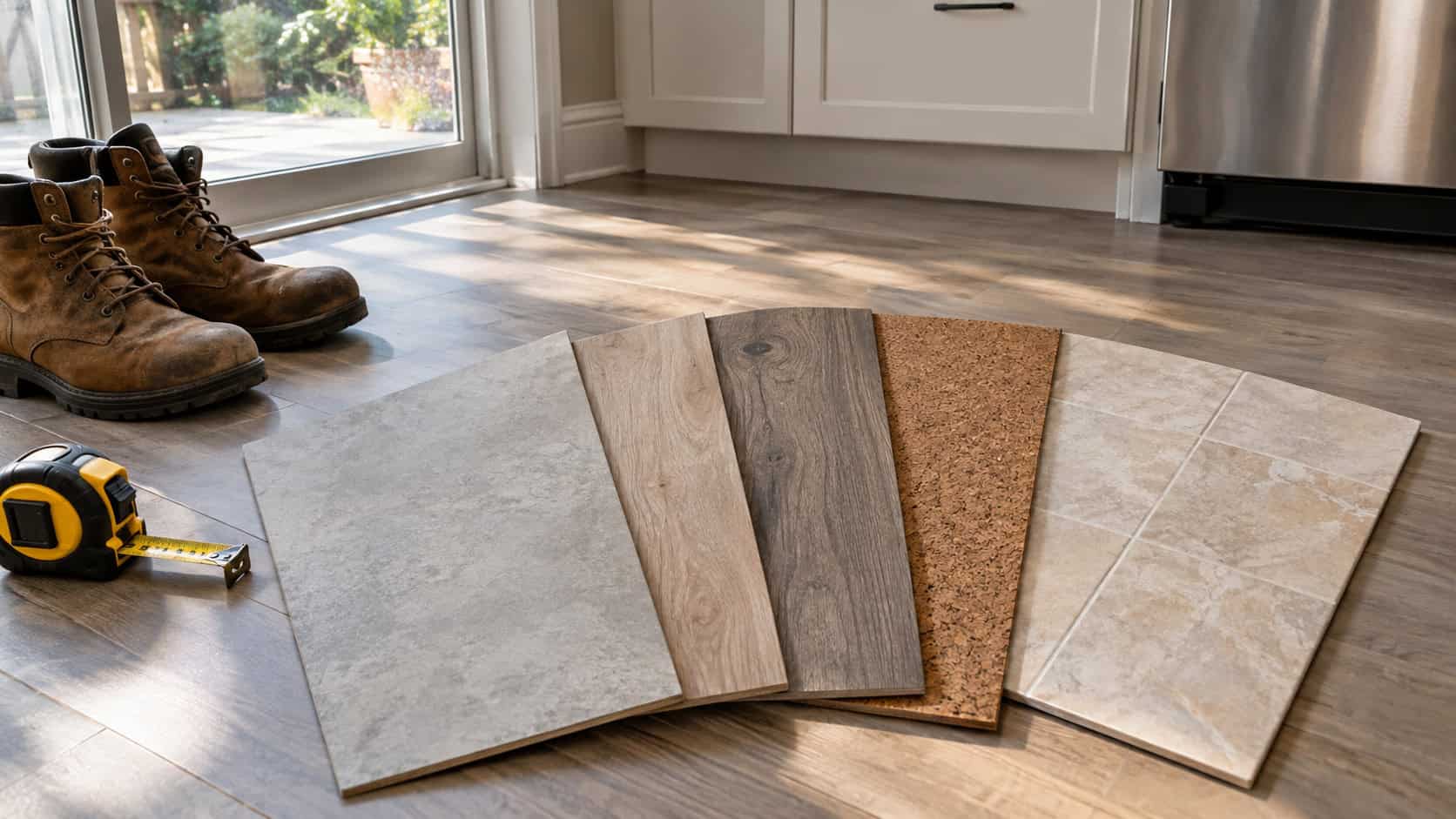
Walk into a kitchen that’s five years old and look down, not up. The cabinets still look fine. The floor is where the house tells on itself.
Flooring installers see the same failures over and over — cupped boards at the dishwasher, gray grout in front of the sink, a curled corner under the trash pull-out. The homeowner picked it in a showroom under track lighting, dry, with no dog and no boiling pasta pot.
Spills and claws are the two forces that decide everything. Almost every regret on this list traces back to one or the other.
Here are the kitchen floors that quietly fall apart, and the ones pros keep specifying when they know a golden retriever lives there.
1. Solid Hardwood in a Working Kitchen

Ask an installer for the most common kitchen flooring mistake and this is the answer, nearly every time.
Solid wood moves. Oven heat on one side, dishwasher steam on the other, sink splash in the middle — boards expand, cup along the edges, then shrink back and leave gaps you can catch a fingernail in. Two or three seasons is all it takes.
Then there’s the failure that ends the conversation. A supply line lets go behind the dishwasher overnight and you’re not replacing a plank, you’re replacing the run — because new oak will never match five-year-old oak.
2. Bargain Laminate With a Fiberboard Core

Strip the pretty photographic layer off cheap laminate and you’ve got wood dust pressed under heat into a board. That core drinks.
A glass of water left overnight is usually survivable. A dog accident at 2 a.m. that nobody finds until noon is not. Neither is the fridge ice line that’s been weeping a tablespoon a day behind the appliance for eight months.
The swelling shows up at the seams first. Edges lift into little ridges you feel through a sock, the laminate’s top layer separates, and no amount of drying brings it back down — once that fiberboard expands, it’s permanent.
Here’s the part that stings. Most laminate warranties cover manufacturing defects, not what the industry calls site-caused moisture. Your installer points at the dishwasher, the manufacturer points at the installer, and Servpro shows up to tell you the planks come out either way.
And the subfloor underneath has been wet the entire time. If the plywood reads above 16% on a moisture meter, you’re drying it for days with fans before anything new goes down.
Skip the $1.19 clearance laminate. If budget is the constraint, a decent rigid-core vinyl at the same price point fails far more gracefully.
3. Polished, High-Gloss Porcelain

Gloss tile is perfectly safe right up until the moment it isn’t.
The industry benchmark for interior floors likely to get wet is a DCOF of 0.42 or higher — a measured coefficient of friction, printed right on the spec sheet. Polished porcelain frequently tests below that, and Bedrosians is blunt about what that means for a kitchen.
Now add a dog. Claws need micro-texture to grip, and polished glaze gives them nothing — you get the scrabbling, splay-legged slide every time the doorbell rings.
Matte or lightly textured, every time. Check the DCOF number before you check the price.
4. 6-Mil Wear Layer Luxury Vinyl

Shoppers compare total plank thickness. It’s the wrong number.
What protects the floor is the clear wear layer on top, measured in mils. Six mils is rental-turnover grade — it hazes under dog nails and goes dull in a path from fridge to sink inside two years.
Pros building for pets and kids spec 20-mil. Twelve is the minimum you should accept, not the target, as Floor Critics breaks down in detail.
5. Honed Marble or Limestone Underfoot

Scratching and etching aren’t the same problem, and homeowners usually only find that out afterward.
Etching is chemical. Lemon juice, vinegar, a splash of wine — the acid dissolves the calcium carbonate and leaves a dull spot with a visible edge. Sealer slows staining. It does not stop etching.
Five years in front of a sink produces a pale, matte traffic path that no cleaner touches. Restoring it means honing and repolishing the stone in place, which is a Tile Doctor job, not a Saturday one.
6. Carpet or Carpet Tile in the Kitchen
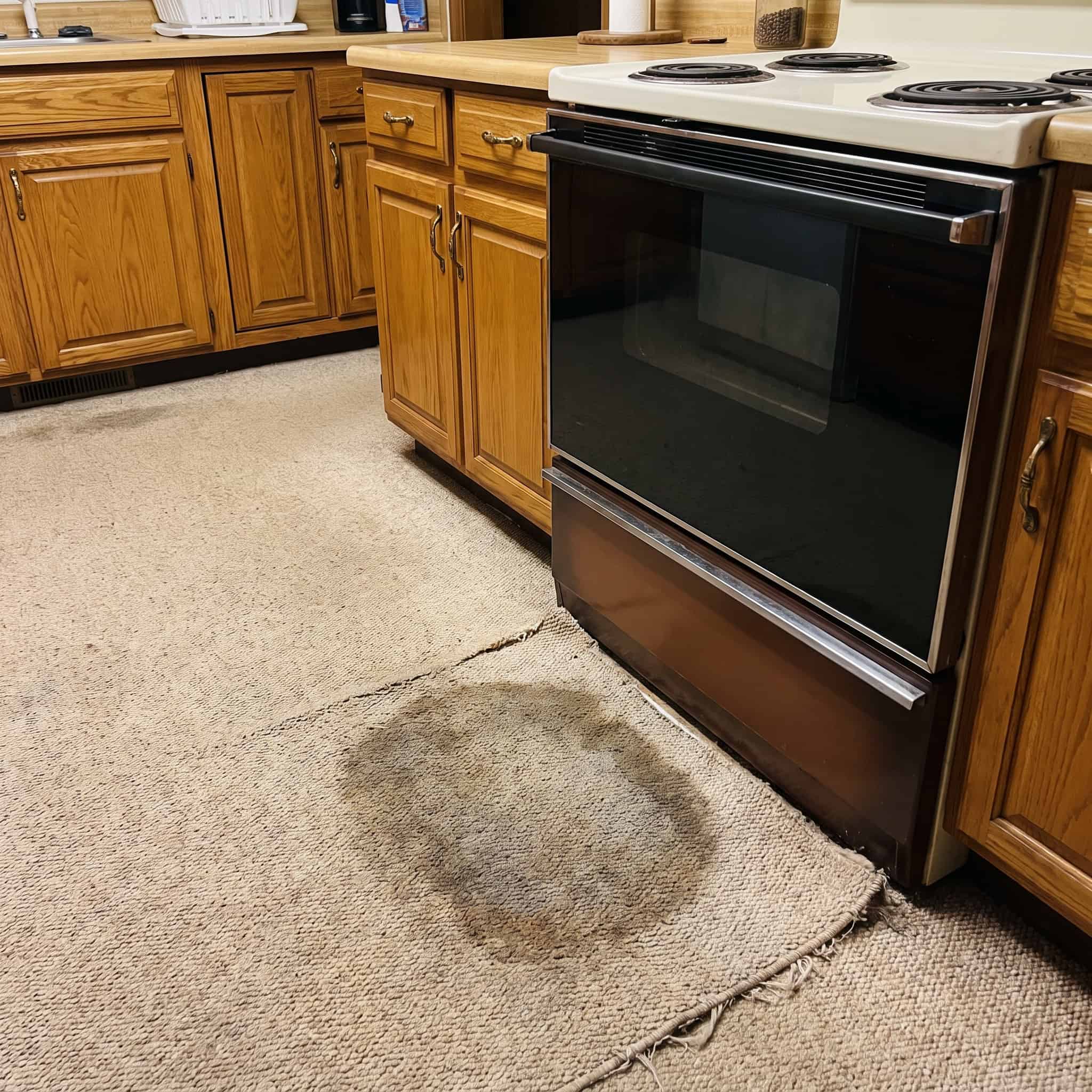
It still exists. Plenty of 1978 split-levels have it, and somebody is reading this standing on it right now.
Cooking throws aerosolized grease into the air, and it lands. Fiber grabs it and holds it, which is why kitchen carpet develops a smell that shampooing doesn’t fix.
Pet accidents are worse. Urine passes through the carpet into the pad and then into the subfloor seams, three layers down from where any cleaner reaches.
This is the one thing nearly every flooring pro vetoes without debate.
7. Trusting the Word “Waterproof” on the Box
Waterproof plank and waterproof floor are two different products, and only one of them is in the box.
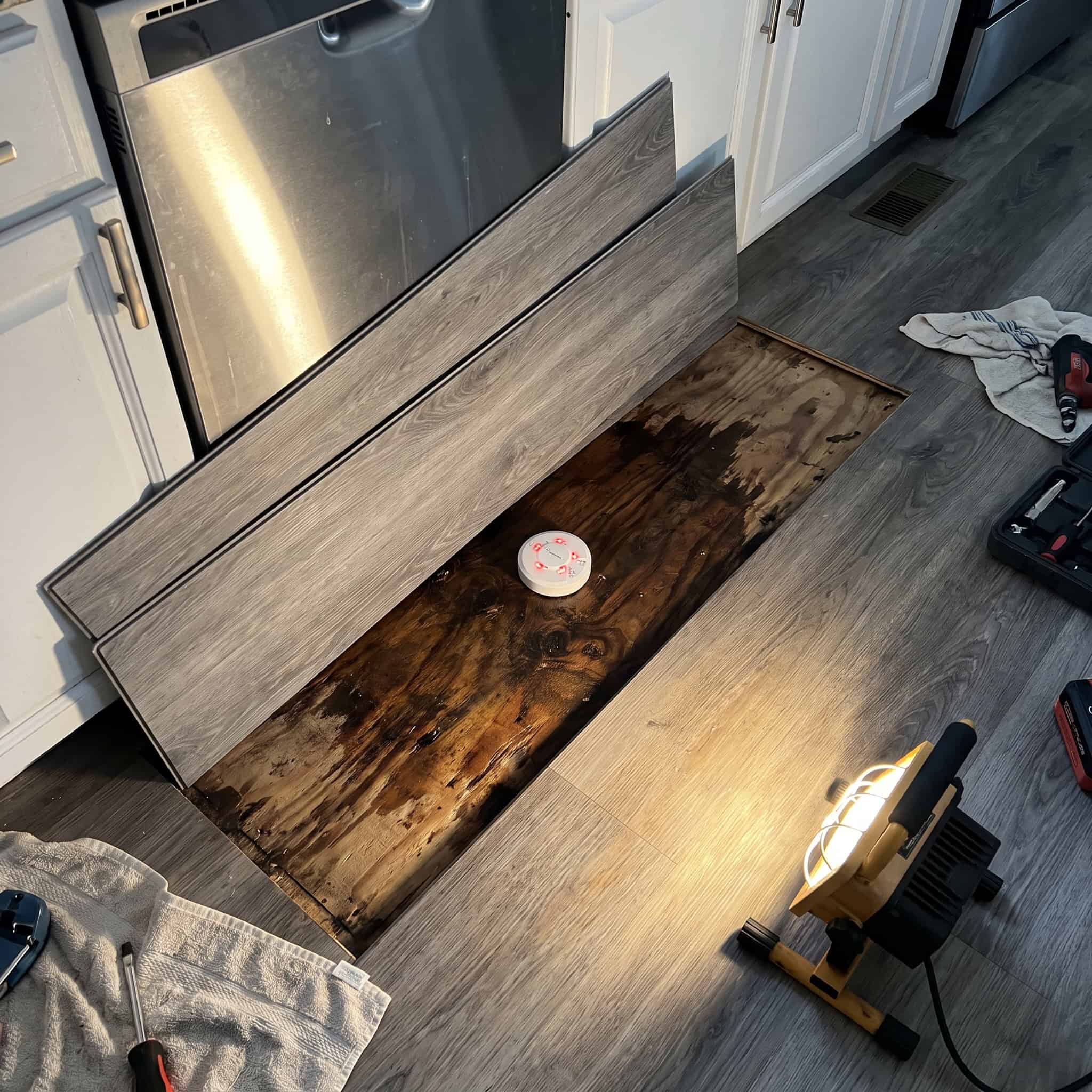
A waterproof core means the plank won’t swell if it gets wet. Fine. But water doesn’t sit politely on top — it runs along the seams, finds the quarter-inch expansion gap around the perimeter, and goes under.
Now it’s between your floor and your subfloor, in the dark, with no airflow. The planks look immaculate. The plywood is soaking.
Mold needs about 48 hours and a food source, and plywood glue plus wood fiber is a buffet. By the time anyone smells it, the growth is established under 40 square feet of floor that still looks brand new.
The tells are subtle: a musty note when the dishwasher runs, a soft spot underfoot near the appliance bay, baseboards that look slightly swollen at the bottom edge. Any of those means lifting a plank, not deodorizing.
Pros treat the dishwasher opening as the highest-risk two feet in the room. A cheap leak sensor on the floor of that bay catches the failure while it’s still a towel job.
8. Bright White Cement Grout

It photographs beautifully on day one. Nobody photographs it on day 700.
Standard cementitious grout is porous by nature. Coffee drips, olive oil mist, red wine, and wet paw traffic work into the joints, and the lines in front of the sink and range go gray while the rest stays lighter — so it reads as dirt, not age.
Sealing helps for a while. It’s also a chore most people do once.
Spec epoxy or urethane grout in a mid-tone and the scrubbing weekend disappears from your life permanently.
9. Peel-and-Stick Vinyl Tile

The adhesive is the whole product, and the adhesive is the problem.
Mop water creeps under the seams. Heat from a dishwasher or a sunbeam through a slider softens the glue. Corners lift, collect a black line of grime, then catch a bare toe.
You can’t spot-repair it invisibly either — the replacement square is a different age and a different sheen. The classic rental-flip shortcut, and it looks like one by summer two.
10. A Floating Floor Pinned Under Cabinets and the Island

A floating floor isn’t fastened to anything. It’s a connected raft that expands and contracts with seasonal humidity, which is exactly why it works.
Set a cabinet run on top of it and you’ve nailed the raft down. Anchor a 900-pound stone-topped island through it and you’ve done it twice, in the middle.
The floor still wants to move. It can’t. So it buckles — usually a ridge near the toe kick, or a gap that opens along a baseboard twelve feet away where the movement had to go instead.
Correct sequence: cabinets and island first, floor second, cut to fit around the boxes with the expansion gap intact and hidden under shoe molding. Blackburn’s Interiors lays out why that order matters more than almost any other decision in the install.
There’s a dishwasher wrinkle too. Floor under the cabinets means the dishwasher sits higher, and in ten years you may not be able to slide the old one out without damaging planks. Ask about shimming the cabinet run instead.
And warranties exclude improper installation. This mistake is free to avoid and costs a full tear-out to fix.
11. Bamboo Planks Sold as “Harder Than Oak”

The Janka numbers on strand-woven bamboo are legitimate. Some rate harder than hickory.
Hardness isn’t the failure mode in a kitchen. Bamboo is a grass, and it reacts to humidity swings more aggressively than oak does — installers report cupping and seam gaps in bamboo kitchens faster than in wood ones.
It also shows dark water marks that go deep and won’t buff out. Hard surface, nervous material.
12. Dark, Glossy Floors of Any Material

Espresso plank. Glossy black tile. Both are the floor you’ll never see clean again.
Dark and shiny shows crumbs, dried water spots, dust, and every paw print within ten minutes of mopping. Light and shiny shows dirt. Mid-tone and matte shows almost nothing.
That’s the entire reason pros push variegated mid-tone product with a matte finish. Not taste. Camouflage.
13. Tile Set Over a Bouncy Subfloor

Cracked grout lines almost never mean bad grout. They mean the floor beneath is flexing.
The structural standard for tile is L/360 — a joist span can deflect no more than its length in inches divided by 360 under load. Natural stone wants L/720, twice as stiff. Plenty of older homes, especially with 2×8 joists on 16-inch centers over a long span, don’t meet it.
Walk the room before anyone orders tile. If glassware rattles in a cabinet when you cross the floor, or you feel a trampoline give near the center of the span, that’s deflection you can perceive without instruments.
Fixes exist and they aren’t exotic: sistering the joists, adding a mid-span beam, or laying a second layer of plywood to bring total subfloor thickness to around 1-1/8 inch. Do it before the tile, not after.
Then there’s the membrane. An uncoupling membrane over plywood lets the subfloor move a hair without transmitting that movement into the tile bed. Installers skip it to save a few hundred dollars and the client pays for it in year three.
Hollow-sounding tiles are the other early warning — tap across the floor with a coin and listen for the change in pitch. That’s mortar that’s already let go.
Regrouting a movement crack never holds. The crack comes back in the same line because the cause was never addressed.
14. Cork Flooring in a Busy Kitchen

Cork gets recommended for a real reason: it’s warm, quiet, and genuinely easier on knees and lower backs during a long prep session.
It’s also compressible. Bar stool legs leave dimples, a dropped Dutch oven leaves a crater, and dog claws leave a permanent stipple near the door.
The topcoat is doing all the waterproofing, and it needs renewal on a schedule. Let it wear through and spills reach the cork itself, which swells and darkens.
15. Deeply Embossed or Heavily Textured Surfaces

Embossed-in-register vinyl, wire-brushed wood, rough-faced stone. In a showroom the depth looks expensive.
Six feet from a range, it’s a grid of valleys, and airborne cooking grease settles into every one of them. A mop glides across the high points and never touches the low ones.
Anything the mop skips is something you’ll eventually do on your knees with a brush.
16. Engineered Wood With a 1mm Veneer

Engineered wood is the right answer when a client insists on real wood in a kitchen. The spec is what makes it right or wrong.
A 1 to 2mm veneer sands through on the first refinish — sometimes on the first pass. That means a field of dog scratches is permanent from day one, because there’s nothing to remove.
Look for a 4 to 6mm wear layer over a plywood core. That’s two or three refinishes and an actual 30-year floor.
17. Unsealed Terracotta or Saltillo Tile

Warm, handmade, and absorbent as a sponge.
Unglazed clay pulls in olive oil, wine, and pet accidents and holds them as dark blooms that spread outward from the spill. Sealer works — and needs reapplying on a cycle almost nobody keeps past year two.
Common throughout Southwest and Spanish-revival houses, which means a lot of readers are looking at it right now wondering why the tile by the stove is two shades darker.
18. Sheet Vinyl Seams at the Dishwasher

Sheet vinyl actually handles water well. It’s continuous, which is its advantage and its trap.
One split seam at the dishwasher, one torn corner from sliding the fridge out, and there’s no patching it without an obvious scar. The material fails as a single 200-square-foot piece.
Fridge wheels and stool feet also press permanent dents into it. The World Floor Covering Association is clear that cushioned vinyl trades indentation resistance for comfort.
19. Natural-Cleft Slate
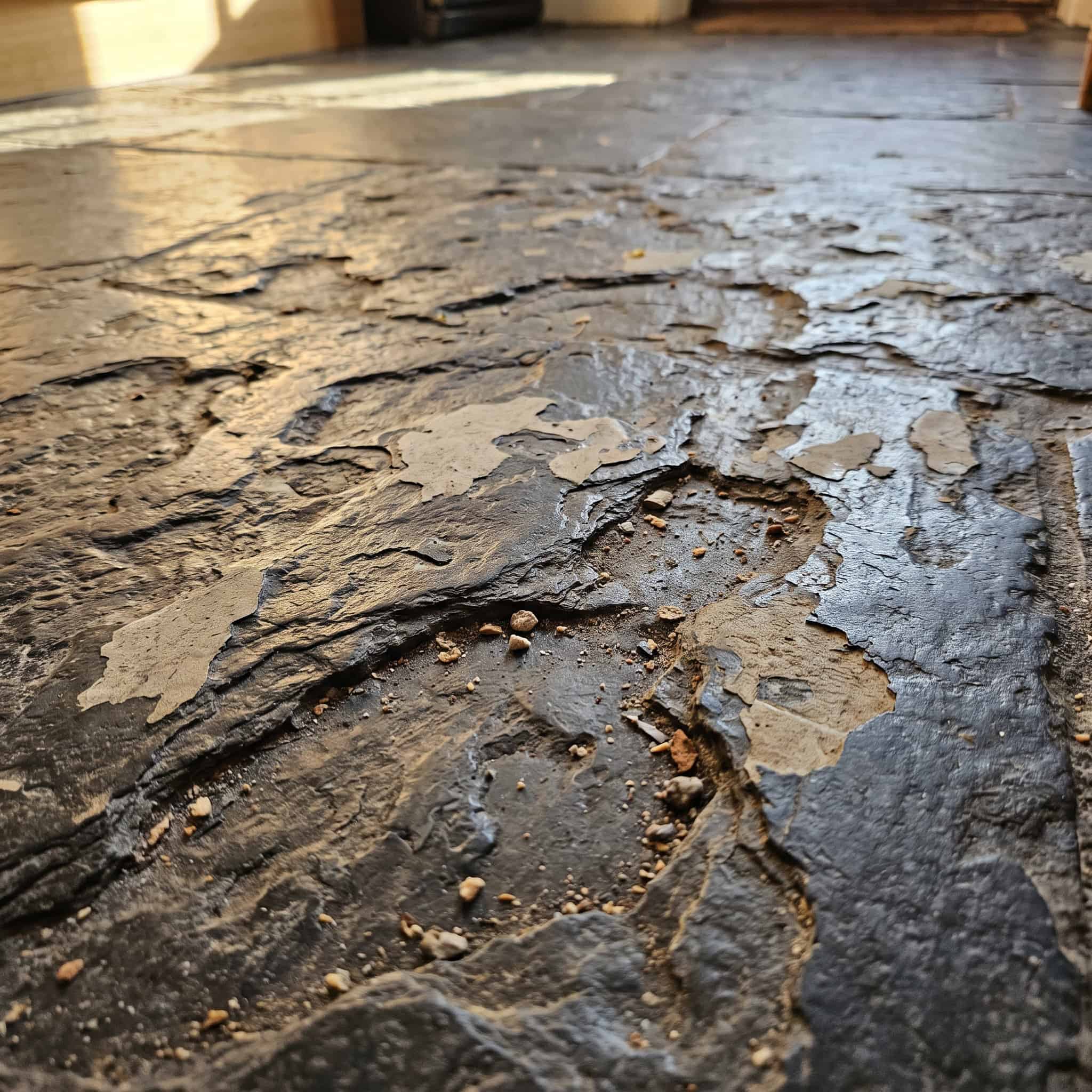
Cleft slate is split along its natural layers, which is where the charm and the problem both come from.
Those layers shed. Thin flakes pop off under traffic, leaving lighter patches, and the peaks-and-hollows face makes mopping an exercise in moving grit from one hollow to another.
Gauged, honed slate behaves well in a kitchen. The rustic cleft version is the one that gets replaced.
20. Hand-Scraped Wood Sold as “Hides Scratches”

This is the single most repeated line aimed at dog owners on a showroom floor. It isn’t true.
Factory distressing is stained and finished along with everything else. A fresh claw mark cuts through the finish into raw wood and reads as a bright line — and against a dark scraped texture, it reads brighter.
Scraping hides manufacturing variation. It hides nothing your dog does.
21. Polished Concrete in a Home Kitchen

Concrete cracks. That’s not a defect, it’s the material — slabs move, and they relieve stress somewhere.
In a 4,000-square-foot loft, a hairline running across the floor is character. In a 12-by-14 kitchen, it’s a line through your kitchen.
It’s also unforgiving underfoot, loud, and guarantees that every dropped wine glass becomes a dustpan job. Cold, too, unless there’s radiant heat in the pour.
22. Penny Tile and Small Mosaic on the Floor

Run the math once and the appeal fades.
One square foot of penny round contains roughly 20 linear feet of grout joint. A 180-square-foot kitchen is somewhere north of 3,000 linear feet of joint, all of it porous, all of it downstream from a range.
Beautiful in a powder room. In front of a cooktop, it’s a standing appointment with a grout brush.
23. Tile With No Heat and No Give

Porcelain is the most durable kitchen floor you can buy and the least pleasant to stand on for an hour of prep in January.
It’s also why the dog won’t lie down anywhere but the one rug, and why nothing dropped from counter height ever survives.
Electric radiant mat runs roughly $8 to $12 per square foot installed when the floor is already open. Afterward it means tearing out the tile you just paid for.
24. Buying a Clearance Floor With No Attic Stock

Closeout pricing exists because the product is being discontinued. That’s the whole arrangement.
Year four, a fridge line leaks and takes out six planks. The SKU is gone, and even current production drifts between dye lots — the “same” product ordered two years apart rarely matches across an open floor.
Order 10% overage. Label a box, put it in the garage, and write the product name and lot number on the lid in marker.
25. What Pros Actually Install: Matte Wood-Look Porcelain

This is the default spec in pro kitchen jobs, and it isn’t close.
Matte wood-look porcelain plank at 0.42 DCOF or better is actually waterproof — not core-waterproof, genuinely impervious. Claws can’t mark it. A dishwasher flood is a mop and a fan, not a claim.
Pair it with mid-tone epoxy grout and a radiant mat, and most of the regrets above simply stop being possible. The NAHB life expectancy study puts ceramic and porcelain tile at a lifetime component when it’s installed over sound structure.
The only thing it doesn’t fix is comfort. That’s what the heat mat and a gel mat at the sink are for.
26. The Dog Bowl and Sink Splash Zone

Floors almost never fail evenly across a room. They fail in two square feet.
One is under the water bowl, where a sloppy drinker leaves a permanent shallow puddle. The other is the strip in front of the sink, hit a dozen times a day with splash and drips from loading the dishwasher.
In wood, those zones go black first — tannins reacting with moisture and iron, a stain that sits deeper than any sanding will reach. In laminate, the seams there swell before anywhere else. In tile, it’s where the grout darkens into an obvious outline of your standing position.
Fix it at install. Have the seams in those two areas run with the room instead of across the traffic line where possible, and seal the perimeter against the toe kicks.
Then the trap almost nobody warns you about: rubber-backed mats can permanently discolor vinyl and some resilient floors. The plasticizers in the backing migrate into the floor and leave a yellow or amber shadow shaped exactly like the mat.
Use woven mats or ones labeled vinyl-safe. Lift them weekly and let the floor dry — a mat that’s always damp underneath creates the exact condition you bought the mat to prevent.
Raise the water bowl onto a tray with a lip. Catch it before it reaches the seam, as the University of Florida IFAS Extension notes about standing moisture and floor assemblies — the damage happens below the surface long before it shows on top.
27. Real Linoleum (Marmoleum) Sheet

Not vinyl. Actual linoleum — linseed oil, pine rosin, wood flour, jute backing. It’s been made since the 1860s and floors from the 1950s are still in service.
Warm underfoot, naturally antimicrobial, and genuinely long-lived. The catch is installation: it demands a dead-flat subfloor and heat-welded seams by someone who’s done it before.
It can also arrive with a yellowish cast from the curing oils. That fades in a few weeks of light exposure, which is worth knowing before you panic on install day.
28. Rubber Flooring

Standard in commercial kitchens for two reasons: grip and standing comfort. Both are unmatched.
For a senior dog with hip trouble, nothing else comes close — the traction difference is immediately visible in how they move.
But grease stains it, and residential rubber reads institutional unless the rest of the room is working hard against it. Worth it for some households, wrong for most.
29. Terrazzo

Chips of marble and glass suspended in cement or epoxy, ground flat and polished. It outlives the building.
It’s also having a genuine design moment, which is driving prices to $25 to $60 per square foot installed.
And polished terrazzo carries the same wet-slip problem as polished porcelain, at four times the cost. Honed finishes exist and are the better call for a kitchen — ask for one before you fall in love with a sample.
A lifetime floor with an entry fee and a texture decision.
Conclusion
Nearly every regret on this list was invisible in the showroom. Dry tile grips. New grout is white. Nobody drops a lemon wedge on the sample board.
Pick for the two square feet that take the abuse, and the other 178 take care of themselves.
Five years from now, the floor is going to tell anyone who looks down exactly how carefully you chose it.