
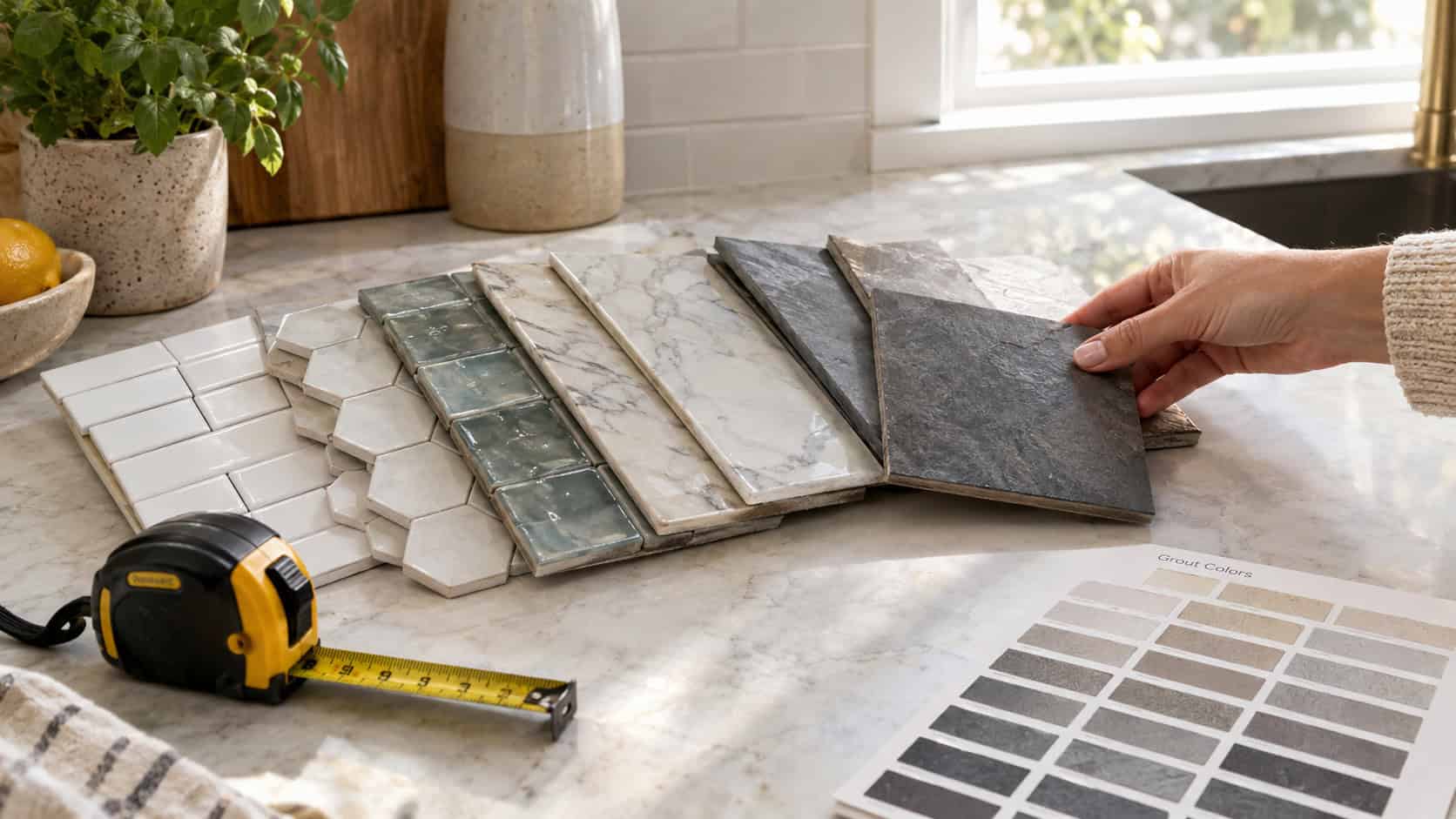
Tile is the most permanent decision in a kitchen or bathroom. Cabinets get painted. Faucets get swapped in an afternoon. Tile gets demolished.
That’s why the regrets sting. Five years in, the grout behind the range is the color of weak coffee, the mosaic sheets have visible seams, and the whole wall reads like a dated magazine spread.
Installers see the same failures over and over — and most of them were decided at the store, not at the wall.
Here are 30 tile and backsplash choices that age badly, plus what the people who set tile for a living pick instead.
1. Iridescent Mesh-Backed Glass Mosaic Sheets

Small tile means more grout. A sheet of half-inch glass mosaics can carry five times the grout length of a 4×12 tile covering the same wall.
Grout is the part that fails. Always.
The shimmer finish is the second problem — it reflects light at every angle, so a trowel ridge under one sheet or a seam that drifted a sixteenth of an inch shows up like a scratch on a mirror. Livingetc designers now put mesh-backed mosaic panels near the top of the list of things that instantly date a kitchen.
Pros pick one larger format in a quiet finish and let the countertop do the talking.
2. Tumbled Travertine With Diagonal Deco Dots

Beige stone on the diagonal. Little glass or metal squares at the intersections. If you bought a house built between 1998 and 2012, you know exactly what this looks like.
Tumbled travertine is full of open pits. Cooking grease settles into them and stays, and no amount of degreaser pulls it back out once it’s in there.
It also needs resealing every couple of years, which nobody does.
The deco dots are what pin it to a decade. Remove them and you still have a dated wall — you just have a dated wall with holes in it.
3. Peel-and-Stick Vinyl Backsplash

The adhesive gives up first exactly where you need it most.
Behind the range, the heat plume off a burner cycles that strip of wall from room temperature to 120 degrees and back, several times a day. Edges curl. Corners lift. Grease wicks underneath.
Realistic lifespan is three to five years in a kitchen that actually cooks, and removal frequently takes the drywall paper with it — so the “temporary” option leaves you skim-coating a wall before you can tile it properly.
Pro pick: real tile on a primed, prepped wall. Or paint, and wait until the budget’s there.
4. The 4-Inch Granite Backsplash Strip

Builders did this because the offcut was already paid for.
It reads as exactly what it is — a stone scrap glued to the wall where a backsplash should be. And the horizontal seam along the top becomes a permanent ledge for grease, dust, and caulk that mildews no matter how often you re-run it.
Pros either go full-height slab or tile from the counter to the underside of the uppers. Nothing in between.
5. Standard Cement Grout Behind the Cooktop

Portland-cement grout is porous by design. That’s not a flaw in cheap grout — it’s how all of it works.
Tomato sauce, oil mist, turmeric, red wine. Within eighteen months of real cooking, the joints behind a range go from light gray to blotchy brown, and scrubbing won’t reverse it because the stain is below the surface.
Epoxy grout costs more and takes a skilled hand to install — it sets fast and hazes if you’re slow. Urethane is more forgiving.
Either one in the cooking zone is the single best money you’ll spend on a backsplash.
6. Glossy 3×6 White Subway With Charcoal Grout

The white subway tile itself isn’t the problem. It’s been around since 1904.
The charcoal grout is. High-contrast joints turn a quiet wall into a visible grid that competes with the cabinets, the counter, and the hardware all at once — and once you see the grid, you can’t unsee it.
Dark grout also fades unevenly. Over a sink where it gets soaked daily, it goes chalky and patchy within a few years while the rest of the wall stays dark.
Homes & Gardens now flags this exact combination as the most overused backsplash in America. Pros use a grout within a shade or two of the tile.
7. Polished Carrara Marble Behind the Range

This one deserves more than a sentence, because the failure mode gets confused constantly.
Staining and etching are two different things. A stain is something soaking into the stone — sealer helps with that. Etching is a chemical reaction: acid dissolves the calcium carbonate at the surface and leaves a dull spot. Sealer does nothing to stop it.
A lemon wedge resting on the counter edge. Vinegar splashing out of a pan. Tomato sauce spattering off a hot skillet. Any of those leaves a matte ghost mark on polished marble in under a minute, and it’s permanent until someone refinishes the surface.
Refinishing means honing the stone back with diamond pads and re-polishing — typically $12 to $25 per square foot from a stone restoration company, with a minimum charge that makes a small backsplash job cost as much as a big one. On a vertical surface behind a range, that’s a mess of slurry and plastic sheeting in your kitchen for a day.
Two better moves. Honed marble, which has no polish to lose, so etching barely registers. Or a marble-look porcelain with a high face count — impervious to acid, zero maintenance, and from three feet away nobody can tell.
If you want real marble on a cooking wall anyway, go in knowing it will develop a patina. Some people love that. Most people say they will and then don’t.
8. The Picture-Frame Mosaic Medallion Over the Range

A diagonal mosaic inset, framed in rope-twist liner, centered over the cooktop. It was the custom flourish of its moment.
Now it’s the clearest date stamp a kitchen can carry.
It also freezes your floor plan. Move the range eight inches during a future remodel and the whole composition goes crooked — so the tile dictates the layout instead of the other way around.
9. Pebble River-Rock Shower Floor

Serene in the showroom. Gravel underfoot at 6 a.m.
The grout volume is enormous — stones only touch at a few points, so you’re essentially filling a shower floor with grout and dotting rocks into it. Soap scum collects in every valley and a scrub brush can’t reach the bottoms.
The irregular surface also makes proper slope to the drain a guessing game, and standing water is how a shower pan starts to smell.
Pro pick: 2-inch hex in porcelain, epoxy grout, done. Plenty of grip, flat enough to clean, and it won’t look dated in a decade. If you’re rethinking the whole wet area, the same logic runs through a lot of shower and tub choices people regret.
10. Bargain Large-Format Tile That Isn’t Rectified

Big tiles warp in the kiln. All of them do, slightly.
Rectified tile is cut to size after firing, so the edges are dead straight and the warpage is held to a tight spec. Unrectified bargain tile isn’t — and on a 24×48 plank that gentle bow turns into lippage, where one edge sits proud of its neighbor.
You feel it with a bare foot. You see it every time afternoon light rakes across the floor.
Industry guidance for large formats caps the offset at a third, not the old brick-style half, for exactly this reason. The Tile Council of North America publishes the standards your installer should already be following.
11. Mirrored and Antiqued-Mirror Tile
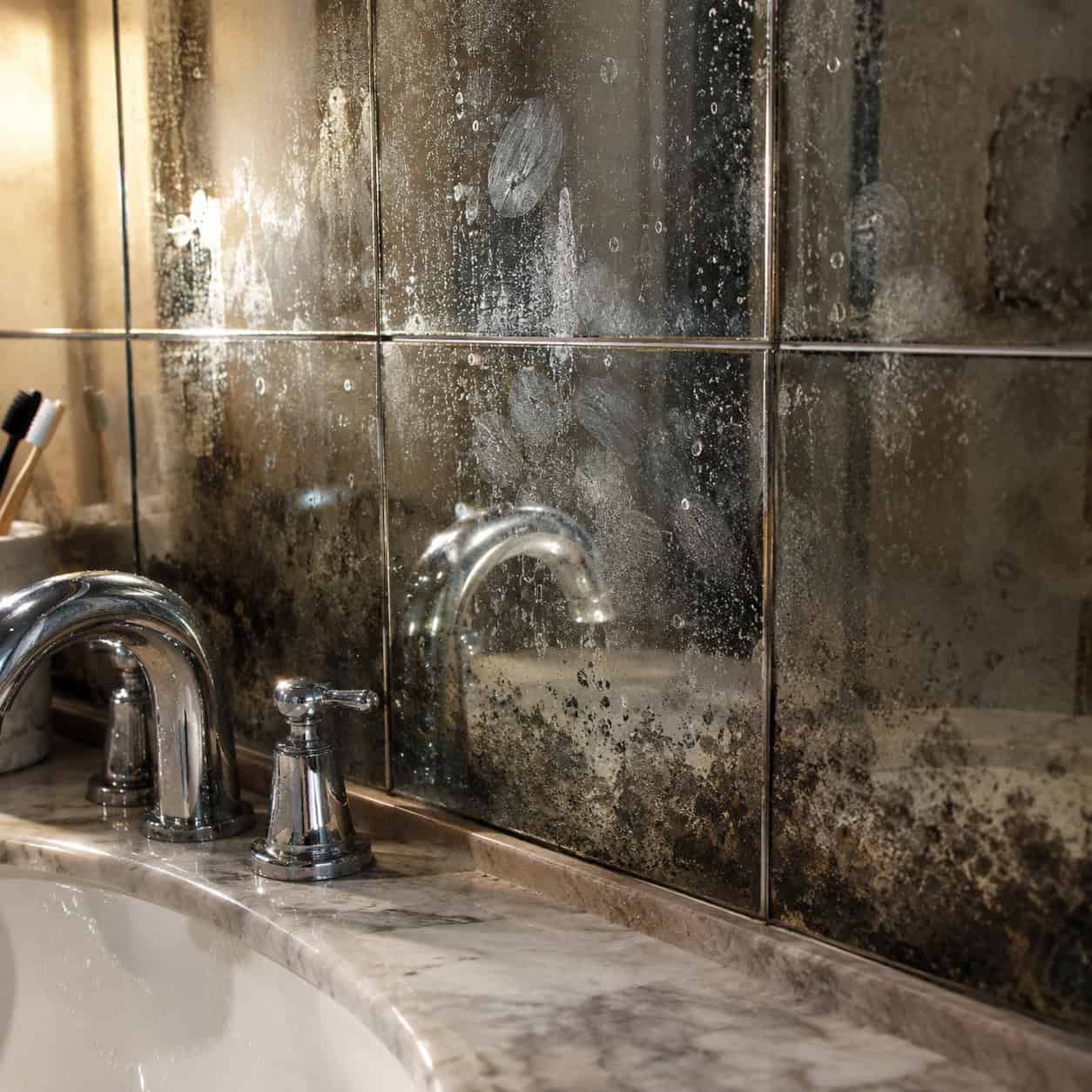
Beautiful in a dining room. Miserable behind a sink.
Every fingerprint, water spot, and grease haze shows. And the antiqued speckling — the whole selling point — makes it impossible to tell dirt from patina, so you never know whether you’ve actually cleaned it.
The silvering fails too. Where mirror tile meets constant moisture, the backing clouds and black creep works in from the edges within a few years.
12. Unsealed Cement (Encaustic) Patterned Tile

Cement tile is beautiful and genuinely old-world. It’s also a sponge.
It needs a penetrating sealer before grouting, a second application after, and periodic resealing for the rest of its life. Skip the pre-grout seal with a dark grout over a pale pattern and the color bleeds into the tile face in a single afternoon.
That’s the classic heartbreak, and it isn’t fixable. Cement Tile Shop spells out the full sequence, and it’s worth reading before the installer shows up rather than after.
Acid etches it too. So no vinegar, no bleach, no standard bathroom cleaner — ever.
13. Tile Set Straight Over Drywall in the Wet Zone

Green board is not waterproofing. It’s drywall with a water-resistant facing, and it was never rated as a tile substrate for a shower.
This is the most expensive mistake on the list, and it hides for years.
Here’s how it goes. Water passes through grout — grout is not waterproof, it never was. Behind a properly built shower that moisture hits a membrane and drains back to the weep holes. Behind a drywall shower it hits paper and gypsum, and gypsum turns to oatmeal.
By the time you see it, the framing behind has been wet for two or three years. Mold remediation on an interior wet wall routinely runs $2,000 to $6,000 once the studs and insulation come out, and that’s before anyone re-tiles.
The warning signs come early if you know them. A grout line that stays dark hours after the shower’s off. A tile that sounds hollow when you tap it. Caulk at the corner that cracks open within weeks of every repair. Soft spots at the base of the wall. A musty smell when the bathroom door’s been shut.
Pro pick: cement backer board with a bonded sheet membrane over it, or a foam board system where the waterproofing is built into the panel. The Ceramic Tile and Stone Consultants group is blunt about workmanship standards here, and any installer who shrugs at the question is telling you something.
Behind a kitchen sink, drywall is acceptable — but prime it and keep the caulk joint at the counter intact, because that’s where water gets in. A slow leak you ignore has the same ending as a bad shower; there are simple ways to avoid water damage from a leaky faucet that cost almost nothing.
14. Arabesque and Lantern-Shape Tile

The scalloped silhouette was the signature Pinterest shape of 2014 to 2019. It’s a timestamp now, the same way the listello was in 2004.
It’s also a nightmare to terminate. Curved edges mean every outlet cut, every cabinet end, every window return requires grinding a compound shape — and the field almost never ends cleanly.
Look at the edges in any photo of it. That’s where the installer struggled.
15. High-Gloss Polished Porcelain Floor Tile

This is a safety problem before it’s a style problem.
The industry measure is DCOF — dynamic coefficient of friction, how much grip a tile offers when it’s wet and someone’s moving across it. The accepted floor for interior wet areas is 0.42, and mirror-polished porcelain frequently tests well below that. Some polished lines are explicitly labeled walls-only, and people install them on floors anyway because the box didn’t scream about it.
Add a shower, a dropped glass of orange juice, or a dog shaking off, and you have a skating rink.
It matters more every year you stay in the house. Falls are the leading cause of injury among adults over 65, and a bathroom floor is where a lot of them happen. If anyone in the household is aging in place — or will be — this choice has consequences beyond the deposit on your damage claim.
The cosmetic penalty is real too: polished porcelain shows every footprint, every water droplet, and every speck of dust within an hour of mopping.
Pro pick: matte or lightly textured porcelain with a published DCOF of 0.42 or higher. In a curbless shower or a mudroom, go higher still. Ask the showroom for the number — a good supplier has it on the spec sheet and a bad one will tell you not to worry about it.
16. Faux Tin and Thermoplastic Panel Backsplash

PVC and thermoplastic panels sold as pressed tin do one thing reliably in a kitchen: warp.
The heat plume off a range softens them, and they develop a yellow cast within a few years that no cleaner touches.
The seams never disappear either. You see the sheet joints from across the room, which defeats the entire illusion.
Want the look? Buy actual pressed metal. Or run a single stainless panel behind the cooktop only — commercial kitchens have done it for a century and it wipes clean in one pass.
17. Wood-Look Plank Tile With a Three-Face Repeat

Count the knots.
Budget wood-look lines print only three or four unique tile faces, so the same distinctive knot shows up four times in a single row. Your eye catches the repeat immediately, even if you can’t articulate why the floor looks fake.
Long planks compound it with lippage — a 48-inch board has a lot of room to bow.
Pro pick: ask for the face count before you buy. Eight or more unique faces, rectified edges, and stagger the joints no more than a third.
18. Plastic Edge Trim and Mismatched Bullnose

Nothing cheapens good tile faster than a white vinyl L-channel on an outside corner.
You spent real money on the field tile. Then $4 of plastic framed it.
Bullnose has its own trap: it’s often fired in a different run than the field tile, so it glows a half-shade off at every edge. In a glossy white, that mismatch is glaring.
Pro pick: a metal profile in a finish that echoes the faucet and pulls — brushed nickel, matte black, unlacquered brass. Or a mitered edge if your installer has the hand for it. Not every installer does, and the honest ones will say so.
19. Full-Height Tile in a Trend Color

Sage. Navy. Terracotta. The pink that owned 2019.
Tile trends turn over roughly twice as fast as cabinet trends, which means a full-height colored splashback hits its awkward phase while the rest of the kitchen still looks current. Homes & Gardens puts bold, high-contrast splashbacks near the top of what dates a kitchen fastest.
And you can’t repaint tile. Not convincingly, not for long.
Pro pick: keep the permanent surface quiet and put the personality where it’s cheap to change — a painted island, bar stools, art, a colored faucet.
20. Natural Cleft Slate
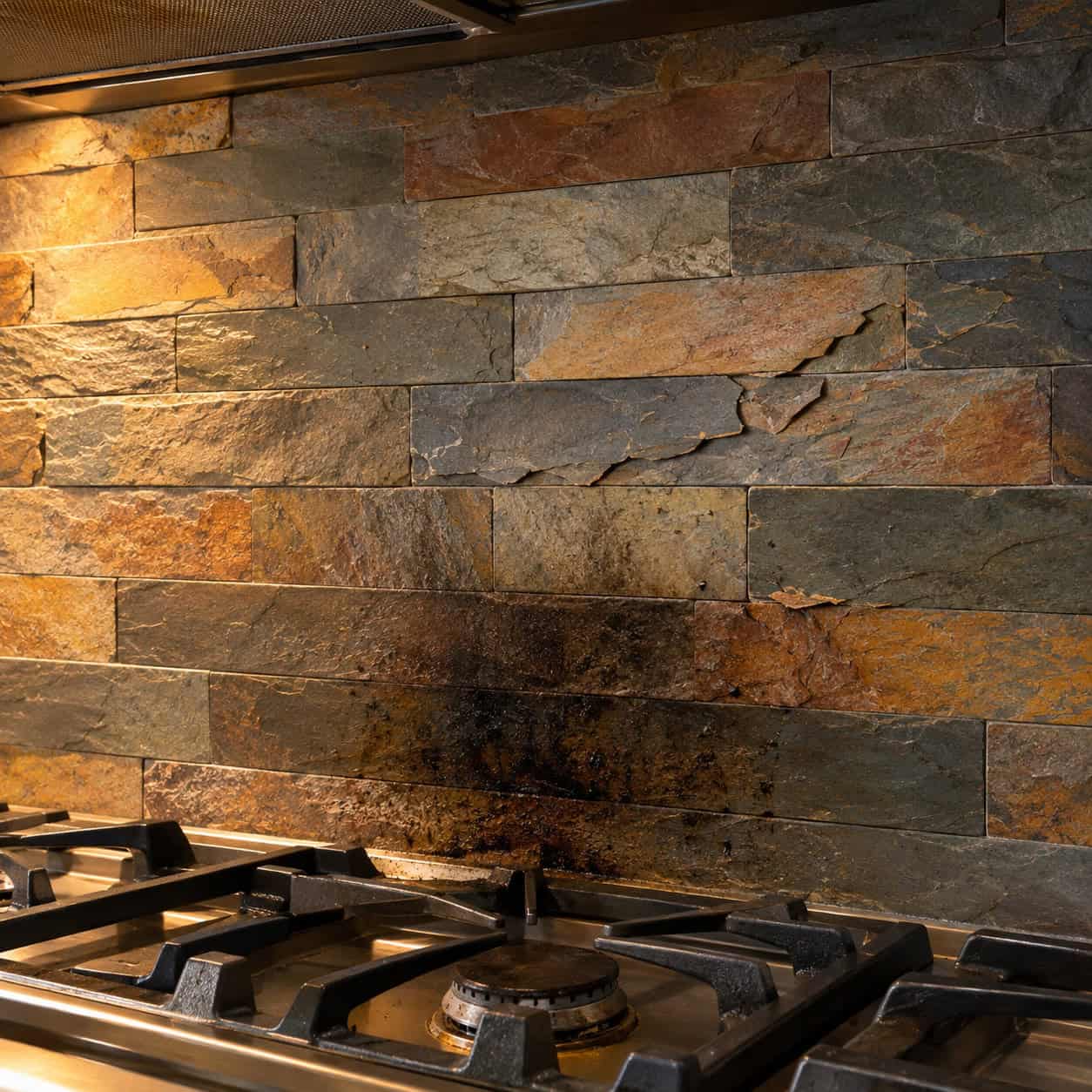
Slate is layered rock. Layers lift.
Over time, thin flakes spall off the face — sometimes a chip, sometimes a whole sheet of surface — and there’s no way to put it back.
Behind a stove, the cleft texture grabs grease and never fully releases it. Within a few years the area directly behind the burners is visibly darker than the rest of the wall.
The color variation that sold you in the showroom fades unevenly in sunlight, too. The greens go first.
21. Marble-Look Porcelain With Obvious Veining Repeats

Porcelain is absolutely the right call for a cooking wall. The problem is which porcelain.
Budget marble-look lines recycle the same vein pattern every three or four tiles, and once you spot the repeat the whole wall reads as printed. Premium lines run 40 or more unique faces and some run over 100.
Ask the number. Any decent supplier knows it.
Then dry-lay the whole wall on the floor before a single tile gets set, and shuffle until no two matching faces sit near each other.
22. The Listello Accent Band at Eye Level

A horizontal stripe of glass, metal, or mosaic running the length of the backsplash. The standard way to “add interest” from 1998 through about 2010.
It’s the loudest date stamp in a kitchen after the medallion.
It also anchors the composition to one cabinet layout permanently. Shift an upper cabinet and the band dead-ends into a stile.
Pros add interest with scale and finish now — a larger format, a soft sheen, a stack-bond layout. Not a racing stripe.
23. Zellige Bought From the Photograph

Real zellige is hand-pressed Moroccan clay. It’s irregular, the glaze pools and crazes, edges chip, and no two tiles are the same thickness.
That’s the entire point, and good installers love it.
The regret belongs to people who bought it expecting machine-flat tile and then spent five years annoyed by lippage, wandering grout lines, and the fine crazing that collects cooking grease behind a range.
Buy it knowing what it is. Budget 20 percent extra for breakage, pay for an installer who’s set it before, and accept that behind a stove it will darken. Do that and it’s one of the few handmade products that genuinely ages well.
24. 3D Sculptural Wave and Geometric Tile

Dimensional tile throws gorgeous shadows. It also catches airborne cooking oil in every single relief.
You can’t wipe a texture clean. You can only scrub it, one facet at a time, with a brush.
Behind a range that’s a weekly chore that nobody does weekly. Six feet from a range it’s fine — in a powder room or a bar wall it’s a great move.
Just know it’s the first thing a future buyer wants gone.
25. The Backsplash That Stops 18 Inches Short

A narrow strip under the uppers with bare drywall above it looks unfinished because it is unfinished.
It also leaves the most splash-prone section of wall — the stretch beside and above the range where there are no cabinets — completely unprotected.
Designers now call small-scale backsplashes flatly out of date.
Pro pick: run tile to the underside of the uppers everywhere, and take it full height behind the range or hood where there’s open wall. The cost difference is a few boxes of tile and one extra day.
26. Outlets Nobody Planned Into the Layout

You’ll notice this every day for as long as you own the house.
A beautiful pattern chopped into pieces by six beige outlet plates sitting at four different heights, two of them cutting a tile at an awkward angle. Nobody planned it. The electrician set boxes before anyone picked tile.
Fix the order of operations. Choose the tile and draw the layout first, then have the electrician move boxes so they land in one clean horizontal line — or relocate them under the cabinets entirely.
Under-cabinet power strips put the outlets out of sight completely and most jurisdictions allow them. Ask before you tile, not after.
27. Buying Exactly Enough Tile

This one bites in year four.
Tile ships in dye lots, and natural or high-variation products shift noticeably from box to box — which is why installers are told to open several boxes and mix as they go. Order to the square foot and you’ll end the job short, grab one more box, and watch it land a shade off in the corner.
Worse, a tile cracks in 2029 and the line’s been discontinued since 2027. Daltile puts short-ordering near the top of its list of avoidable mistakes.
Order 15 to 20 percent over. Keep the leftovers labeled in the garage. That half box is worth more than it looks.
28. Matte Black Hexagon Floor Tile

Durable, well-made, and still specced by pros — this one’s a judgment call rather than a flat no.
But in a hard-water house it’s brutal. Every dried droplet leaves a white mineral ring, every footprint shows, and dust reads as gray film within a day of mopping.
If your water runs above 10 grains per gallon, you’ll be squeegeeing a bathroom floor for the rest of your life. Worth knowing the difference between hard and soft water before you commit to any dark matte surface.
Soft water, low-traffic bath, no kids? It’s a great floor.
29. Penny-Round Mosaic Shower Floor

Penny round has been in American bathrooms since the 1910s and pros still spec it constantly. The shape isn’t the regret.
The grout is.
All those joints in standard cement grout turn gray-brown in a shower within two years, and no brush reverses it. Set the same tile with epoxy grout and it stays bright for a decade.
Same tile. Entirely different outcome.
30. Hexagon Honeycomb on Every Surface

Hex is a century-old classic. Nobody’s calling the shape a mistake.
The regret is running it on the floor, up the shower walls, across the backsplash, and onto the niche — all at once, in the same size, in 2018.
Saturation is what dates a material, not the material. One surface of hex looks timeless. Four surfaces look like a specific year.
Pick one place for the strong geometry and let everything else stay quiet.
Almost every item here traces back to the same two decisions: how much grout you signed up for, and how honestly you assessed what happens to that surface when someone actually cooks or showers.
Tile pros aren’t conservative because they lack imagination. They’re conservative because they’ve torn out the alternative.
Buy the better grout. Ask for the DCOF number and the face count. Order the extra box.
Five years from now you’ll either be glad you did, or you’ll be standing in the aisle looking for a tile that doesn’t exist anymore.