

Walk into a Scottsdale bathroom and you can usually guess the renovation year within about eighteen months. Not from the layout. From the edges, the finishes, and whatever motif someone stamped onto a permanent surface.
Designers who work the desert markets have been watching this cycle run for forty years. Southwestern architecture — thick walls, deep window reveals, honest clay, real wood — ages beautifully. Southwestern decoration does not.
The difference between the two is the whole game. And the trends that will embarrass homeowners in 2028 are, almost without exception, decoration pretending to be architecture.
Some of these are already dated and nobody’s admitted it yet. Others are still being installed this month, at full price, by people who think they’re playing it safe.
Here are 28 Southwestern bathroom trends pros expect to look dated by 2028 — and what they’re specifying instead.
1. Kokopelli and Howling-Coyote Accent Tile

Start with the hard line every designer draws. A thick adobe wall is architecture. A flute-playing figure grouted into a border strip is a date stamp.
Literal motifs date faster than any material ever will. The coyote with the bandana peaked between 1985 and 1998, and homeowners in Tucson and Albuquerque have been chiseling those borders out ever since — the Arizona Daily Star has covered the updating of exactly this look.
Now check Etsy. Kokopelli tile sets and coyote figurines are moving again on resale, which is precisely how a 2027 relapse begins.
Nostalgia buys the figurine. It doesn’t buy the grout removal.
2. The Hammered Copper Vessel Sink

The single most recognizable Southwestern bathroom object of the last twenty years. Also the first thing designers flag.
Vessel sinks already sit near the top of national outdated bathroom lists for the obvious reasons — water splashes over the rim, the base ring collects crud, and the bowl forces a tall awkward faucet that nobody loves. Copper adds a second problem. That living patina needs babying, and most owners didn’t know they’d signed up for it.
Wipe it with the wrong cleaner once and you’ve got a bright pink streak that takes months to blend back.
Swap: semi-recessed or undermount copper, so the metal reads as a detail instead of a sculpture. Or move the copper to a mirror frame and leave the sink alone.
3. Peach, Teal, and Mauve “Santa Fe Pastel”

This one escaped the desert entirely. By 1990, white walls with peach towels and teal accessories were running in Ohio split-levels that had never seen a cactus.
The Consumer Aesthetics Research Institute pins the aesthetic’s run at roughly 1986 to 1994. Eight years. Then it curdled fast enough that “peach bathroom” became shorthand for a gut job.
It’s coming back through the 80s-revival pipeline right now. Look at the pattern: dark Mission style in the 70s, pastel Southwest in the late 80s, Tuscan beige in the 2000s. Each swing lasted under a decade.
No reason to think this one breaks the streak.
4. Glass Block Shower Walls and Windows

Phoenix, Tucson, Albuquerque, Vegas. From about 1987 to 2002, the curved glass-block half-wall was practically code in master baths.
It’s having a small art-deco moment again in 2025 and 2026. That’s the trap. A feature that already dated once almost always re-dates faster the second time, because the revival audience is smaller than the original one.
Also, it’s heavy, it leaks at the mortar joints eventually, and demo is miserable.
Swap: fluted or reeded glass in a slim steel frame. Same privacy, same light, none of the Dynasty energy.
5. Oil-Rubbed Bronze on Every Single Fixture

Faucet, towel bar, robe hook, shower trim, sconce, cabinet pull. All bronze. All matched. All that same near-black brown.
Pros don’t hate bronze. They hate the matched suite — the 1998-to-2012 hacienda reflex of buying everything in one finish from one display wall.
Budget ORB has a second problem. It’s a thin living finish over brass, and the spots your hand touches wear through to bright copper within a few years, so the finish comes off in blotches while the untouched pieces stay dark. Now nothing matches anyway.
6. Wall-to-Wall Sealed Saltillo in a Wet Bathroom

This is where the nuance matters, because the tile isn’t the villain.
Saltillo is genuinely durable, genuinely old, and genuinely timeless — handmade terracotta that’s been underfoot in Mexican homes for centuries. Plenty of flooring experts argue it’s not outdated at all. Keep it in the hall and it’ll outlive you.
The dated part is the high-gloss sealed orange field running wall to wall in a room that gets soaked twice a day.
Here’s the mechanical problem. Saltillo is porous and soft — it’s low-fired clay, not porcelain. It only survives because of the sealer and wax on top. In a bathroom, that topical coating takes a beating from standing water, shampoo, bleach cleaners, and hot steam. It hazes white. It wears thin at the shower door and the tub step.
Once the sealer fails, water goes straight into the tile body and the grout. You get permanent dark staining that no cleaner lifts, efflorescence blooming white at the joints, and — the expensive one — moisture working down into the mortar bed and subfloor. Plywood under a leaking tile field doesn’t announce itself. It goes soft first, then the tiles start sounding hollow when you tap them, then a corner lifts.
Restoration isn’t a weekend job either. Stripping old wax and sealer off Saltillo means chemical stripper, a floor machine, multiple rinse passes, and then two or three days of drying before anything new goes down. Professional strip-and-reseal on a mid-size bathroom commonly runs $600 to $1,500. Full tear-out with subfloor repair lands in the thousands.
And it’s slick when wet. Glossy sealer on round-edged terracotta is a legitimately bad surface to step onto out of a shower.
Swap: honed, unglazed terracotta with a penetrating sealer if you want the warmth, or a slip-rated porcelain that mimics the clay tone. Save the real Saltillo for dry rooms where it belongs.
7. The Rain Head as the Only Showerhead

Designers are done with this one, and not for aesthetic reasons.
A ceiling-mounted rain head as the sole water source means you can’t rinse conditioner out without standing directly under the drop. You can’t keep your face dry. You can’t wash the dog, rinse the shower walls, or help a kid.
Apartment Therapy’s roundup of bathroom trends on the way out puts the solo rain head squarely in the “over it” column, and it’s showing up on 2026 lists across the board.
It’ll read as a 2010s spa-era decision, same way a jetted tub reads as 1991.
Swap: rain head plus a handheld on a slide bar. Better for resale, better for aging in place, better for every actual shower you’ll take. If you’re comparing options, the differences between the major shower head brands matter more than the ceiling mount does.
8. Swirl-Textured Faux-Adobe Shower Walls

Knockdown texture troweled right into the shower surround to fake adobe. It was a builder shortcut across the Southwest through the 90s and 2000s, and it’s one of the worst surfaces you can put in a wet room.
Texture means valleys. Valleys hold soap film, body oil, and water that never fully dries between showers. That’s the exact condition mildew needs — a damp organic film on a porous surface at 75 degrees.
You’ll see it start as gray shadowing in the low spots, usually on the wall opposite the showerhead where airflow is worst. Scrubbing knocks the surface color off the texture peaks but never reaches the bottoms. Bleach lightens the stain without killing what’s rooted in the pores.
Then there’s the repair problem. Textured stucco can’t be patched invisibly. Match the swirl pattern by hand and it still catches light differently forever, so a small repair turns into resurfacing the whole wall.
And what’s behind it matters more than what’s on it. A lot of these surrounds were troweled over drywall or over a mortar bed with no real waterproofing membrane. Once water finds a hairline crack, it wicks sideways into the wall cavity. Framing stays wet. That’s not a cleaning problem anymore.
Know when to stop scrubbing. Persistent musty smell that returns within a day of cleaning, discoloration spreading beyond the textured area onto adjacent drywall, soft spots or bubbling paint on the other side of the wall — that’s remediation territory, not a bathroom-cleaner weekend. Anything past roughly ten square feet of suspected growth, or anything involving wet framing, calls for a professional with containment and moisture meters.
Pros draw a sharp distinction here. Integral-color plaster and real tadelakt deliver the same soft handmade look, cure hard, and shed water. That’s the 2028-safe version. Fake stucco troweled over drywall is not.
9. Saguaro and Cactus-Print Wallpaper

People will defend this one hardest, which is the tell.
Cactus wallpaper, saguaro line art, desert-sunset murals — 2018 through 2025, peaking in powder rooms right about now. It’s the Kokopelli of this generation. A literal motif applied to a permanent surface at the exact top of its hype curve.
The mechanism is identical to entry one. Pattern recognition is brutal. Once a motif becomes shorthand for a period, every instance of it reads as that period forever.
Paper is cheap to remove, at least. That’s the one mercy.
10. Tone-on-Tone Travertine Drenching

Filled travertine on the floor. Same travertine up the walls. Same on the tub deck and the countertop. One unbroken field of beige from 1999 through about 2012.
Call it the Scottsdale beige box. Thousands of spec homes, all photographing identically.
Travertine itself is coming back as an accent — a vanity top, a shower niche, a single feature wall. That version is fine. The zero-contrast drench is what carbon-dates the room.
Contrast is the fix, not a different stone.
11. Matte Black Everything

Cresting right now, which means the slide starts soon.
Matte black faucet, matte black mirror frame, matte black hinges, matte black shower system, against a warm clay-toned palette. It’s been the default “modern desert” move since about 2017.
Two practical problems for anyone in mineral-heavy Southwest water. Hard-water spotting shows on matte black worse than on any other finish — white chalk against flat black, visible from across the room, and it needs wiping after nearly every use. Black fixtures are genuinely harder to keep clean than chrome or brushed nickel.
Second: manufacturers kill black lines faster than chrome lines. When your shower trim fails in 2031, matching it may be impossible.
12. 4×4 Bullnose Edges (and Their Modern Cousin, Schluter Strips)

Nobody photographs a tile edge. Everybody reads it.
Rounded bullnose caps on a 4×4 field say 1994 instantly. It’s not the tile — it’s the fat rounded trim piece and the slightly-off grout line where it meets the wall.
Designers now say the shiny metal edge strip run around every corner will say 2022 just as loudly. Apartment Therapy flagged exactly that in its 2026 outs list.
Swap: mitered edges where the budget allows. Or one quiet liner, used once.
13. Faux Viga Beams Over the Tub

Real vigas hold up a roof. They’re structure, they read as permanent, and they’ll still look right in 2060.
Foam or hollow box beams screwed to a bathroom ceiling read as costume from the doorway.
Humidity makes the fake version worse fast. Stained faux beams over a tub gray out from steam, the joints check and split, and the mitered corners open up within a few years. Now the costume looks like a tired costume.
14. Floor-to-Ceiling Talavera
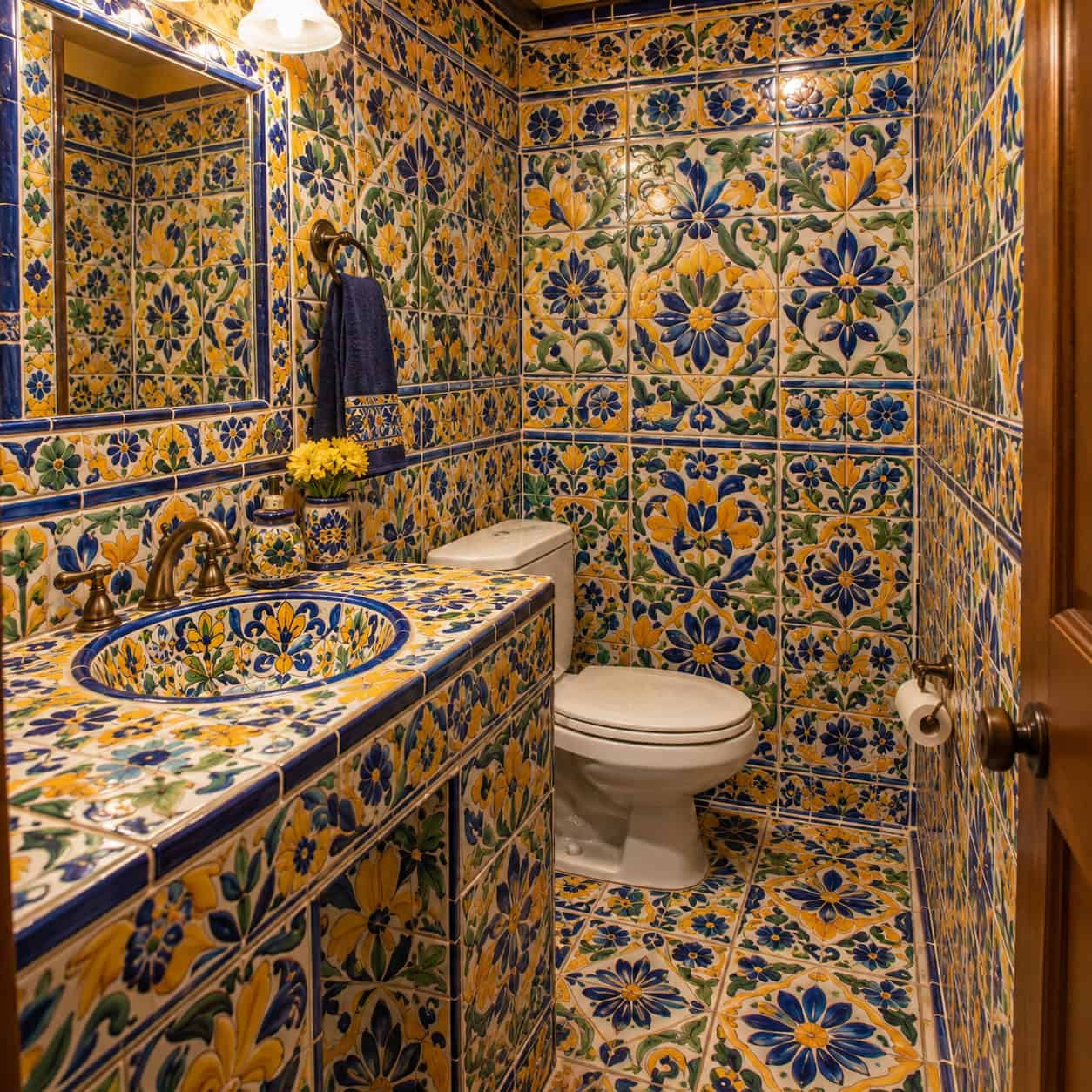
Talavera is a real craft tradition with a genuine lineage — Puebla, centuries of it, individually hand-painted.
Pros aren’t against the tile. They’re against wrapping every wall, the vanity face, the stair risers, and the sink basin in it at once, which was the 2015-to-2024 maximalist move.
The eye has nowhere to rest. And you’ve locked the room into a fixed palette — those blues and yellows and greens dictate every paint color, towel, and fixture choice for as long as the tile stays.
Swap: one nicho. Or one backsplash. Or the sink alone against plain white plaster, where the craft actually shows.
15. Open-Channel Waterfall Faucets

The flat open-trough spout that sheets water like a miniature weir. Spec-home upgrade of choice from about 2019 on.
Three problems, all practical. At low flow it burbles and spits instead of sheeting — the effect only works wide open. It splashes badly in the shallow wide basins Southwestern bathrooms favor. And the open channel collects mineral scale where everyone can see it, so cleaning a waterfall faucet becomes a regular chore rather than an occasional one.
The silhouette is also unmistakably of its moment. Flat, wide, rectangular. You can date it to a four-year window.
16. River-Rock Pebble Shower Floors

Sold as barefoot-on-a-creekbed. Delivered as roughly ten times the grout line of any other floor.
Run the math. A 3×4 shower pan in large-format porcelain has maybe twelve feet of joint. The same pan in pebble mosaic has hundreds of feet of irregular grout wrapping every stone. Every inch of that is a porous surface sitting in standing water.
So it stains. Body oil and shampoo film settle in the low spots between stones and turn the grout gray-brown no matter how hard you scrub. Mildew colonizes the joints. And pebble floors drain slowly because water has to work around the stones rather than across a smooth slope, so the surface stays wet longer than it should between uses.
Then comes the part that costs real money. All that grout is sitting directly over the shower pan — the waterproofing layer that keeps the shower from being a hole in your floor. Grout is not waterproof and never was. It’s a filler. The membrane underneath does the actual work.
When grout cracks or crumbles in a pebble floor — and it does, because thin irregular joints have no strength — water goes down to the membrane constantly. A properly installed modern pan handles that fine. A pan from 2008 with a mortar bed over hot-mopped felt, with a clamping drain that was never torqued right, often doesn’t.
Signs the pan is failing: a musty smell near the shower that won’t go away, discolored or soft flooring just outside the curb, a stain appearing on the ceiling below a second-floor bathroom, or loose tiles at the base of the walls. A plumber can run a flood test — plug the drain, fill the pan, mark the level, wait 24 hours. If it drops, water is going somewhere it shouldn’t.
Repair means demo. There’s no patching a failed pan from above. Figure $2,000 to $6,000 for a rebuilt shower floor, more if the subfloor rotted.
Pros now spec large-format slip-rated porcelain with a modern sheet membrane, or a honed stone mosaic with tight joints if they want texture. Same grip, a fraction of the grout.
17. The Scrolled Wrought-Iron Hacienda Chandelier

Twisted black scrollwork, amber seeded-glass shades, hung over a vanity it was never scaled for.
It’s the lighting equivalent of oil-rubbed bronze — not offensive, just carbon-dated to roughly 1998 through 2010.
The amber glass is the functional killer. It throws a yellow-orange cast that makes every skin tone look jaundiced in the mirror, which is a problem in the one room where people actually examine their faces.
Clear or opal glass, and the right relationship between your light fixtures and your faucet finish, solves more than a new fixture style does.
18. Terracotta Microcement Drenching

The current darling. Clay-toned microcement or limewash run over every wall, the ceiling, the shower, and the built-in bench. Peak is happening right now.
Designers love the material. They distrust the saturation — same disease as travertine drenching, different decade and different color.
There’s a technical catch too. Microcement in a steam-heavy bathroom lives or dies on its sealer. Under-sealed, it telegraphs water staining as dark patches around the shower and behind the sink, and those patches show up well before 2028.
Spot-repair it and you’ll see the patch. The whole appeal is seamlessness.
19. Carved Knotty-Alder Vanities with Corbels

Heavy distressed alder. Rope molding. Applied corbels under a bowed apron. The Southwest’s answer to the Tuscan kitchen, running 2000 to 2012.
The wood isn’t the giveaway. The stain is — that orange-red tone that no amount of new hardware walks back.
And there’s no path forward from it. You can’t lighten it, you can’t stain over it convincingly, and the carved profiles make a clean repaint look like a sloppy repaint.
Standard pro fix: a flat white-oak slab front, or a plaster-faced vanity. Keep the stone, swap the box.
20. Zellige in Every Shower

Handmade Moroccan zellige went from specialty import to the single most-specified shower surface on the internet in about five years. That’s the definition of a trend, no matter how old the craft is.
Pros aren’t against the tile. They’re against the saturation — and against how little homeowners were told going in.
Zellige is wildly irregular by design. That means lippage, where tile corners sit proud of their neighbors and catch a squeegee or a shin. It chips at those high corners. And installers who haven’t worked with it before often fight it into a grid it was never meant to hold.
Budget for 20% overage and an installer who’s actually set it before. Or use it somewhere smaller than a full shower.
21. Unlacquered Brass on Every Fixture

Here’s the contrarian one, and it’s defensible.
Unlacquered brass is this decade’s oil-rubbed bronze. Same emotional pitch — a warm living finish that “develops character.” Same buying behavior — everything matched, bought at once, from one line.
Give it until 2028 and a fully matched brass suite with fingerprint-darkened handles will read as mid-2020s exactly the way an all-ORB bathroom reads as 2006.
What pros are actually doing: mixing. Brass faucet, polished nickel shower trim, iron hardware. If you’re weighing warm tones, the difference between antique brass and champagne bronze is worth understanding before you commit a whole room.
Matched suites date. Mixed metals don’t.
22. Stacked Arches (Mirror, Niche, Doorway, Shower)

One arch is architecture. Four arches in a 60-square-foot room is a theme park.
The organic-modern wave from 2020 onward took a genuinely good Southwestern form and repeated it until it stopped meaning anything — arched mirror over an arched niche, inside an arched shower opening, behind an arched doorway.
It’s the same mistake as the 90s stacked-motif problem, just with better lighting.
Useful rule: keep the arch that’s structural or load-bearing. Square off everything else. The one arch gets stronger when it stops competing.
23. The Barn Door on the Bathroom

A reclaimed-wood slider on a black track, installed on the one room in the house that genuinely needs a seal.
It doesn’t lock. It doesn’t block sound — there’s a half-inch gap all the way around by design. It doesn’t contain steam, which means your mirror fogs and your hallway doesn’t.
It also eats an entire wall. The door has to park somewhere, and that somewhere is usually where the towel bar, the light switch, or the art wanted to be.
This one dates on function, not looks. That’s a harsher death.
24. Mass-Produced “Navajo-Print” Textiles and Macramé Styling

Factory tribal-print towels, polyester “Southwest” rugs, macramé plant hangers, all bought as a matched set around 2019.
Designers are steering clients two directions now: toward actual Diné, Hopi, or Zuni artisan work, or toward nothing at all.
The real textile appreciates. It’s made by someone with a name, it holds value, and it gets better as it softens.
The copy looks like a staging kit, because it was one.
25. The Giant Freestanding Tub in the Desert-View Window

The centerpiece shot of 2014 through 2024. A sculptural soaker posed in front of a picture window full of saguaros, lit at golden hour, sold a thousand houses.
Almost nobody fills it.
Industry research keeps pointing the same direction — the NKBA’s bath trends work shows homeowners prioritizing shower experience and storage over tub drama, and designers across the Sun Belt report the same client conversation on repeat. The tub gets used twice a year and dusted twelve times.
The practical complaints stack up. A 60-gallon freestanding soaker usually outruns a standard 50-gallon water heater, so the water goes lukewarm before the tub is full. Cleaning around and behind it is awkward — floor-mounted fillers are a pain to seal and a magnet for hard-water scale. And climbing over a high unsupported rim is a legitimate hazard for anyone over 65, with no good place to mount a grab bar.
So the conversion is now one of the most-requested bathroom jobs in the desert markets: pull the tub, extend the waterproofing, and build an oversized wet-room shower with a bench and a linear drain.
Budget realistically. A straight tub-to-shower conversion in an existing alcove runs roughly $4,000 to $9,000. A full wet room with a curbless entry, relocated drain, and a glass panel more commonly lands between $10,000 and $20,000, because curbless means cutting the subfloor to recess the pan and re-routing drain lines. If the tub sat on a slab, the concrete work alone adds several thousand.
Worth doing anyway. A single excellent shower with a bench, a handheld, and a thermostatic valve that holds temperature beats a sculptural tub nobody uses, every day of the year.
Keep a tub somewhere in the house for resale if you have young kids in the buyer pool. Just don’t make it the room’s monument.
26. Copper Soaking Tub

Gorgeous in photos. Brutal in practice.
Luxe-rustic peak ran 2008 to 2018. The problems are the vessel sink’s problems scaled up — the patina needs constant management, hard water etches it, and a single wrong cleaner leaves a permanent bright scar across a very expensive surface.
Copper also sheds heat fast. The metal that makes it a beautiful object makes it a cold bath by minute fifteen.
It’ll date as a 2010s luxury flex. Keep copper small.
27. Turquoise Grout and Turquoise Vanities

Boho-Southwest, roughly 2016 to 2023. Turquoise grout under white tile, or a turquoise-lacquered vanity as the one bold move.
Colored grout is the riskier half. It fades unevenly under cleaners, shows every repair, and the color you chose from a chip under fluorescent showroom light rarely cures to the tone you expected.
The vanity’s easier to walk back. Paint fixes a cabinet. Nothing fixes grout but a grout saw and a weekend.
28. Backlit Onyx Vanity Panels

A slab of translucent onyx lit from behind, glowing amber above the sink. High-end Scottsdale and Vegas, roughly 2010 to 2020.
Spectacular for about a year. Then the LED strips behind it start failing unevenly, so you get a bright patch and a dim patch across a $4,000 stone panel with no access from the front.
Onyx is also soft and porous — it etches from toothpaste and hand soap, and polishing it back means pulling the panel.
Beautiful material. Terrible place for it.
Run the list again and one pattern does all the work. Everything on it is a decision applied to a surface — a motif, a finish, a texture, a color repeated until it stopped meaning anything.
The Southwestern features that survive every cycle are the structural ones. Deep window reveals. Thick plaster walls. A real wood beam doing a real job. Honest clay underfoot in a room that stays dry.
Pros aren’t predicting the future when they call these. They’re just watching homeowners commit, again, to the same kind of choice that got torn out last time — only now it’s clay-toned microcement instead of peach paint.
Build the room. Let the decade be a towel.