
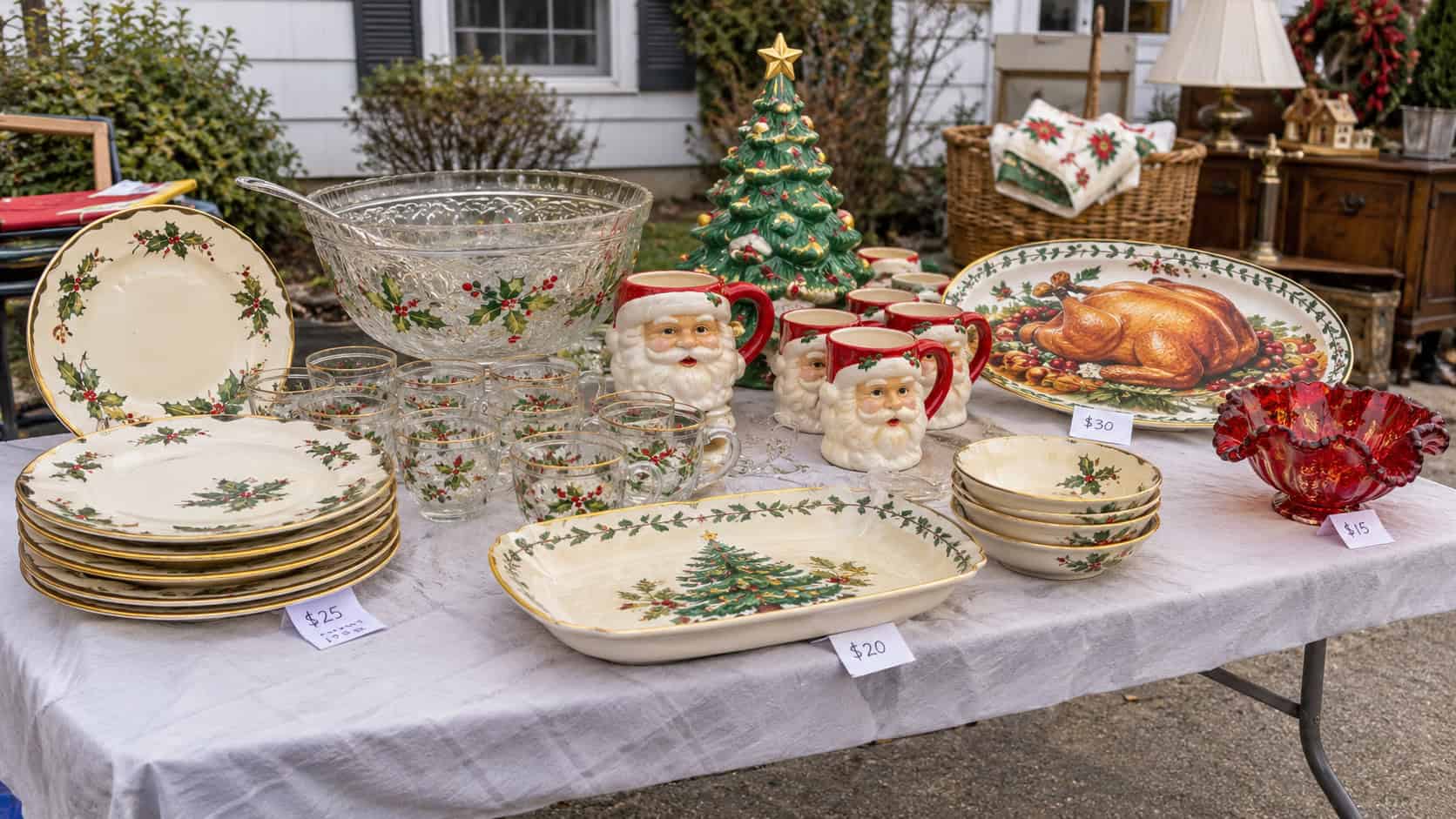
There’s a smell that comes out of a china cabinet when you open it in late November. Dust, old felt, a little vinegar from whatever got wiped down last January.
Most of what’s in there got used twelve days a year, maybe fewer. Then it went back behind glass and waited.
Some of it is worth about what the thrift store will give you. And some of it — the heavy cut-glass punch bowl, the gravy ladle nobody ever polished, the red Pyrex bowl with the gold holly — brings more than the dining table it sat on.
The tricky part is that the two categories look identical to anyone who didn’t grow up setting that table. Price gets decided by a backstamp the size of a thumbprint, a color that only ran for three years, or whether somebody once put the thing in a dishwasher.
Here are 34 vintage holiday dishes worth checking for before anything gets boxed up for donation.
1. Spode Christmas Tree (with the English backstamp)

Start here, because almost every American family of a certain vintage has at least one piece. Spode launched the pattern in 1938 — a green tree topped with a round-faced Santa, designed specifically for the U.S. market by a Stoke-on-Trent factory that had never made a Christmas dish before.
Flip the plate over. That’s where the money lives.
English-marked pieces — “Spode England,” “Copeland Spode England,” the older black or green marks — are the ones collectors want. Production shifted overseas in the 2000s, and those newer pieces, however pretty, trade for a few dollars at every estate sale in the country.
Dinner plates are not the prize. There are millions of them. The real values sit in the odd serving pieces people bought once and never replaced: the punch bowl with its matching cups, covered tureens, candlesticks, the tree-shaped canapé plates, the coffee pot. Complete boxed sets with the original green-and-gold sleeves add another layer.
Condition is brutal on this pattern because people actually used it. Look at the gold rim under a lamp — if it’s thinned to gray at the handles or faded unevenly, a dishwasher got it, and that cuts the number hard. Knife scratches across the tree are common and tolerated; gold loss isn’t.
Resale for the Christmas Tree line has held steady for decades, and the Telegraph Herald has tracked how the serving pieces consistently outrun the place settings. If a box in the attic has anything with a lid, open it first.
2. Tom & Jerry eggnog punch bowl set

White bowl, red script lettering, six or twelve little mugs. For about thirty years it was the centerpiece of every holiday party where the adults had their own punch.
Hall, McKee, Hazel-Atlas and Universal all produced versions between the 1930s and the 1950s. The lettering style and the foot shape tell you which.
Completeness is everything. A bowl with all its original mugs and unworn gold script regularly clears $100. A bowl alone — which is what usually survives, because mugs get broken one at a time — is worth almost nothing.
Count the mugs before you get excited.
3. Johnson Brothers ‘His Majesty’ turkey platter
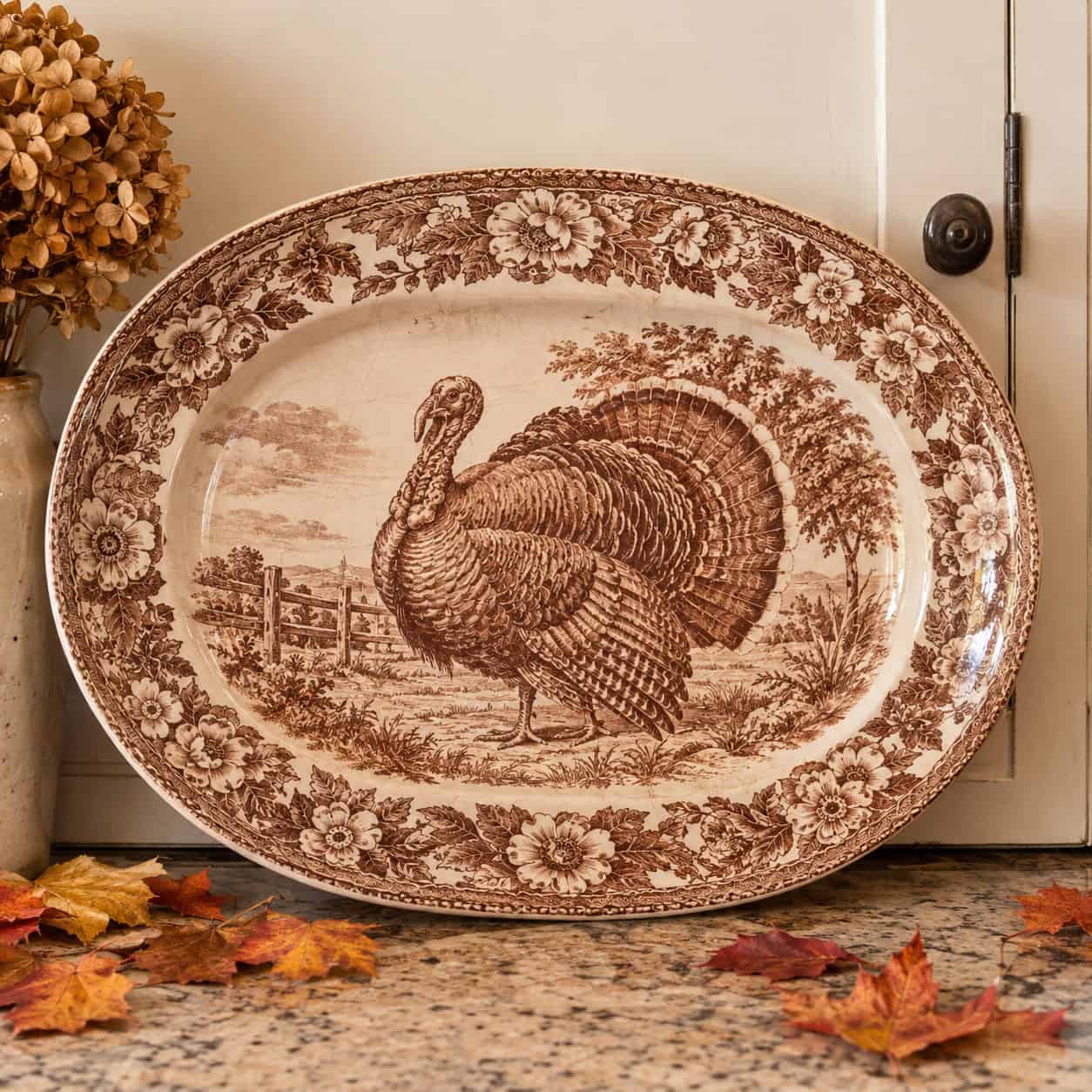
You’ve seen it. Enormous tom turkey in full fan, autumn leaves and fruit crowding the border, brown transferware on cream.
Johnson Brothers introduced His Majesty in 1959 and made it in England into the 1990s. It became the default Thanksgiving platter for a generation of American tables.
The 20-inch oversized platter is the money piece — it’s too big for most cabinets, so plenty got chipped or passed along. Matching turkey dinner plates, each with a different bird, sell well in sets of eight or more.
Check the back rim for hairlines. A platter that big flexes under a 22-pound bird.
4. Pyrex ‘Golden Leaf’ holly and pine cone #404 bowl

A one-season promotional bowl from 1960 — the big four-quart #404, red body, gold holly and pine cones circling the outside. There’s a scarcer orange variant that fools people into thinking it’s faded red.
This is the stuffing bowl. It came out every November, got scrubbed, went back in the bottom cabinet.
And that scrubbing is why most surviving examples are worth half what they could be. The gold is surface decoration. Abrasive cleaners and forty years of dishwashers take it down to ghost outlines.
Bright, complete, unscratched gold on a clean red body is the whole ballgame here.
5. Lenox ‘Holiday’ (Dimension) holly and berry china

Ivory bone china, gold rim, a sprig of holly with red berries. Lenox introduced it in 1974 and never stopped making it, which is exactly the problem.
Current production keeps basic plate prices flat. You can buy a new dinner plate, so nobody pays a premium for an old one.
The discontinued Dimension-shape serving pieces are a different story. Carver platters, the two-tiered servers, the odd giftware shapes that ran a few years and quit — those are what people hunt when they’re finishing an inherited set.
A boxed service for twelve, unused, still in the Lenox tissue? That sells as a unit, and it sells well.
6. Holt-Howard winking and starry-eyed Santa mugs

Holt-Howard is the blue-chip name in mid-century Japanese-made Christmas ceramics, and the Santa line is why.
Winking Santa, starry-eyed Santa, the Santa pitcher, the salt-and-pepper sets. Made from 1958 into the early 1960s and copied relentlessly ever since.
Look for the copyright-dated backstamp — “HH” with a year — and the original foil label if you’re lucky. Unmarked lookalikes flooded the market and they’re worth a dollar or two.
Cold paint on the cheeks and eyes wears off with handling. Crisp paint plus a dated mark is the combination that pays.
7. Anchor Hocking Royal Ruby glass

Deep, saturated red pressed glass, made from 1938 to 1967. For two generations it was simply what you set out in December because it looked like the holidays.
Which means there’s a lot of it. The tumblers and small bowls everyone still has in a kitchen cabinet bring a couple dollars apiece.
Punch sets with the original cups and hooks hold real value. So do the footed sherbets in sets of eight and the large 11-inch salad bowls, which were less likely to be bought than the drinkware.
Hold a piece to a window. True Royal Ruby glows an even red clear through — flashed-on red imitations show clear glass at the chipped edges.
8. Cuthbertson ‘Original Christmas Tree’ china

Here’s the fact that stops Spode collectors cold: Cuthbertson put a central Christmas tree on English dinnerware in 1922, sixteen years before Spode did.
The design is busier — a fuller tree, scattered toys and gifts around the border, a slightly warmer body color. Produced in England into the 1980s.
Tea sets and lidded casseroles sell strongest. Dinner plates lag, as they do in every pattern on this list.
Plenty of people mislabel Cuthbertson as Spode when they list it, which means plenty of people also buy it for Spode money by mistake. Read the mark.
9. Sterling silver gravy ladle, meat fork and serving spoons
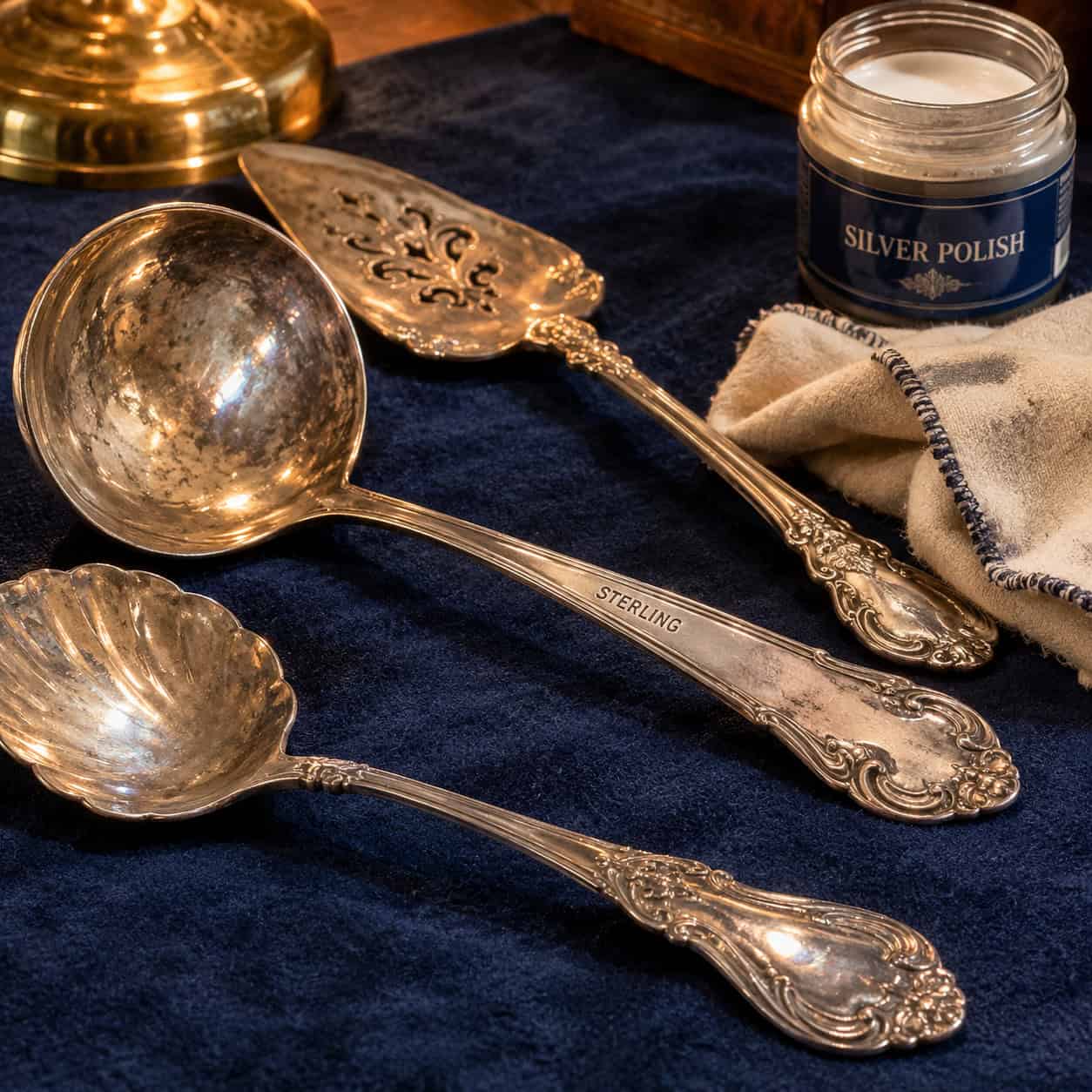
These are the pieces that lived in a felt-lined drawer and came out twice a year, tarnished, to be rubbed down with polish before anyone sat down.
And they’re frequently solid sterling, not plate — because the serving pieces were often the splurge in an otherwise modest household.
Finding out takes thirty seconds. Turn the handle over and look at the back near the stem. Sterling is marked “sterling,” “925,” or “925/1000.” Silverplate is marked with a maker’s name and words like “EPNS,” “A1,” “triple plate,” “Community,” or “silver on copper.” If it says anything about plate, it’s plate.
- “Sterling” or “925” — solid silver, has melt value
- “EPNS” or “triple plate” — plated, worth very little as metal
- No mark at all on an American piece — usually plate, sometimes coin silver
- Worn brassy patches at the high points — always plate
Weight matters because sterling has a hard metal floor. A heavy Victorian soup ladle can run 6 to 8 troy ounces; a gravy ladle is typically 2 to 3. At silver prices in the $30-per-ounce range, that floor alone is real money before anyone considers the pattern.
Then pattern multiplies it. Reed & Barton Francis I, Gorham Chantilly, Kirk Repousse — these trade well above melt, sometimes three or four times over, because people are actively filling in sets. Common patterns in heavy gauge still do fine on weight alone.
One warning. Hollow-handle carving knives and forks are sterling only in the handle, filled with pitch and a steel blade — don’t weigh those and assume.
10. Blue Ridge hand-painted Christmas Tree dinnerware
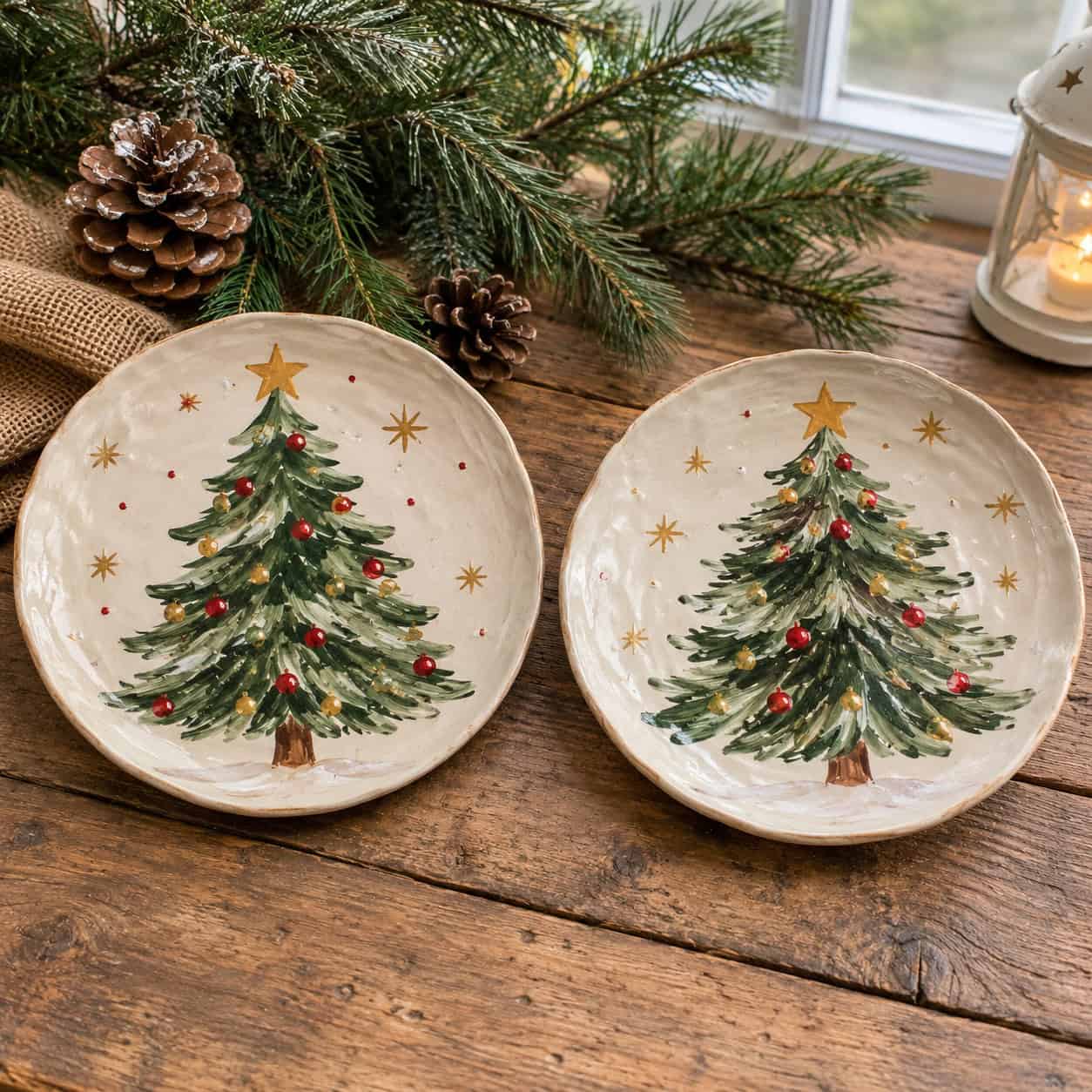
Southern Potteries in Erwin, Tennessee, painted every one of these by hand with a brush, which means no two plates in a stack are quite the same.
That variation is the appeal. Collectors go through a dozen plates looking for the one with the best tree.
Christmas Tree and Christmas Doorway are the two most-wanted Blue Ridge holiday designs, made from the 1940s into the mid-1950s. Underglaze painting means the color doesn’t wear off, so condition problems are chips and crazing rather than fading.
Look for the “Blue Ridge Hand Painted Underglaze Southern Potteries” stamp on the back.
11. Indiana Glass ‘Christmas Candy’ in teal blue

The name is literal, not seasonal marketing — the pattern looks like ribbon candy. Introduced in the late 1930s, revived in the early 1950s.
Crystal is everywhere. Teal blue is not.
The teal run was short and small, and a single teal luncheon plate can outprice an entire crystal luncheon set. People sell it at yard sales for a dollar because they see pressed glass, not color rarity.
If there’s teal-blue depression-era glass in the cabinet, photograph it before it leaves the house.
12. McCoy and Brush Santa cookie jars

Santa-head jars and Santa-with-a-toy-bag jars are among the most heavily reproduced American pottery pieces ever made. The fakes started in the 1990s and never stopped.
Mold detail is the first tell. Originals have crisp fingers, sharp fur texture, clean eyelashes. Reproductions come out of worn molds and look soft and puffy by comparison.
Second tell: cold paint wear. Real sixty-year-old cold paint is thin at the nose and fingertips where hands touched it. Fake wear is applied evenly, or there’s no wear at all on a supposedly old jar.
Weight and glaze ring help too. Hold the lid and tap the rim — original McCoy clay has a dull, dense sound.
13. Hall China ‘Autumn Leaf’ (Jewel Tea)

Jewel Tea salesmen handed these out door to door as premiums starting in 1933, and kept it up until 1976. If your family is Midwestern, this was Thanksgiving.
Forty-three years of production means plates are plentiful and cheap. Expect a few dollars each.
The scarce forms are what collectors chase: the oval tureen, the covered butter dish, the candy dish, the marked tidbit trays, and the early range sets. Those run many times plate money.
Decal wear around the rim from stacking is the usual condition issue.
14. Fostoria ‘Holly’ etched crystal stemware

A fine holly-and-berry etching on blown crystal, introduced in 1942 and made into the 1980s. These are the glasses that lived on the top shelf and came down once a year, carried two at a time.
Etched decoration doesn’t wash off, so condition here is about chips on the rim and base, plus the cloudy sickness that hard water leaves inside bowls.
Water goblets are the common form. Cordials, iced teas and claret glasses are the hard ones, because fewer were bought in the first place.
Twelve of anything matching beats eight, and beats it by more than fifty percent.
15. Metlox Poppytrail ‘Christmas Tree’ dinnerware

California earthenware, heavy in the hand, with a raised glossy tree and little red ornament dots standing up off the surface.
Metlox made this in the late 1950s and into the 1960s as a West Coast answer to the English imports, in far smaller numbers. You rarely see it east of Denver.
Serving bowls and the tree-shaped platters are genuinely scarce in complete, undamaged condition — the raised ornaments chip, and a chipped ornament is obvious from across the room.
Poppytrail is the mark to look for on the base.
16. Fitz and Floyd Santa tureens and lidded serving pieces

These are 1980s and 1990s pieces, which puts them in the dead zone — too new to feel like antiques, too elaborate to use casually. So they get donated.
Then they surprise people at resale, especially the big figural tureens with the original matching ladle. A ladle alone can be worth $40.
Damage is the norm, not the exception. Sculpted hat tips, outstretched hands and the finials on lids are the first things to chip, and buyers inspect those spots first.
Check the ladle. Then check the hat.
17. American Brilliant Period cut-glass punch bowl
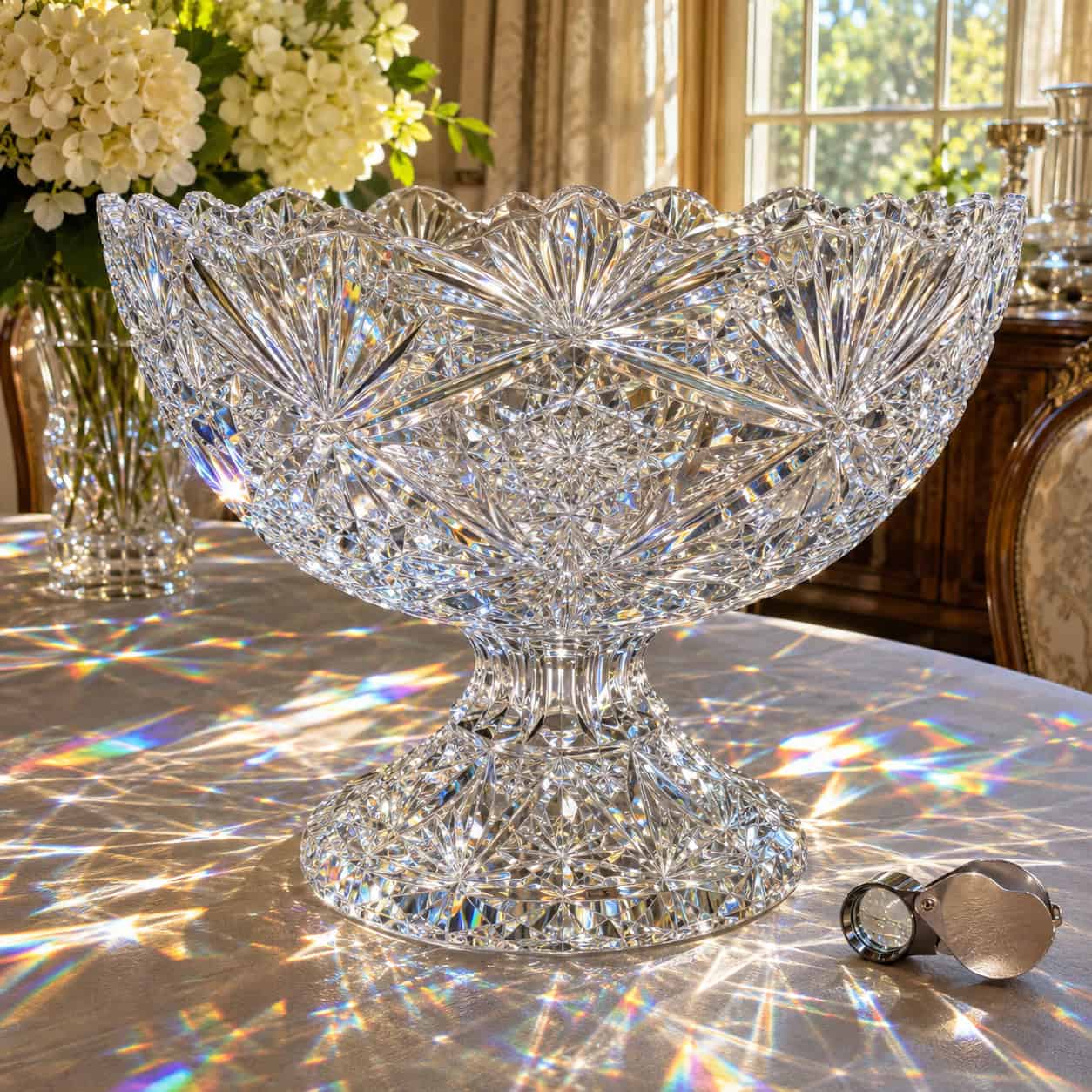
If an older family’s cabinet holds one genuinely valuable object, this is often it — and it’s usually the piece nobody can lift alone.
American Brilliant Period runs roughly 1890 to 1915. Glasshouses started with heavy lead blanks, often 30 to 40 percent lead oxide, then cut deep miter patterns by hand against stone wheels. The result weighs far more than it looks like it should and throws light in sharp rainbow lines.
Three authentication checks, in order.
Run a fingernail across the cuts. Hand-cut miters have knife-sharp edges that catch the nail; pressed imitation glass has rounded, soft mold lines and often visible seams.
Then weigh it in your hands. A true ABP punch bowl of 14 inches is startlingly heavy — pressed glass of the same size feels hollow by comparison.
Then ring it. Flick the rim with a fingernail and listen. Lead blanks give a long, bell-like tone that hangs in the air for a second or two. Soda-lime pressed glass gives a short dull tick.
Signatures are acid-etched, tiny, and easy to miss. Look in the center of the base, inside the bottom of the bowl, or hidden in the plain spaces between cut motifs — Hawkes, Libbey, Dorflinger, Tuthill, Sinclaire. A good lamp and a loupe are worth the trouble; a signature can double the number.
Two-piece bowls on their own matching pedestal base are the top of the category, because the two halves got separated in almost every household that owned one.
The lead content that makes these ring is also why the Corning Museum of Glass draws such a sharp line between cut lead crystal and the thin machine-pressed glass that replaced it after 1915.
18. Salem China ‘Christmas Eve’ by Viktor Schreckengost

A stylized snowy house with a tree beside it, rendered in the flat graphic style of early-1950s American industrial design.
Schreckengost designed it, and that name brings a second group of buyers to the table. He shaped everything from dinnerware to pedal cars to riding mowers across a seventy-year career, and design collectors pursue his work independently of any holiday interest.
Two buyer pools on one pattern pushes prices above what the production numbers alone would suggest.
Once you’ve seen the house-and-tree scene, you’ll spot it from across a church sale.
19. Culver and Georges Briard 22k gold holiday barware

Highballs, rocks glasses, ice buckets and chip-and-dip sets in 22k gold holly, snowflakes and swooping “Noel” script. The cocktail glassware of the 1960s office party.
Culver signed most pieces on the base. Georges Briard used a small script signature right in the design, usually tucked near the bottom of the motif.
Dishwashers destroyed most of these. Detergent strips applied gold within a dozen cycles, and faded sets are worth a fraction of bright ones.
A hand-washed set of eight with full crisp gold is the find.
20. Lefton white holly and poinsettia porcelain

Creamy white Japanese porcelain with applied holly leaves, hand-painted red berries and gold trim. Snack sets, teapots, tiered tidbit trays, candy dishes.
Lefton flooded American gift shops through the 1950s and 1960s, so there’s plenty out there.
The premium goes to pieces that still wear the red-and-gold Lefton foil sticker. Most got scrubbed off in the first wash, which makes an intact label a strong sign the piece was displayed rather than used.
Intact applied holly leaves matter too — they snap off in a drawer.
21. Spode ‘Woodland’ game-bird serving pieces
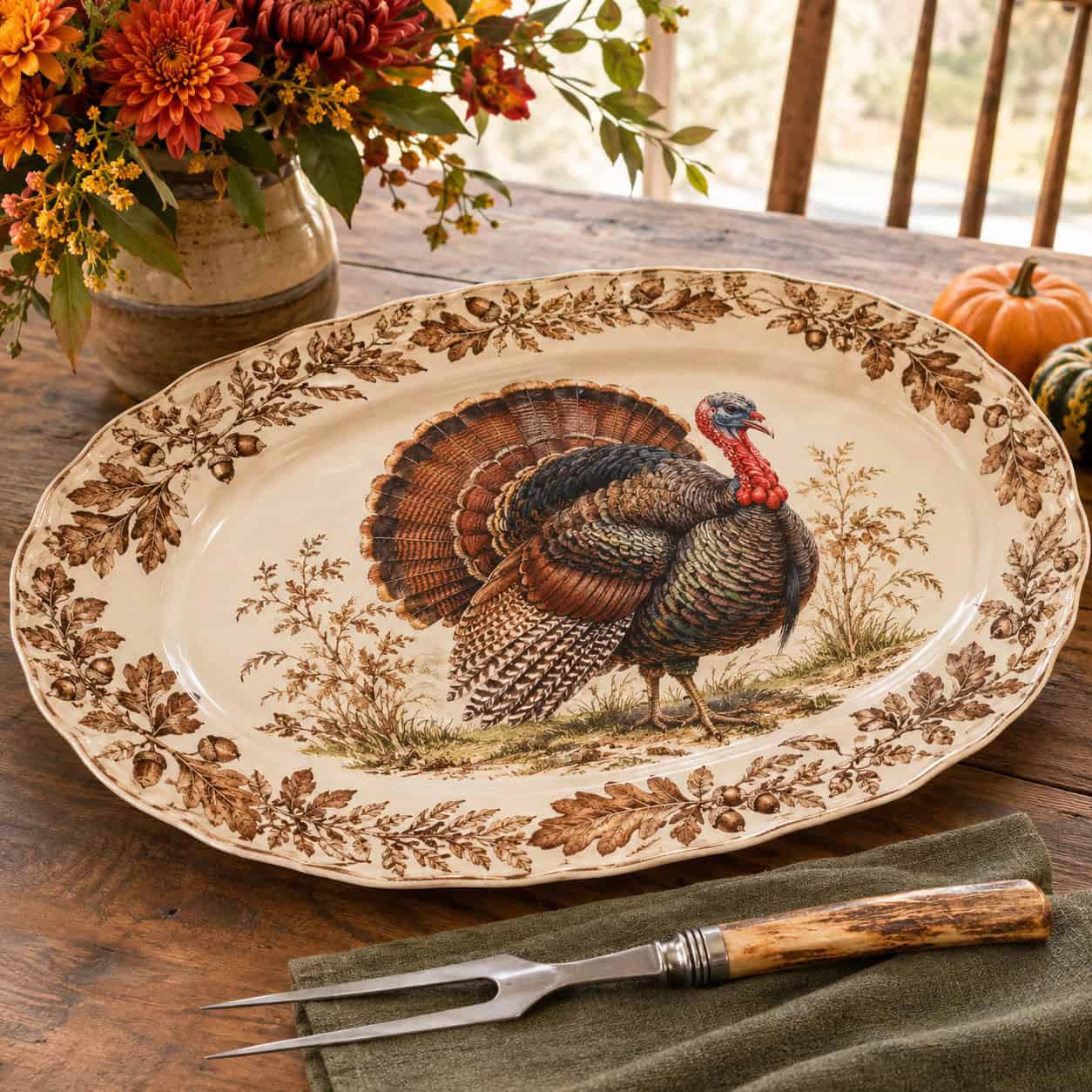
Spode’s Thanksgiving counterpart to Christmas Tree. Pheasants, quail, woodcock, turkeys and a few mammals rendered in naturalistic color on an off-white body with a brown botanical border, introduced in the 1990s.
Some animals stayed in production. Others got retired, and those plates now sell for multiples of the common ones.
The oversized turkey platter is the headline piece — 19 or 20 inches, bought once for Thanksgiving, and still in demand every October.
Check which animal is on each plate before you price the stack as one lot.
22. Jeannette Glass ‘Holiday’ (Buttons and Bows) in pink

Pink pressed glass in a raised button-and-bow pattern, made for exactly three years — 1947 to 1949.
The pattern name alone makes it a seasonal table favorite, which is funny, because it wasn’t designed as holiday ware at all.
Common forms are the cups, saucers and plates. The scarce ones are the footed tumblers, the console bowl and the covered butter dish, and those are the pieces worth real money.
Pink depression glass emerged from the same Pittsburgh-area glasshouses that made affordable tableware through the worst of the 1930s, a history the American Ceramic Society traces back to the region’s cheap natural gas and glass-sand supply.
23. Hand-painted Victorian turkey set
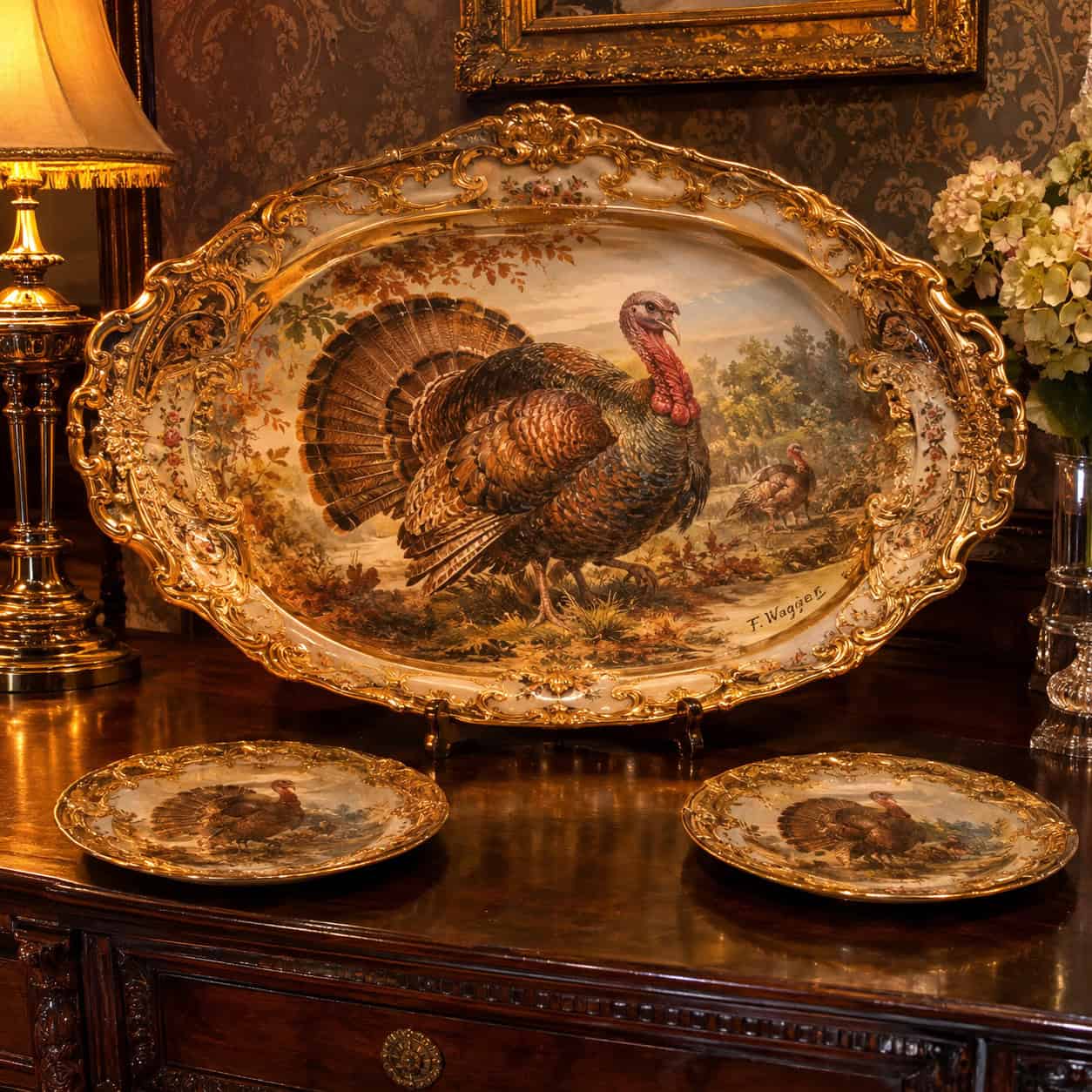
A platter the size of a serving tray plus eight or twelve matched plates, each with a different bird in a landscape, heavily gilded and usually signed by the decorator.
German blanks or Limoges, roughly 1890 to 1915, painted in America by china-painting studios and talented amateurs during a nationwide craze for the hobby.
Complete sets are scarce for an obvious reason: the platter always broke first. It was the heaviest thing in the house and it came out of the oven hot every November.
A set with its original platter intact and legible gold is worth getting appraised rather than listed.
24. Anything stamped ‘Made in Occupied Japan’

Seven years. That’s the entire window — 1945 to 1952, during the Allied occupation, when goods exported from Japan to the United States had to carry that mark.
Airtight dating is rare in ceramics, and collectors buy on the stamp alone. Holiday snack sets, Santa mugs, holly-trimmed dishes, figural salt and peppers, tiny bone-china shoes and angels — if it says Occupied Japan, it’s worth a second look before it goes in the donation box.
Variations exist: “Made in Occupied Japan,” “Occupied Japan,” and the rarer “Made in Japan, Occupied.” All date to the same window. A plain “Made in Japan” mark could be from 1930 or 1975 and carries none of the same certainty.
Marks were applied in red, black, green or blue ink and they wash off. A faint, partially scrubbed Occupied Japan stamp is still a valid mark — look carefully before deciding a piece is unmarked.
Now the caution, because it matters more than the money.
Hand-painted and overglaze-decorated ceramics from this era, Japanese and otherwise, frequently used lead-bearing glazes and lead-based enamels. Acidic food — cranberry sauce, tomato, citrus, wine, vinegar dressings — can pull lead out of a worn or crazed glaze surface. Bright red and orange enamels are the usual offenders.
Treat these as display pieces. If a glaze is crazed, chipped, or has a chalky dull patch where it used to shine, don’t serve food on it at all. Home lead-test swabs from the hardware store cost about $15 for a pack and take two minutes, which is a reasonable price for using grandma’s snack set with a clear head.
25. Stangl Pottery ‘Holly’

New Jersey red clay, hand-carved outlines, engobe-painted holly leaves under a soft matte glaze. It feels nothing like the glossy imports sitting next to it on a shelf.
Heavy, substantial, slightly rustic. Made through the 1960s.
The red clay body chips easily at the rim, and a chip shows as a bright red crescent against the white slip. It’s the most visible kind of damage there is.
Which is why clean examples are much thinner on the ground than Stangl’s production numbers would suggest.
26. Pyrex white milk-glass ‘Merry Christmas’ mug

Corning never sold this one. It went home with employees as a holiday gift, which is why it surfaces almost exclusively at estate sales within driving distance of Corning, New York.
Pyrex collecting has a hierarchy, and employee-only items sit at the very top of it. Scarcity plus a verifiable backstory does that.
The decoration is simple white milk glass with red lettering, nothing visually dramatic. People pass it over constantly.
If you have upstate New York in the family tree, go look in the mug cabinet.
27. Villeroy & Boch ‘Naif Christmas’ stoneware

Folk-art snowy villages — skaters, church steeples, little houses with smoking chimneys — painted in a deliberately naive style on heavy German stoneware.
Sold at department-store prices through the 1980s, then discontinued without much fanfare.
Mugs are everywhere and bring very little. Retired serving bowls, the covered boxes and the figural pieces are where the money went.
Look for the Villeroy & Boch mark with “Luxembourg” or “Germany” underneath.
28. Portmeirion ‘Holly and Ivy’
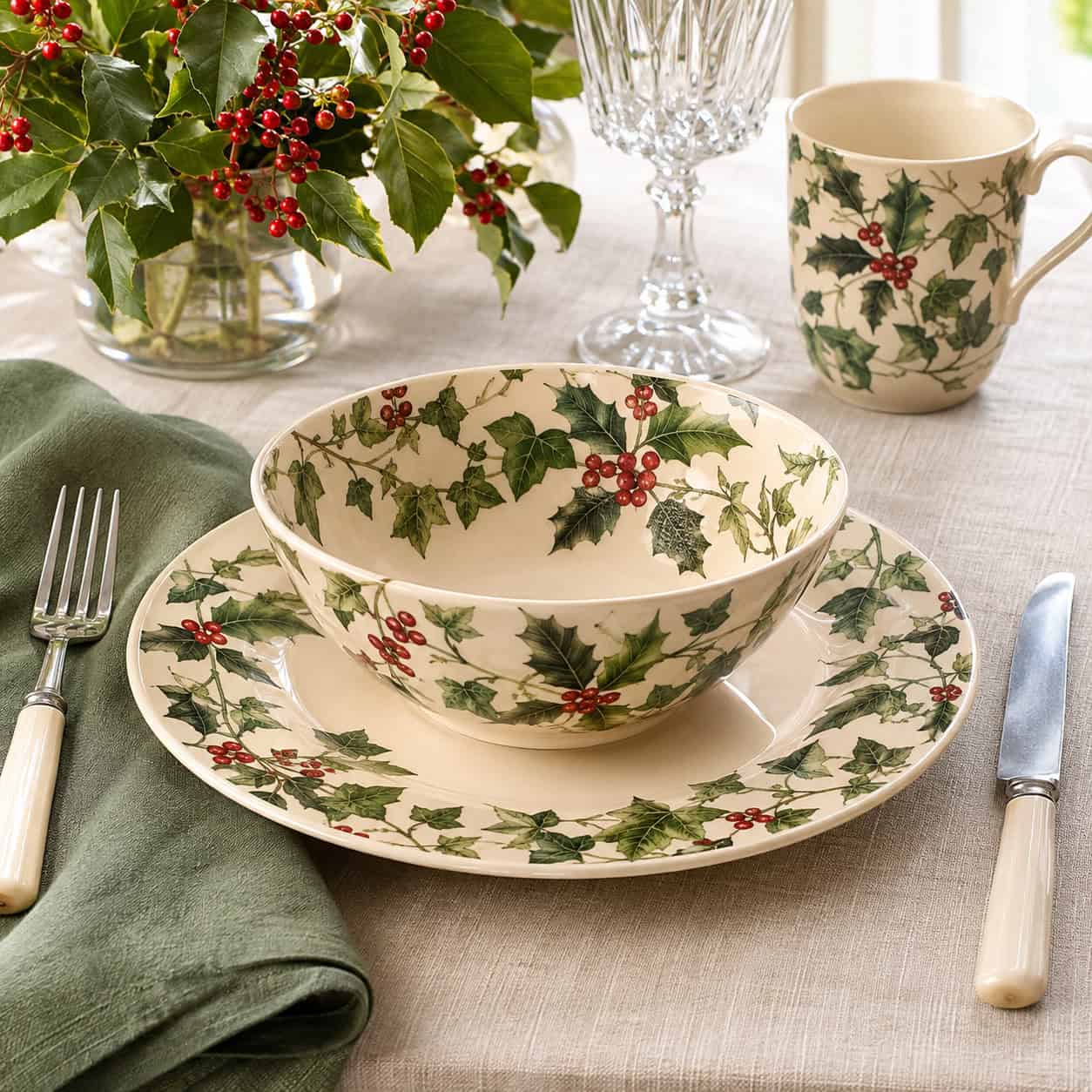
Wraparound botanical holly on a cream body, introduced in 1991 and one of very few patterns from that decade that has genuinely appreciated rather than collapsed.
English-made pieces outsell later production by a clear margin. The backstamp decides the price, same as with Spode.
Botanical collectors overlap heavily with Portmeirion buyers, which keeps demand steady through the year rather than spiking only in November.
Serving bowls and the tall coffee pots lead the category.
29. Royal Copenhagen and Bing & Grøndahl annual Christmas plates
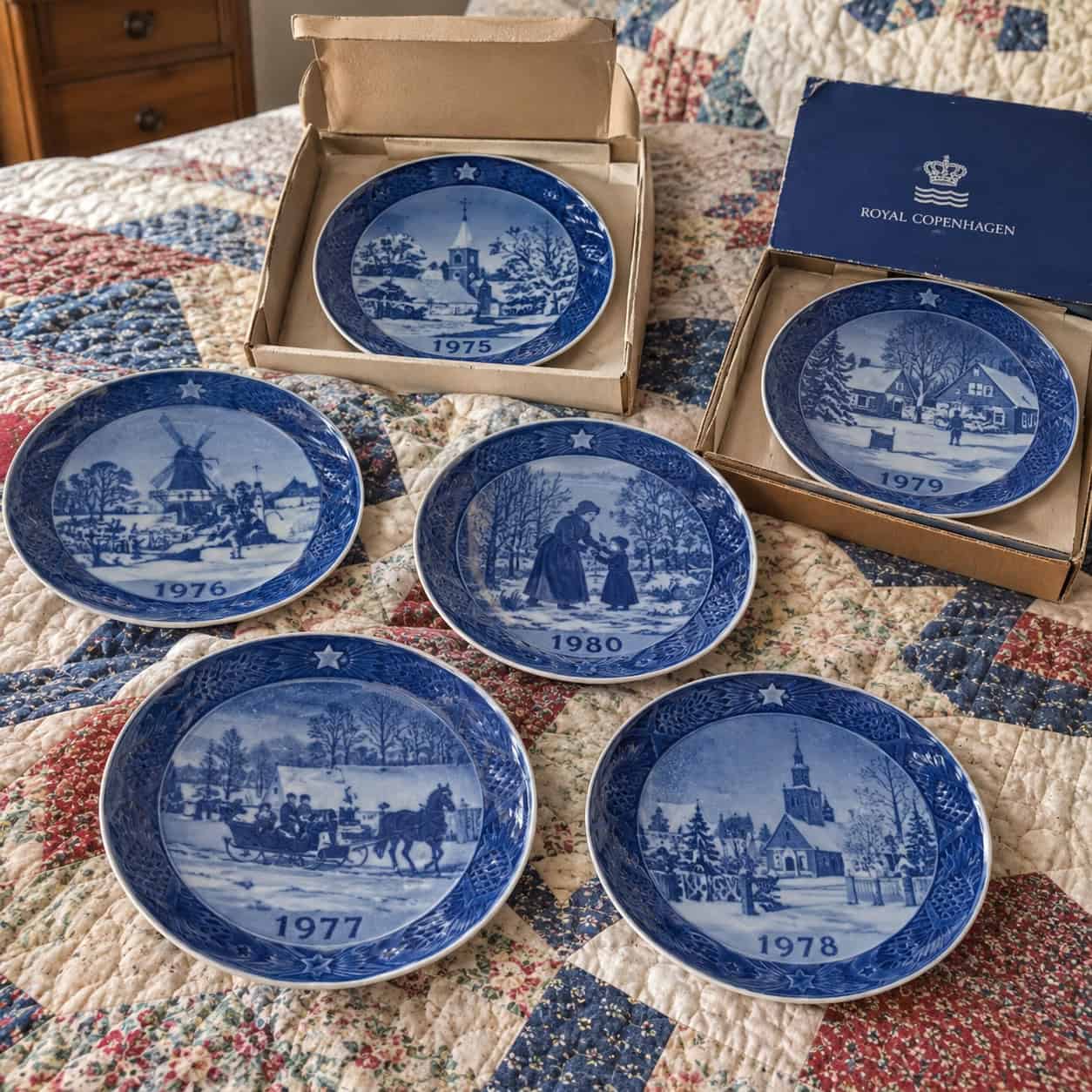
Time for the reality check.
Bing & Grøndahl started its annual series in 1895; Royal Copenhagen followed in 1908. Both were sold for decades as heirloom investments, and both were produced in enormous quantities — hundreds of thousands of some years.
Most years are worth less than a decent frame. Twenty-dollar plates with fifty-dollar sentimental weight.
The real exceptions are the earliest years and a handful of scarce war-era plates with suppressed production. A 1908 Royal Copenhagen first edition is a serious object. A 1978 is wall decoration.
Check the year on the back before you check your expectations.
| Common years | Scarce years | |
|---|---|---|
| Typical range | 1950s–1990s | Pre-1920, WWII era |
| Production run | Very large | Sharply limited |
| Resale | $5–$25 | $200 and up |
| Box matters | Barely | Significantly |
Sort the stack by date first. It takes ten minutes and it tells you whether to list them individually or as one lot.
30. Pfaltzgraff ‘Christmas Heritage’

Stoneware, white holly on cobalt, 1978 into the 2000s. If a family member over fifty hosted a holiday meal, there’s a decent chance this was on the table.
Ubiquity kills value. Dinner plates move for two or three dollars, and plenty of thrift stores won’t take any more of it.
The exception is the discontinued hostess and serving shapes — the tiered server, certain pitchers, the covered casseroles — because people with inherited sets still need those specific pieces and can’t buy them new.
Everything else is a donation.
31. The ceramic Christmas tree with plastic bulbs

Somebody’s mother cast it in a ceramics class at the church basement or the community center, painted it green, twisted in the little plastic bulbs one by one, and plugged it in every December for thirty years.
Atlantic Mold and Holland Mold made most of the blanks in the 1960s and 1970s. There were hundreds of thousands of them, and they went into the same boxes as the holiday dishes.
Demand has climbed hard. Large examples — the 18-inch and up trees — with every original twist-in bulb present, the star topper intact, and a working light base routinely sell for $100 to $300, sometimes more for unusual colors like white or pink.
Missing bulbs are replaceable but obvious. A cracked base or a non-working socket cuts the number sharply.
Of everything on this list, this is the piece most likely to be sitting in an attic box right now, written off as a craft project.
32. Nikko ‘Christmastime’ stoneware

Japanese stoneware from the 1980s, holly and ribbon on white, instantly recognizable to anyone who hosted during that decade.
Recognition doesn’t equal value. Values here are soft, and dinner plates move slowly even in November.
The serving pieces carry what demand exists — the large oval platters, the covered vegetable dishes, the gravy boat with its attached underplate.
Fine to use, hard to sell.
33. Lenox ‘Winter Greetings’ by Catherine McClung
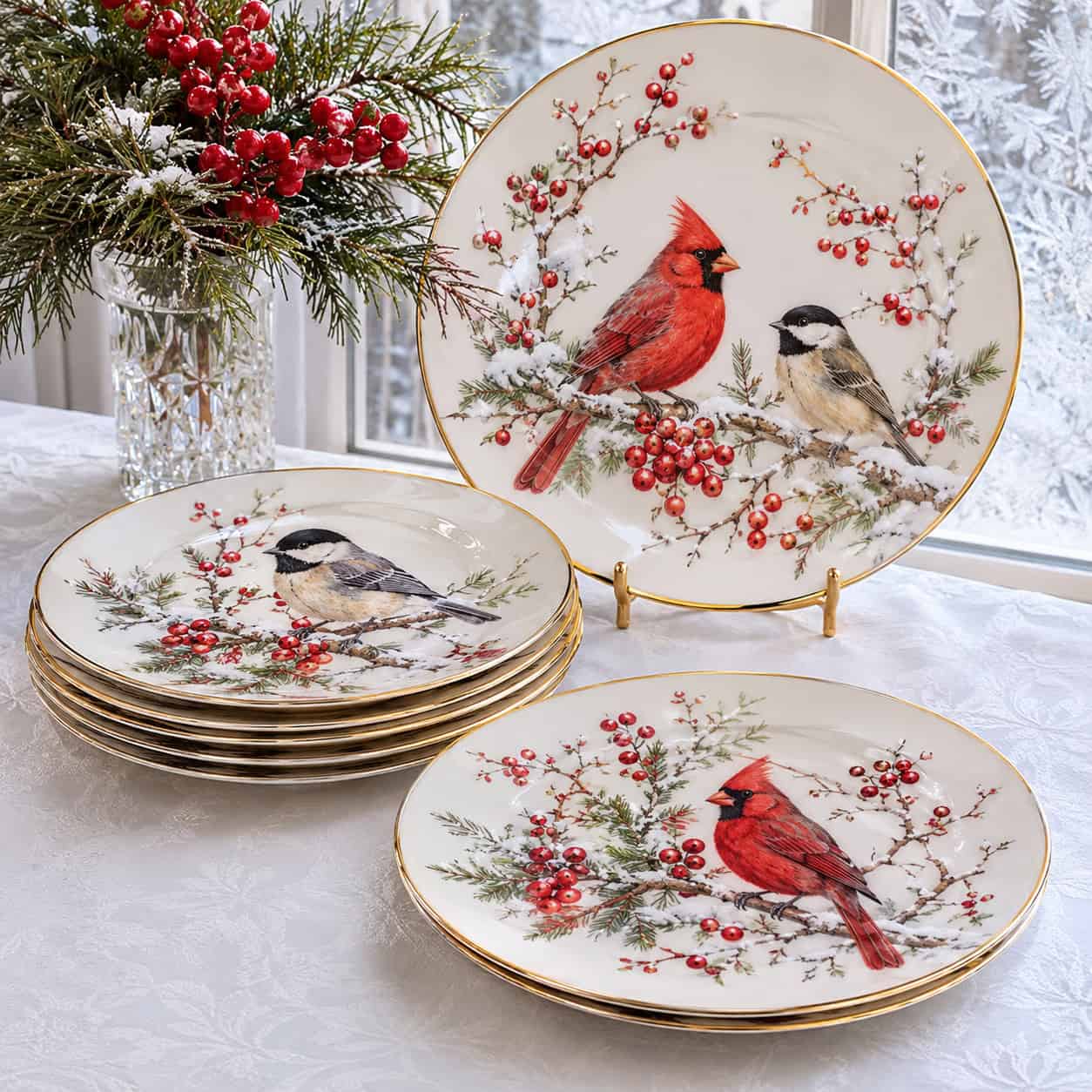
Cardinals, chickadees and winter berries on ivory bone china, introduced in the 1990s and illustrated by a working wildlife artist.
It has a genuinely devoted following, and bird collectors buy it alongside holiday collectors.
Serving pieces again lead — the cardinal platters, the covered boxes, the tea sets. Basic place settings stay reasonable because the pattern isn’t especially old.
Hold it next to the 1974 Holiday pattern and you can see Lenox chasing a slightly different December.
34. Haviland ‘Twelve Days of Christmas’ plate series

Limoges porcelain, one plate per year from 1970 through 1979, each illustrating a verse of the carol in Haviland’s soft blue-and-gold style.
A complete twelve-plate run with the original boxes and certificates does sell, and sells respectably. Broken-up partial runs mostly don’t.
Same lesson as the Danish annuals: these were marketed as investments and produced accordingly, so completeness is the only thing holding up the price.
If there are boxes in the closet, keep them with the plates. The cardboard is worth more than it looks.
Most of this stuff got used quietly for decades. Gravy went in that boat, stuffing went in that bowl, somebody’s uncle drank too much out of those gold-rimmed highballs, and then it all went back behind glass for another year.
Pull it out before you price it. Turn every piece over and read the back, because the difference between $8 and $800 is almost always a word stamped in a circle the size of a dime.
And if a few pieces turn out to be worth something — that’s fine. But the heavy ladle with the worn monogram is still going to feel like the best thing in the box.