

There was a coffee can on the back of the stove. A lemon half in a saucer by the sink. An old toothbrush in a jar under the counter that nobody would dream of throwing out.
None of it came from a store aisle with forty-dollar bottles and a scent called “Coastal Linen.”
Most of those tricks still work. A few of them work better than anything sold today, because they attack the actual problem — mineral scale, hardened grease, bacterial film — instead of perfuming over it.
And a handful of them will wreck a modern kitchen. Grandma’s counters were laminate. Yours might be marble.
Here are 34 old-school kitchen and bath cleaning tricks worth knowing, including which ones to keep, which ones to retire, and which ones will quietly ruin a finish.
1. A Vinegar-Filled Bag Rubber-Banded Over the Faucet Spout

Fill a sandwich bag halfway with plain white vinegar. Push the spout down into it and band it tight around the neck. Leave it overnight.
By morning the calcium that was choking the aerator screen from the inside has dissolved, and the stream comes back straight instead of splitting into three angry directions. No wrenches, no disassembly.
Plumbing outfits like Mr. Rooter Plumbing still publish this exact method, which tells you something.
If the flow never recovers, the screen itself is packed solid. That’s when you remove the aerator and soak it loose in a cup.
2. Half a Lemon Dipped in Coarse Salt

The original all-in-one scrubber. Citric acid cuts mineral film, salt does the abrading, and the rind is the sponge you throw away.
Victorian kitchens used it on copper pots and tarnished brass. It still brings copper bottoms and chrome trim back to a genuine shine in about a minute of work.
Keep it off marble, limestone, and unlacquered brass. The acid doesn’t know the difference between tarnish and patina.
3. Crumpled Newspaper on the Bathroom Mirror

The smell of newsprint and ammonia glass cleaner is a whole decade in one breath.
Old rag-content paper had almost no wood pulp, so it left zero lint and buffed glass to a streak-free finish. Today’s soy-ink newsprint smears gray across everything.
Flat-weave microfiber does the same job now. So does a plain paper coffee filter, which is the closest modern stand-in to what your grandmother was actually holding.
4. Bacon Grease Into the Coffee Can, Never Down the Drain

Wartime fat rationing started it. Frugality kept it going. Plumbing physics is why it should never have stopped.
Hot bacon grease pours like water. It goes down the drain, hits the cooler P-trap under the sink, and congeals into something with the texture of candle wax.
That layer doesn’t wash away. It builds inward, ring by ring, catching coffee grounds and rice and shreds of paper towel until the two-inch pipe has a half-inch hole running through the middle of it.
The worst buildup usually isn’t in the trap where you can reach it. It’s in the horizontal trap arm behind the cabinet wall, where flow slows down and fat has time to stick.
Then one Thanksgiving the sink fills up and won’t drain, and a plumber runs a cable through and pulls back something that looks like gray tallow.
A can under the sink costs nothing. Pour the grease in, let it set, and toss it with the trash. If you want the full list of things that shouldn’t go down there, plenty of common items are worse for your drain than grease.
5. An Open Box of Baking Soda in the Back of the Fridge

Every grandmother had one, with the date scratched on the flap in ballpoint pen.
Sodium bicarbonate neutralizes acidic odor molecules chemically. It isn’t masking the smell of last week’s cantaloupe — it’s ending it.
Tear the box fully open, not just the little perforated window. More surface area, more absorption.
When you swap it, dump the old one down the disposal with cold water running.
6. The Overnight Vinegar Bag on the Showerhead

Same principle as the faucet, different payoff. Scale plugs the outer jets first, which is why one side of the spray suddenly aims at the shower curtain.
Band a bag of white vinegar over the head and leave it four to eight hours. Overnight for anything you’ve been ignoring for years.
A monthly twenty-minute soak keeps it from ever getting there, a point Bob Vila makes well.
Run hot water for thirty seconds afterward to flush the loosened grit out.
7. A Worn-Out Toothbrush for the Base of the Faucet

Nobody threw a toothbrush away. It got demoted — to the shoe polish tin, the jewelry box, or the cleaning caddy under the sink.
That seam where the faucet base meets the countertop is where pink bacterial film and hard-water crust start. Nothing else reaches it.
Left alone, that ring of scale eats the finish underneath. On brushed nickel it turns into a permanent dull halo you can’t polish out.
Thirty seconds a week. Rinse, done.
8. A Baking Soda Paste Scrubbed Into Porcelain

Bicarbonate rates around 2.5 on the hardness scale. Porcelain enamel is roughly 6. That gap is the whole trick.
It lifts the gray tub ring and the coffee stain in the sink without leaving the fine web of micro-scratches that old chlorinated scouring powder ground into everything.
Those scratches are why so many 1950s cast-iron tubs look permanently cloudy. The enamel got sanded, not stained.
Three parts soda, one part water. A little dish soap if the ring is greasy.
9. Lemon Peels and Ice Cubes in the Garbage Disposal

Run a tray of ice cubes with a handful of lemon or orange peel. The ice knocks food film off the grinding ring, the citrus oil deodorizes what’s left.
Cold water the whole time. Hot water melts fat and spreads it downstream.
Now the myth: coffee grounds and eggshells do not sharpen disposal blades. There are no blades — just blunt impellers that fling food against a stationary ring.
Grounds pack into wet sludge in the trap arm. Eggshell membranes wrap around the impellers. Both make things worse, and both are still repeated as gospel.
10. Squeegeeing the Shower Glass Before You Step Out

Not a product. A discipline.
Thirty seconds of wiping beats forty minutes of scrubbing soap scum with a scraper six months later.
Hard water spots aren’t dirt sitting on glass. Minerals dry, bond, and slowly etch into the surface — and once glass is etched, it stays etched. No cleaner reverses it.
Prevention isn’t the better option here. It’s the only one.
11. A Pot of Boiling Water and Dish Soap Down the Kitchen Drain

The old Saturday-night grease flush. A big pot of hot water, a long squeeze of dish soap, poured slowly down the kitchen drain.
Surfactant plus heat emulsifies the soft fat film lining the pipe walls and carries it out to the main before it has a chance to harden.
Do it once a month and you may never meet the inside of your own P-trap.
Now the cautions, because they matter. If your trap and tailpiece are white PVC — which they are in most homes built after 1975 — don’t use water at a hard rolling boil. PVC softens near 140°F and the glued joints are the weak point. Take the pot off the heat, wait a minute, then pour.
Never pour boiling water into a sink that’s already holding standing water. It won’t reach the clog, it just sits there and cooks the top of the basin.
And never onto a porcelain or enameled cast-iron sink with a cold bowl. Thermal shock crazes the glaze.
Pour in stages — a cup, wait, another cup. Slow and hot beats fast and scalding. If the water backs up instead of going down, stop; you’ve got an actual clog, not a grease film.
12. A Denture Tablet Dropped in the Toilet Bowl

Two tablets, fifteen minutes, one swipe of the brush.
The fizz is citric acid meeting sodium bicarbonate, and it works its way under the rim where a brush never goes. No fumes, no bleach smell, safe on older glazes.
It was also the original fix for a cloudy flower vase and the tea film inside a Thermos.
13. Scouring the Cast Iron Skillet With Salt, Not Steel

Coarse salt, a folded paper towel, a warm pan. The salt shears stuck bits off without touching the polymerized seasoning underneath.
But the folklore needs correcting. A drop of modern dish soap will not strip a well-seasoned pan.
The rule came from an era when soap meant lye soap, and lye genuinely did dissolve baked-on oil. Today’s detergents don’t come close.
Dry it on the burner. That part was never optional.
14. Stove Grates Sealed in a Bag With Ammonia Overnight

A tablespoon of household ammonia and the grates in a sealed trash bag on the back porch. Overnight.
The fumes do the work, not the liquid. Baked-on grease breaks down and wipes off with a rag by morning.
Safety isn’t optional here. Open the bag outdoors, hold your breath, and step back before you lean in.
Never anywhere near bleach. Not the same bag, not the same bucket, not the same afternoon.
15. A Cream of Tartar Paste on Rust Rings

Potassium bitartrate — the same white powder in the back of the baking cabinet — is a mild acid that dissolves iron staining.
It’s the original fix for the orange ring a shaving-cream can leaves on a glass shelf or a porcelain sink ledge.
Mix a spoonful with a few drops of water into a paste. For stubborn spots, use hydrogen peroxide instead of water.
It also brightens dulled aluminum, which is why old pot-scrubbing recipes are full of it.
16. White Toothpaste as Chrome Polish

Plain white paste is a micro-abrasive plus a mild detergent. That’s precisely what chrome plating wants.
It knocks water spots off a tub spout and brings back the mirror without any of the scratching that a scouring pad guarantees.
Plain white only. Whitening gels carry hard silica beads and blue polymer that streak.
Keep it away from brushed nickel, matte black, and unlacquered brass — abrasives destroy those finishes, which is part of why black faucets are fussier to maintain than chrome ever was.
17. Rubbing the Sprayer’s Rubber Nozzles With Your Thumb

Look at the face of your pull-down sprayer. Those little rubber bumps are silicone, and they flex on purpose.
Scale can’t bond permanently to a surface that moves. Run your thumb hard across them under warm water and the deposits crack off as white flakes.
Crooked spray pattern fixed in thirty seconds.
No manual mentions it. Every plumber does it without thinking.
18. Bar Keepers Friend on the Stainless Sink
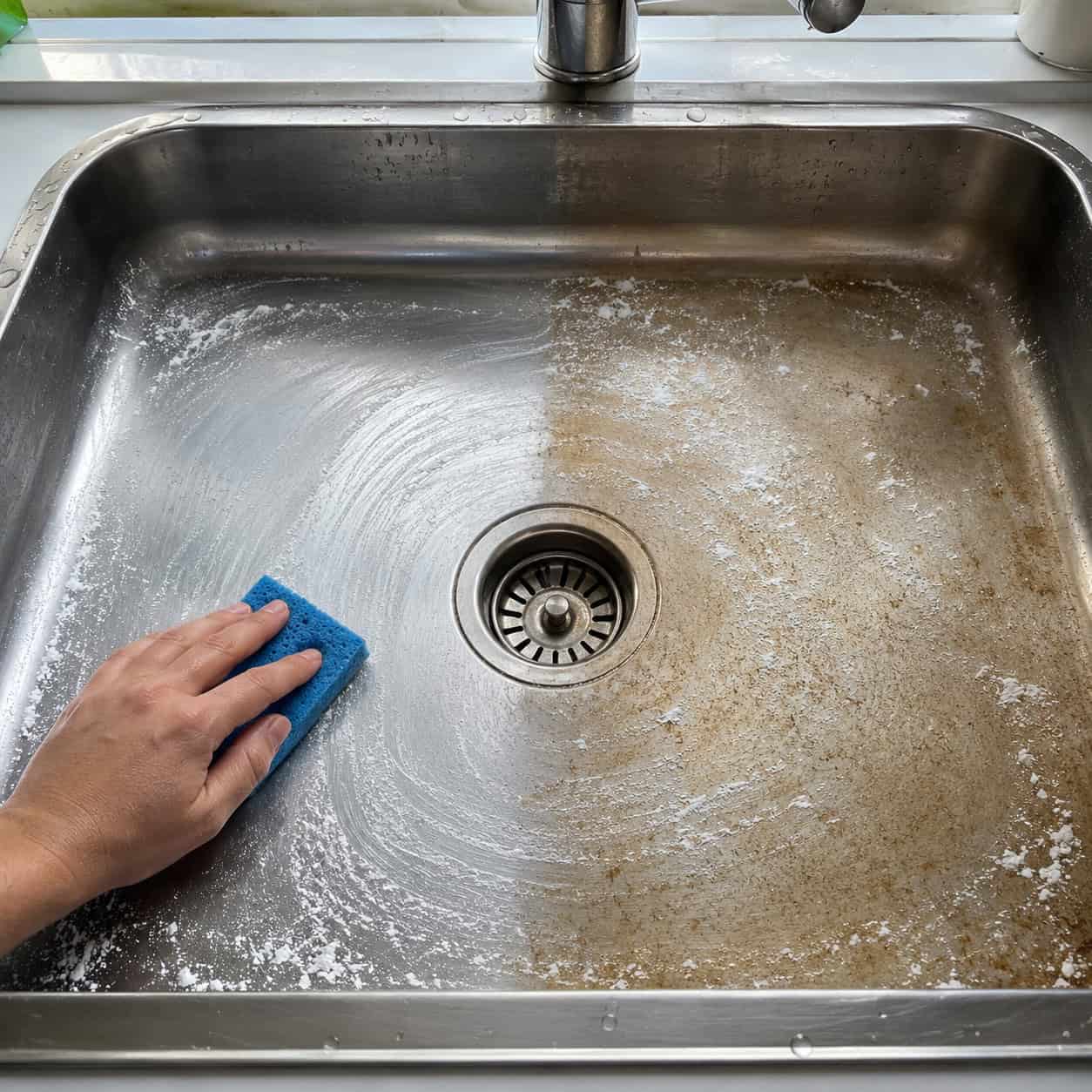
On store shelves since 1882, which makes it older than most of the tricks on this list.
Oxalic acid plus powdered feldspar pulls tea stains, gray pot marks, and rust flecks out of stainless steel and leaves it looking new.
Scrub with the grain of the steel, never across it. Cross-grain scratches catch light forever.
Rinse within a minute. Acid left to dwell on stainless will haze it.
19. A Pumice Stone on the Hard-Water Toilet Ring

Old janitor knowledge. When acid won’t touch a mineral ring that’s been building for a decade, pumice shears it off mechanically.
It works because pumice is softer than vitreous china. The stone wears down, the bowl doesn’t.
The rule is absolute: stone soaking wet, surface soaking wet, always. A dry stone on dry porcelain will score it permanently.
Never on colored fixtures or antique glazes. Those finishes are thinner and less forgiving than white china.
20. Boiling Vinegar Through the Kettle and Coffee Maker

Half vinegar, half water, run it through, then two full cycles of clean water.
Scale on a heating element is an insulating blanket. It steals efficiency, adds minutes to the brew, and puts a flat mineral taste in everything.
The modern nuance: for machines with aluminum boilers or a lot of rubber seals, citric acid powder is gentler and rinses cleaner than vinegar. A tablespoon in a full reservoir.
21. Salt, Lemon, Then Mineral Oil on the Wooden Cutting Board

Coarse salt across the surface, a lemon half as the scrubber, then rinse and stand the board on edge to dry.
Standing it up matters more than the scrubbing does. A board lying flat traps moisture underneath and cups.
Once bone dry, rub in food-grade mineral oil until the grain stops drinking. A board that’s fed doesn’t crack.
Wood isn’t the sanitation risk people were told it was. Kept dry, it holds up as well as plastic — and doesn’t develop knife grooves that trap film.
22. Hydrogen Peroxide Poured Straight Onto Grout

The brown bottle from the medicine cabinet, in households since the 1930s, and still the best thing for dingy grout lines.
Pour 3% peroxide straight onto the grout. Ten minutes. Scrub with a stiff brush and rinse.
It brightens the discoloration and disinfects at the same time, with no fumes, no residue, and nothing that eats the grout the way straight bleach does over time.
Use it alone. Peroxide plus vinegar makes peracetic acid, which is corrosive and irritating.
Keep it in the original opaque bottle, too. Light breaks peroxide down into plain water, which is why decanting it into a clear spray bottle quietly ruins it. Homemade cleaners work when you respect their limits — Oklahoma State University Extension has a good rundown of which pantry ingredients actually earn their reputation.
Now the part that matters most. If the dark staining comes back within days, or the grout feels soft, or there’s a musty smell that never clears, you’re not looking at a cleaning problem.
Black growth spreading behind tile means water is getting into the wall — usually a failed shower pan, bad caulk at the curb, or a leaking valve. Peroxide treats the surface. It does nothing about the source.
Get a professional to look at it before you regrout. Cleaning stained grout twice a year is maintenance. Cleaning it every week is a symptom.
23. A Coat of Paste Wax on the Faucet After You Clean It

Borrowed straight from the garage. Mid-century homeowners waxed chrome bumpers, then figured out the tap looked better too.
Clean and dry the faucet, then apply the thinnest possible coat of automotive or furniture paste wax. Buff it off.
Water beads and rolls instead of sitting and drying. Spots stop forming for weeks at a stretch.
Keep it off handle grips — slippery — and off the aerator screen entirely.
24. Range Hood Filters Soaked in Washing Soda
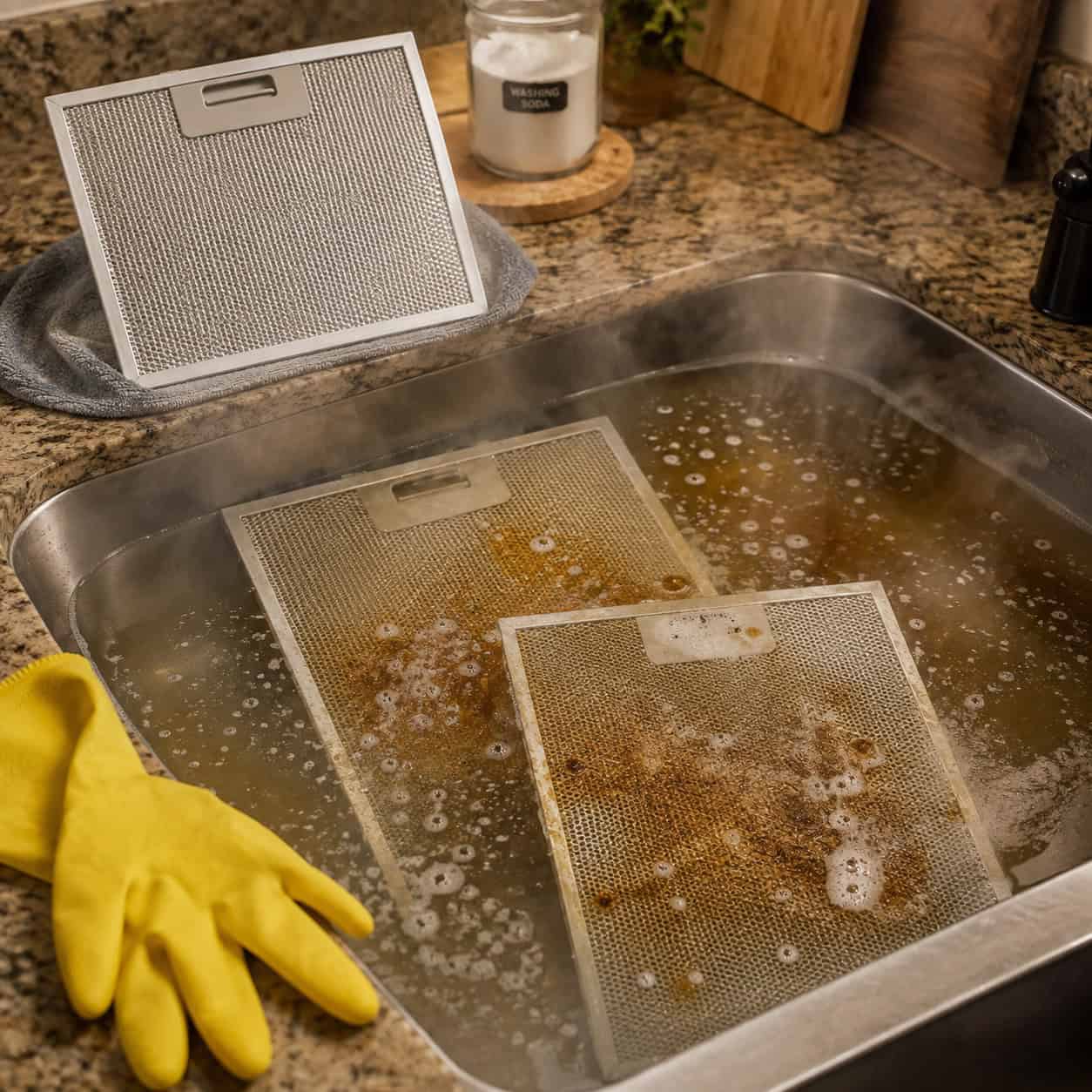
Washing soda is not baking soda. Sodium carbonate, far more alkaline, sold with the laundry supplies.
A half cup in a sink of near-boiling water. Drop the aluminum mesh filter in and wait twenty minutes.
The alkali saponifies the hardened cooking grease — literally turns it into soap — and the filter lifts out silver again instead of brown.
Wear gloves. It’s rough on skin, and it will dull raw aluminum if you leave it in for an hour.
25. Rubbing Alcohol on Fingerprints and Water Spots

Isopropyl evaporates before it can leave a film. That’s the entire advantage over glass cleaner, which streaks on stainless every time.
Damp cloth, quick wipe, done. Refrigerator doors, dishwasher fronts, polished chrome.
It’s also the fastest way to kill the greasy halo that builds around a cabinet pull — the mark that makes a clean kitchen still read as grimy.
26. A Balled-Up Piece of Aluminum Foil on Rusted Chrome

Old bumper trick. Ball up foil, dip it in water, scrub the rust spot.
Aluminum is softer than chrome plating, so it shears the rust and scale off without scoring the surface. There’s a mild galvanic reaction helping too.
Works on tub grab bars, old towel bars, vintage tap handles.
Chrome only. Never brushed nickel, never painted, never PVD, never matte black — foil will scratch all of them straight down to the base metal.
27. Unscrewing the Sink Strainer Basket and Scrubbing It by Hand

You cleaned the whole sink and it still smells. This is why.
Under the strainer flange and inside the top of the tailpiece is a ring of black biofilm that no amount of surface cleaning touches.
Pull the basket out, put a bucket under the trap if you’re going further, and go at it with a bottle brush and hot soapy water.
Ten minutes, and the sink smell disappears without a single drop of chemical.
28. The Baking Soda and Vinegar Volcano Down the Drain

Time for an honest verdict. It doesn’t work.
The foam is carbon dioxide, and the reaction is over in seconds. What’s left in your pipe afterward is salt water — the acid and the base neutralize each other into something with roughly the cleaning power of tap water.
The fizz feels productive. It isn’t dissolving hair, it isn’t cutting grease, and it isn’t moving a blockage. Balkan Plumbing has been saying so for years.
As a deodorizer for a drain that just smells a bit sour? Fine. Keep it.
As a clog cure, kill it. Here’s what actually clears a blocked kitchen sink, in order:
- Plug the other bowl and plunge with a flat cup plunger — steady strokes, not violent ones
- Pour a pot of hot water with dish soap if the clog feels like soft grease
- Put a bucket under the trap, unscrew the slip nuts, and clean the trap by hand
- Run a 25-foot hand auger through the trap arm toward the stack
Pulling the trap sounds intimidating and takes about six minutes with a bucket and channel-lock pliers. Most kitchen clogs are sitting right there.
Skip the caustic drain chemicals. If the clog doesn’t move, they sit in the pipe as a pool of lye that a plumber has to reach into later — and they’ll say so.
If two or more fixtures back up at once, or the sink gurgles when the washing machine drains, the problem is further downstream than any home method reaches. Call someone.
29. Keeping Vinegar Away From Marble, Granite, and Unlacquered Brass

Grandma sprayed vinegar on everything because everything in her house could take it. Laminate counters, enameled cast iron, chrome, glazed tile.
Your kitchen probably can’t.
Marble, limestone, and travertine are calcium carbonate. Acid dissolves them on contact, and the dull etched spot it leaves isn’t a stain — it’s a divot in the polish that only a stone restorer can grind out. On granite, repeated vinegar breaks down the sealer and lets water in, which COIT Cleaning and Restoration spells out plainly.
Unlacquered brass is the other casualty. That warm living patina people pay extra for strips off in one wipe.
Mild dish soap and warm water on stone. Nothing else.
30. Never Mixing Bleach With Vinegar or Ammonia

This is the oldest rule in the cabinet and the one people still break every spring.
Bleach plus any acid — vinegar, a citrus cleaner, most toilet bowl products — releases chlorine gas. Bleach plus ammonia, including window cleaners and some floor products, releases chloramine vapor.
Both happen in a small, closed, poorly ventilated room. Both can put someone in an emergency department after a single bathroom cleaning session, and health departments reissue the warning every year for exactly that reason. Washington State Department of Health keeps a page up on it year-round.
The symptoms show up fast:
- Burning eyes, nose, and throat within seconds
- Coughing, chest tightness, or wheezing
- Watery eyes and a sharp, biting smell like a chlorinated pool
- Nausea or a headache that arrives out of nowhere
If that happens, get out of the room and get fresh air immediately. Don’t go back in to open a window first — leave, then ventilate from outside the doorway. Call Poison Control at 1-800-222-1222.
Mixing doesn’t require a deliberate act, either. It’s usually accidental: a toilet cleaner used on Tuesday, bleach poured into the same bowl on Wednesday. Residue is enough.
Rinse everything thoroughly between products, run the exhaust fan, open a window, and never combine two cleaners hoping for a stronger one. The U.S. EPA maintains a list of products vetted for exactly this kind of household safety.
One cleaner at a time. That’s the whole rule, and it hasn’t changed in eighty years.
31. Boiling the Dishrags, Then Drying Them in the Sun

A stockpot of cotton rags simmering on the back burner. Then a line of them out back, stiffening in the afternoon light, smelling like nothing at all.
Heat kills what detergent only relocates. Ten minutes at a simmer does more than any wash cycle.
Sunlight finishes it. UV plus complete drying is what actually stops the sour-sponge smell, because the bacteria causing it need moisture to survive.
Nobody does this anymore. It was the cheapest sanitizing method ever invented, and it worked better than the packet of antibacterial wipes on the counter.
32. A Dryer Sheet Left Soaking in the Baked-On Casserole Dish

Warm water, one dryer sheet, leave it overnight in the Pyrex.
The softening agents genuinely loosen scorched-on residue, and by morning it slides off with a sponge.
Worth knowing. But it’s a modern product wearing an old-school costume — 1970s at the earliest, not something anyone’s great-grandmother did.
33. Flour Buffed Over a Bone-Dry Stainless Sink

Depression-era polish. Dry the sink completely, dust flour across the bottom, buff hard with a soft cloth.
The shine is real — a genuine mirror finish for about two days.
Rubbing alcohol gets you there faster with less mess in the drain. But there’s something satisfying about a trick whose only ingredient was already in the bin.
34. Borax Left to Sit in the Toilet Bowl Overnight

A cup of borax in the bowl before bed, swished under the rim, left until morning.
The alkaline soak breaks down organic staining and knocks back mildew at the water line. A laundry-room staple since the early 1900s, back when the box had a twenty-mule team on the front.
Still effective. Just slower than a pumice stone on mineral rings, and messier than a denture tablet.
Keep the box out of reach of kids and pets.
None of this is nostalgia for its own sake. Vinegar dissolves calcium whether it’s 1948 or now. Grease still hardens in the same bend of pipe it always did.
What changed is the house. Stone counters, PVC traps, PVD finishes, matte black everything — surfaces that punish the wrong cleaner instead of shrugging it off.
So keep the tricks. Just read the room first.
The coffee can under the sink was never about being poor. It was about knowing what happens next.