


Walk into any appliance repair shop and ask the tech what he owns at home. The answer is almost always boring.
A range with knobs. A top-loader with a dial. A fridge with a light bulb you can twist out.
These are people who spend forty hours a week inside broken machines, and the pattern they see isn’t random. Certain features fail on schedule. Certain features fail so predictably that the tech knows the part number before he opens the van door.
None of that shows up in the showroom. The showroom sells the touchscreen.
Here are 31 features repair techs will tell you were designed to sell a machine, not to survive one.
1. The Full-Color Touchscreen Built Into the Refrigerator Door

A refrigerator is a 15-to-20-year appliance. A tablet is a four-year appliance.
Somebody bolted the second one to the first and charged $3,000 for the privilege. The compressor will still be humming along when the display board, the Wi-Fi module and the software have all aged into obsolescence.
Techs quote these repairs and hear the same silence on the phone every time. A failed screen assembly can run into four figures on some models — for a part whose whole job was showing the weather and a running grocery list.
Consumer Reports’ brand reliability work keeps landing on the same conclusion: the more electronics a refrigerator carries, the worse it scores. The screen didn’t make the fridge better. It gave it a second way to die.
2. The Self-Cleaning Oven Cycle

Ask a tech what his busiest week is. He’ll say the one after Thanksgiving.
The self-clean cycle locks the door and drives the cavity to somewhere between 800 and 900°F to incinerate spills. That temperature is well past anything the oven sees in normal use, and it’s exactly the condition that pops thermal fuses, bakes control boards mounted just above the cavity and seizes the door lock motor shut.
The call comes in the same way every year. Cleaned it before the guests arrived, and now the oven won’t heat and the door won’t open.
Skip it. Scrape the cavity with a plastic blade and a paste of baking soda, and save the pyrolytic nuclear option for never.
3. The Rubber Door Boot on a Front-Load Washer

The bellows — that thick rubber gasket sealing the door to the tub — is the most-replaced part on a front-load washer. Techs order them by the case.
Here’s how the failure runs. The boot has folds, and the folds hold maybe a quarter cup of standing water after every wash. Add detergent residue, warm air and a door the owner shuts out of habit, and you’ve got the ideal culture for black mildew inside a week.
Then the smell starts. Owners scrub the visible rim, but the growth lives in the underside fold where nothing reaches without pulling the boot back with your fingers.
Meanwhile the same folds catch coins, bra underwires, bobby pins and screws left in pockets. A single underwire, spun at 1,200 RPM for ten minutes, saws a slit through the rubber.
That slit doesn’t announce itself. It leaks a little during the wash, dries between loads, and then one day dumps 15 gallons across the laundry room floor mid-cycle. If the machine is on a second-floor laundry over finished ceiling, that’s a claim, not a repair.
The maintenance is unglamorous and it works. Wipe the fold dry with a rag after the last load, leave the door cracked open overnight, run a tub-clean cycle monthly, and once a month peel the boot back and look. Coins and grit in there mean you caught it in time.
The machine gets sold as a fifteen-year purchase. The boot is a consumable, and nobody tells you that at the store.
4. The Through-the-Door Ice and Water Dispenser

Cut a hole through the insulated door of a refrigerator, then fill it with moving parts.
That’s the honest description. The dispenser adds an inlet water valve, a chute with its own tiny heater to keep the flap from freezing shut, an auger motor, a dispenser paddle switch, a solenoid and a wiring harness that has to survive the door swinging thousands of times a year.
Any one of those failing takes out the dispenser. And on plenty of models, the internals aren’t sold individually — a $12 flap means buying the whole $300 assembly.
The bigger problem is behind the fridge. That water line is a leak waiting for a schedule.
Older installs used saddle valves — a clamp that pierces a copper pipe with a needle. They’re prohibited by many local codes now, and for good reason: they weep, they clog with mineral scale, and they fail years after the installer drove away. If there’s a saddle valve on your line, replace it with a proper quarter-turn stop.
Then there’s the tubing. Cheap poly line kinks behind the fridge when it’s pushed back against the wall, and once kinked it splits at the crease. Braided stainless is a $25 upgrade that removes an entire category of problem.
Slow leaks are the expensive ones. A pinhole behind a refrigerator drips onto the subfloor, wicks under laminate or hardwood, and delaminates a room’s worth of flooring before anyone notices a stain. Pull the fridge out twice a year and put your hand on the line and the floor behind it.
5. The Hidden Top-Control Touch Panel on a Dishwasher

Hiding the controls on the top edge of the door looks clean in a kitchen. It also mounts a capacitive ribbon strip directly above a machine that vents hot, wet air for two hours every night.
Moisture wicks past the seal into the membrane. Then the buttons start behaving like they’re haunted — a cycle fires on its own, or the start button goes stone dead while the rest still respond.
There’s no repairing a delaminated membrane. It’s a full control assembly, and on mid-range machines that part plus labor can run a third of what the dishwasher cost new.
Front-mounted controls have the same guts. They just live somewhere the steam isn’t.
6. Wi-Fi Connectivity and the Companion App

Nothing mechanical fails here. That’s what makes it worse.
Your dishwasher now depends on a manufacturer’s cloud server and a phone operating system, and both of those change every year on a schedule you don’t control. The appliance is built for 2035. The app was built for the phone in your pocket in 2019.
When a brand sunsets a server — and they do — the connected half of a perfectly healthy machine goes dark. No part number exists for that.
Techs will tell you flat out: they don’t diagnose it, because there’s nothing to diagnose.
7. Flush Glass Touch Controls on Ranges and Cooktops

A knob costs six dollars and works when your hands are covered in raw chicken.
Glass touch controls sit inches from boiling pots. Grease vapor and boil-over creep under the glass edge, the membrane behind it delaminates, and one dead zone kills a burner. Not the burner element — the ability to tell the burner anything.
Then there’s the part nobody mentions in the showroom. You can’t operate it by feel. You can’t glance down and see the knob is at 4. Every adjustment demands you look at the panel.
A $6 part became a $400 board.
8. The Ice Maker Crammed Into the Fresh-Food Compartment

French-door design freed up freezer space by moving the ice maker upstairs. Physics objected.
Making ice on the above-freezing side of the box requires ducting cold air up from the freezer into an insulated box. That duct is a cold surface surrounded by humid air, which means it frosts. Frosted duct means no airflow, no airflow means slush, then a frozen brick, then a technician chiseling it out.
Samsung’s French-door models became the case study. Hundreds of complaints reached the Consumer Product Safety Commission over icemaker freeze-ups and warm compartment temperatures, and the issue turned into years of class action litigation.
Freezer-mounted ice makers have their own headaches. They just don’t need a heated duct to work at all.
9. The Lid Lock on a Top-Load Washer

High-spin top-loaders throw the basket past 800 RPM, so the lid has to lock. Fair enough.
The lock is a plastic hook and a microswitch. If that switch doesn’t report “closed,” the control board refuses to run anything — no wash, no rinse, no drain.
Techs replace them constantly. A two-dollar switch inside a fifteen-dollar assembly turns a $1,000 machine into a laundry hamper.
The hook itself snaps too. Sometimes from a lid slam, sometimes from nothing at all.
10. Air Fry Mode Built Into the Oven

Check the spec sheet on an air fry oven and look for the new hardware. There isn’t any.
It’s a convection fan running faster on a firmware preset, with a rack sold separately. The oven you already owned could roughly do this at 425°F with the fan on.
What it does add is stress — the convection motor and bake element working harder, more often, at high heat.
And most owners keep using the countertop air fryer anyway, because it preheats in three minutes. When the built-in version fails, you’re replacing a control board and a motor instead of a $60 gadget.
11. Auto-Open Door Drying on a Dishwasher

At the end of the cycle, a motorized actuator pops the dishwasher door open a few inches to vent steam. It genuinely dries plastics better than a heated element.
It also fires a column of hot vapor directly at the underside of your countertop, night after night. Butcher block and particleboard cabinet substrate do not love this.
When the actuator or its linkage fails — and it’s a small motor doing a mechanical job — you get one of two outcomes. The door won’t release, or the door won’t latch.
The second one means the dishwasher won’t run at all.
12. The Chipped, Brand-Locked Water Filter

Refrigerator filters carry an authentication chip now. Third-party cartridges get rejected, sometimes silently, sometimes with a dispenser that simply stops dispensing.
Techs get called for “no water” and find a $9 aftermarket filter the fridge refuses to acknowledge. A bad chip read on a genuine filter does the same thing.
There’s a second failure the marketing skips. An overdue, clogged filter starves the ice maker’s fill valve, so you get hollow cubes, then nothing, then a service call for an ice maker that’s perfectly fine.
A maintenance item, engineered into a subscription.
13. The Steam Cycle on a Clothes Dryer

Somebody decided the one appliance in your house whose entire purpose is staying dry needed a plumbing connection.
Steam refresh adds a water inlet, a solenoid valve and a spray nozzle inside the drum housing. Solenoids stick open. Nozzles scale shut in hard water. And a dryer in an unheated garage now has a water line that can freeze and split.
The failure mode that gets techs called is the sticking valve — water trickling into the drum during a normal dry cycle, so clothes come out damp and the owner blames the heating element.
Most owners use the steam setting twice, then never again.
14. The Second Ice Maker That Makes Round ‘Craft’ Ice

A dedicated mold, a dedicated heater and a dedicated harvest motor, all committed to producing three spheres of ice per day.
Three. That’s the published output on most models.
Techs treat it as a bolt-on failure point with its own service kit and its own part numbers. It shares nothing with the main ice maker, so it fails independently and gets repaired independently.
Pure showroom theater. Buy a silicone sphere mold for eleven dollars.
15. The Bulk Detergent Reservoir That Auto-Doses

Fill the tank once, and the washer meters out detergent for the next month or two. In principle, elegant.
In practice you’ve parked a tank of concentrated surfactant next to a small metering pump and left it sitting warm for weeks. It thickens. It gels around the pickup. The pump clogs or drifts out of calibration.
Then dosing goes wrong in whichever direction, and clothes come out either stiff with residue or not really clean. Owners blame the machine.
Techs clear the line, flush the tank, and tell people to go back to pouring a cap in.
16. The Downdraft Vent That Rises Out of the Cooktop

Jenn-Air made this famous in the 1970s and it’s still on sale: a motorized telescoping vent that rises out of the counter beside the burners.
It lives in the greasiest square foot of the kitchen. Aerosolized oil settles on the lift track and inside the mechanism, then cools into varnish. The lift motor strains, the tower rises crooked, then it stops rising.
Sourcing parts is the real punishment. Blower and lift assemblies for discontinued downdrafts are notoriously hard to find, and techs regularly tell owners the unit is unrepairable at any price.
Physics wasn’t on its side either — hot air rises, and this thing is trying to pull it sideways.
17. The Door-Within-a-Door Glass Panel

A small glass door inside the big refrigerator door, so you can grab drinks without opening the whole compartment.
Look at what it adds. A second set of hinges, a second gasket, a lighting board for the knock-to-see feature and a knock sensor — all on the hardest-working door in the house, opened a dozen times a day for fifteen years.
Techs see the hinges sag first. The inner door stops seating flush, the gasket loses its seal, and now the compartment runs warm and the compressor runs long.
The sealed system is usually fine. The door around it isn’t.
18. 1,400-RPM Spin Speeds and the Suspension Holding Them Together

Spin speed became a spec-sheet arms race around 2005. Faster spin means drier clothes and less dryer time, which is a real benefit.
It also means the suspension rods, dampers and tub bearings absorb far more energy every cycle. Those parts wear on a curve, not a cliff.
The result is the five-year-old washer that sounds like a jet on takeoff during the final spin. That’s the tub bearing.
A bearing job means splitting the outer tub, and on most machines the labor alone exceeds what the washer is worth. Techs quote it, then tell you honestly to go shopping. Family Handyman puts the average washer lifespan around 10 years — the bearings often decide when.
19. The Three Stacked Door Switches in an Over-the-Range Microwave

Ask a tech what fails most on a microwave and he won’t say magnetron. He’ll say door latch.
Three interlock switches sit stacked behind the latch, and all three must agree that the door is shut. A plastic hook, molded thin, actuates them. Break the hook or drift one switch and the microwave is completely dead — no display, no fan, nothing.
It’s genuine safety engineering; nobody wants a microwave that runs with the door open. But it’s also a plastic tab guaranteeing a service call.
Stop shutting the door with your hip. That’s the whole prevention plan.
20. The Convertible Drawer That Switches From Fridge to Freezer

Flex-zone drawers promise a compartment you can flip from wine chilling to deep freeze whenever the mood strikes.
Delivering that takes a damper motor, a dedicated thermistor and, on some models, a second evaporator with its own defrost cycle. That’s a lot of parts serving a setting almost nobody touches after the first month.
Techs will tell you they’ve never met an owner who actually converts the drawer seasonally. They have met plenty of failed damper motors — the drawer stuck at one temperature, or worse, dragging the whole compartment off spec.
21. The Ventless All-in-One Washer-Dryer Combo

One drum, two appliances’ worth of components, and no duct to the outside.
The concept keeps coming back — it was niche through the 1990s, and heat-pump models revived it after 2023 for apartments and condos where venting isn’t possible. For those homes it’s the only option, and that’s a legitimate reason to own one.
Understand what you’re accepting. A ventless combo has to condense every ounce of moisture it pulls out of the clothes and drain it, while also capturing the lint that a vented dryer simply blows into the backyard.
That lint goes somewhere. It coats the condenser fins and the heat exchanger, airflow drops, and dry times stretch from three hours to five while the owner assumes it’s normal. Heat-pump models add a compressor and refrigerant circuit to the same cabinet — sealed-system work on a laundry appliance, which almost no independent shop wants to touch.
The failure math is what hurts. One breakdown takes out washing and drying at the same time, and a household with no working laundry at all is a household making laundromat runs.
Parts waits run long, because the install base is small and inventory follows volume. Techs regularly quote three to six weeks on a control board for these.
This is the single strongest case in the whole appliance aisle for a service contract, and that’s not a compliment to the machine.
22. The Turbidity Sensor That Picks Your Dishwasher Cycle
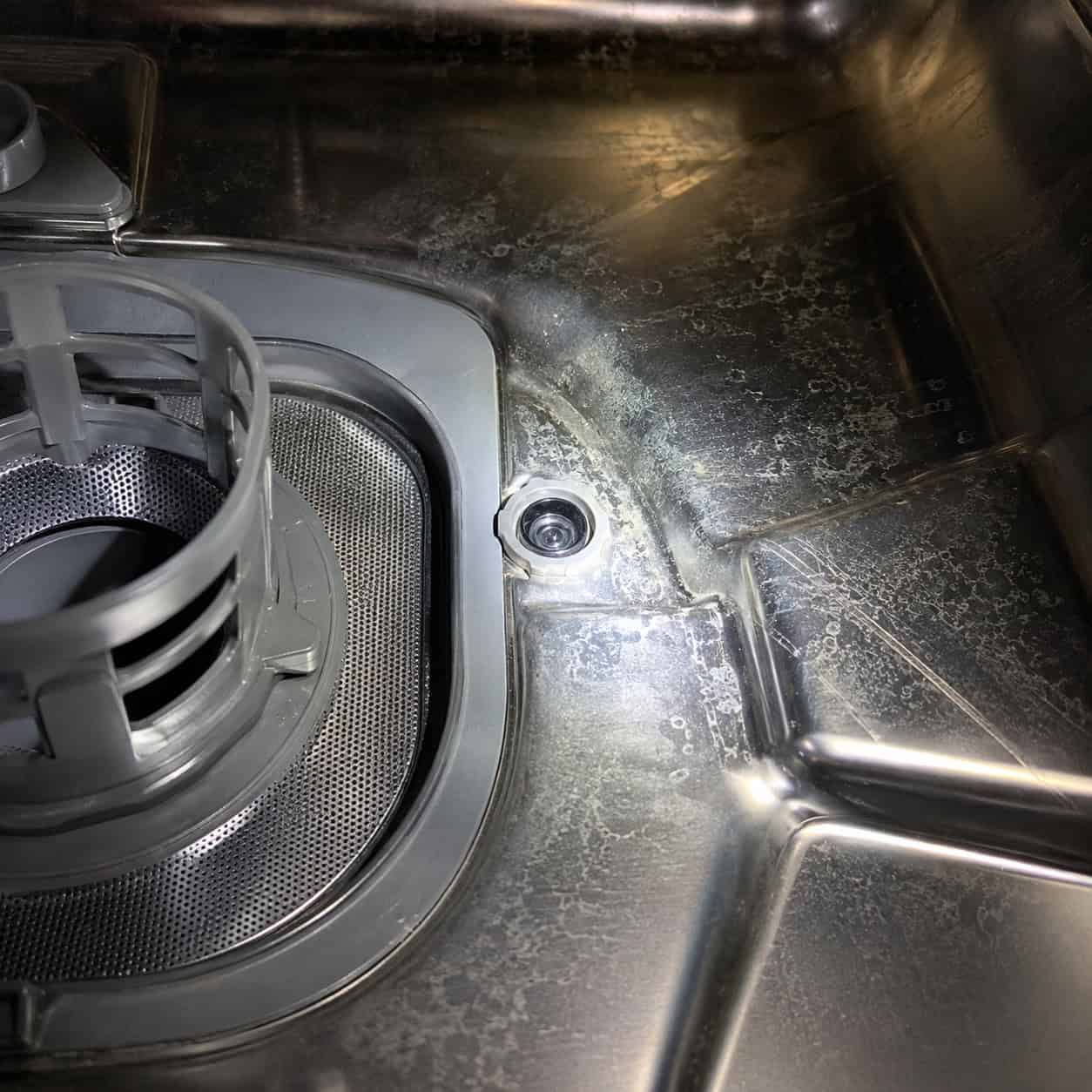
The “auto” cycle isn’t guessing. A small optical sensor shines light through the wash water and measures how much of it gets through.
Cloudy water means dirty dishes, so the machine extends the cycle. Clear water means it can wrap up early. Clever, until the sensor lens fogs.
Hard-water scale and detergent film build a haze on that lens over a few years. Now every load reads as filthy and runs four hours, or — depending on how it drifts — reads clean and does a rinse-and-done that leaves everything crusted.
Owners think the dishwasher is failing. It’s a lens the size of a pencil eraser, and running a citric acid cleaner through it regularly keeps it honest.
23. The Auto-Fill Water Pitcher Inside the Refrigerator

A powered water line, routed into the fresh-food compartment, feeding a removable plastic jug that sits on a shelf.
Read that again slowly. There is now plumbing inside the cold, sealed, food-storage box.
The valve that fills the pitcher is the same style of solenoid used everywhere else in the fridge, and solenoids weep. A weeping valve in a dispenser housing drips into a drain pan. A weeping valve above a shelf drips onto the shelf.
Overfills are the more common call. The fill sensor gets fooled by a pitcher seated slightly off its cradle, the valve stays open, and water sheets across a glass shelf and down into the crisper drawers.
Then comes the part owners don’t expect. Shelves on many models are glass bonded into a plastic or composite frame, and repeated soaking works into the seam. The frame swells, the shelf bows, and a replacement shelf on a premium French-door runs well over a hundred dollars.
Water pooling in the bottom of a crisper doesn’t evaporate in a 37°F box either. It sits, and mold follows it into the drawer channel and the door gasket.
Pull the pitcher out and inspect the cradle every few months. Or use a hand and a faucet, which solved this problem several thousand years ago.
24. The Mini Pedestal Washer Under the Main Washer

Around 2015, both LG and Samsung sold the idea of a small second washer built into the pedestal drawer beneath the main machine. Wash delicates separately, run two loads at once.
What went into that drawer: a second water inlet, a second pump, a second motor and a second control board — in the space that used to hold detergent bottles.
Both brands quietly retreated from the concept. That leaves owners of a machine nobody builds anymore hunting parts on the secondary market, which is exactly the position no appliance owner wants to be in.
25. The Warming Drawer

Every tech has the same line about this one. Open a warming drawer on a service call and you’ll find cookie sheets.
Inside the cabinetry, though, is a heating element, a thermostat, a moisture vent and its own wiring. Components that sit idle 51 weeks a year and get discovered dead the one week you’re hosting.
Idle heating elements corrode. Thermostats drift out of calibration when nothing exercises them.
It’s a $400 line item on a range that stores baking pans.
26. The Sealed LED Light Panel You Can’t Replace

Refrigerator bulbs used to twist out. Four dollars at the hardware store, thirty seconds, done.
Now it’s a bonded LED board with an integrated driver, sealed behind a diffuser panel, held in with tabs that break when you pry them. It’s a part number and often a service call.
And LEDs generate heat at the driver. Techs occasionally find boards that have cooked themselves against the plastic liner, leaving a scorched brown patch inside the fresh-food compartment — an actual burn mark, from a light.
The lighting is beautiful. It’s just not a consumable anymore, which is what a light bulb is supposed to be.
27. Automatic Load Sensing That Decides How Much Water You Get

Federal efficiency standards pushed high-efficiency washers into the mainstream after 2007, and the fill dial disappeared with them.
What replaced it: a pressure switch reading water level through a thin air dome hose, plus an algorithm weighing the load by how hard the motor works to turn it.
The air dome hose is the weak link. Lint, detergent sludge and mineral scale clog it, so the switch reads a level that isn’t there. The machine either under-fills to a damp trickle that never rinses the soap out, or overfills and floods.
Owners report this and get told it’s normal for HE. Sometimes it is. Often it’s a $4 hose that needs to come off and get flushed.
28. The Coffee Maker Built Into the Refrigerator Door

GE introduced this on a Café French-door model in 2016: a single-serve brewer, plumbed into the refrigerator’s own water line and running through the same filter.
It brews a fine cup. It also means the brew head, the heater, the pump and the pod mechanism now live inside a 300-pound appliance bolted into a cabinet run.
When a countertop brewer dies you carry it to the curb. When this one dies, a technician is standing in your kitchen servicing a coffee machine that can’t be moved.
Every failure point that could have been a separate $90 device is instead welded to your fridge’s fate. That’s the whole genre in one appliance.
29. The Linear Compressor With the 10-Year Warranty

This is the one that stings, because it’s the part sold to you as the reason to trust the machine.
Traditional compressors use a crankshaft to convert rotation into piston motion. Linear compressors skip that — the piston is driven back and forth directly by a magnetic field, with fewer moving parts and better efficiency. On paper, a genuine improvement. LG built its refrigerator marketing around it starting around 2014, backed by a 10-year warranty on the compressor itself.
Then the failures started arriving in numbers, and many arrived well inside that ten years — sometimes inside three.
LG has faced multiple class actions and settlements over early linear compressor failures. But the lawsuits aren’t the part that ruins a homeowner’s week.
Read the warranty language. It typically covers the part. Labor is usually the owner’s problem after the first year, and sealed-system labor is the most expensive work in the trade — recovering refrigerant, cutting into the sealed loop, brazing in a new compressor, pulling a vacuum, recharging by weight. That’s a certified job, several hours, and it can run $600 to $1,200 depending on the market.
Then add the fridge full of food that thawed overnight before anyone noticed the compartment was at 50°F.
Then add the wait. Compressor availability comes and goes, and techs routinely tell owners it’ll be a week or three, with a cooler in the garage in the meantime.
Plenty of owners do the math and buy a new refrigerator with eight years of free-part warranty still on paper. That’s the trap: a warranty long enough to sell the machine, structured so it doesn’t cover the expensive half of the repair.
Consumer Reports’ brand reliability rankings are worth reading before you sign anything — and so is the fine print on what “10-year warranty” actually pays for.
30. Adaptive Defrost Control

Old refrigerators ran a mechanical defrost timer that clicked into a defrost cycle every eight hours whether the coils needed it or not. Adaptive defrost watches door openings, compressor runtime and evaporator temperature, then defrosts only when the frost load calls for it.
Techs replace these boards constantly, and a bad one gives you a fully frosted evaporator and a fridge slowly warming up while the freezer looks fine.
But this one earns its spot on the machine. Fewer defrost cycles means less energy burned and less thermal cycling on the whole cabinet.
Sometimes the added complexity actually buys something. It’s a short list.
31. The Water Reservoir on a Steam Oven

Premium wall ovens started carrying steam functions in the 2010s, fed by a small refillable reservoir behind a door panel.
Fill it with tap water and you’re feeding mineral content into a pump and a steam generator. Scale accumulates on the heating element and inside the lines, the pump strains, and eventually one of them quits.
Most units want distilled water and a periodic descale. Most owners read that page once.
The install base is small enough that most people reading this have never used one — which is its own kind of comment on the feature.
Here’s the short version of what techs actually recommend when you ask what to buy:
| What Techs Own | What Techs Service | |
|---|---|---|
| Range controls | Mechanical knobs | Glass touch panels |
| Dishwasher panel | Front-mounted buttons | Hidden top-control strip |
| Refrigerator door | Solid, no dispenser | Screen, ice, coffee |
| Washer type | Simple top-load | All-in-one combo |
| Oven cleaning | Baking soda and a blade | Self-clean cycle |
The pattern isn’t anti-technology. It’s that every feature added to an appliance is another part that can strand you, and the ones on the right side of that table strand people most.
Buy the boring machine. Then treat the parts that do wear — the boot, the filter, the water line behind the fridge — as maintenance instead of surprises.
The best appliance in your house is the one you never think about, and that’s exactly why nobody puts it in an ad.
Brilliant article and accurate! I am an Engineer and have practiced this for years. Especially top loader washers that are mostly mechanical with not micro-processers, sensors and PC Boards. Hence Speed Queen is best. And if you like front loaders because they use less water, you can save by just being efficient by only running full loads.