
The kitchen aisle at a thrift store is where good stuff goes to hide. Chipped, tarnished, dusty, priced by a volunteer who had forty bins to get through that morning.
Nobody at the drop-off window is grading cast iron logos or checking a pan for a Belgian foundry stamp. They see a heavy old skillet and write $8 on masking tape.
That gap between what something looks like and what it is? That’s the whole game.
Some of these finds are worth $30 on a good day. A few hit four figures. Most of them are sitting on a shelf right now looking like junk.
Here are 35 kitchen items you should never breeze past.
1. Griswold and Wagner Cast Iron Skillets

Start with the ugliest pan on the shelf. Rust comes off with steel wool and a vinegar soak — a mirror-smooth machined cooking surface can’t be added later.
Griswold made cookware in Erie, Pennsylvania from 1865 until 1957. Wagner ran from 1891 into the 1950s. Both milled their pans glass-smooth, which is why a 70-year-old skillet outcooks a new one straight out of the box.
Flip it over. You want a maker’s name, a size number, and ideally the big block Griswold logo in a cross. Odd sizes and early logo variants carry premiums, and the Griswold #13 is the one collectors genuinely hunt — House Digest has covered examples trading well into four figures.
Skip anything with a visible crack or a wobble when you set it on a flat surface. Everything else is fixable.
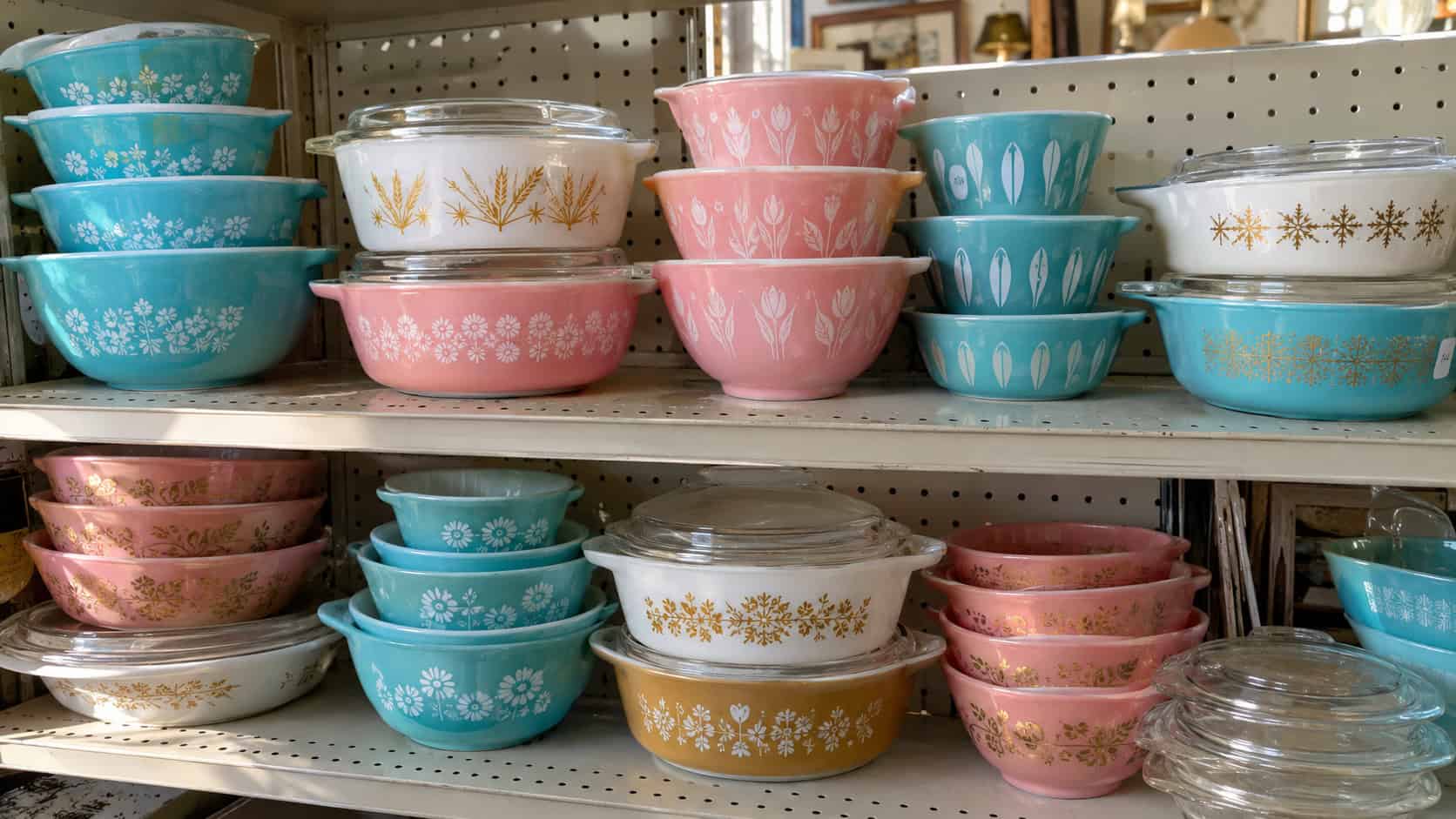
2. Patterned Pyrex Mixing Bowls and Casseroles

Your grandmother had the nesting set. Yellow, green, red, blue, stacked in that order, probably with a chip on the yellow one.
Corning started printing patterns on opal-ware Pyrex in 1945 and kept going into the late ’70s. The glass itself isn’t rare. The pattern decides everything.
Common turquoise Butterprint moves for modest money. Pink Amish Butterprint, Atomic Eyes, and the promotional Lucky in Love pattern climb into the hundreds and sometimes thousands. The Corning Museum of Glass keeps a reference on production history if you want to date a piece properly.
Grab lids, too. A matching clear lid for a Cinderella casserole sells on its own, and thrift stores separate them constantly.
Now the part nobody mentions at the checkout. That decorative exterior paint on mid-century Pyrex was often applied with lead-based enamel, and worn or scratched painted surfaces can test positive. The interior glass is inert and always has been — it’s the painted outside that matters.
Practical approach: use the plain clear Pyrex, display the painted pieces. Don’t eat directly off a chipped painted exterior, don’t run patterned bowls through a dishwasher that’ll strip the print anyway, and if you want certainty, a $10 lead swab kit settles it in thirty seconds.
Quick pass before you buy:
- Hold it up to the light and check for hairlines radiating from the rim
- Run a thumbnail over the pattern — flaking paint kills resale
- Look for the Pyrex backstamp, not just the shape
- Check the base for dishwasher haze, which never comes back
3. Hobart-Built KitchenAid Stand Mixers

Heavy. Beige. Tagged $20 because it looks like an old appliance.
Hobart owned KitchenAid from 1919 until 1986, and the mixers built in that window are all-metal, gear-driven machines with no plastic in the drive train. Model K, K5-A, 3-C — these outlast anything on a showroom floor today.
Plug it in before you commit if the store lets you. If the head rocks on the hinge, it’s usually just a worn pin.
The buyers aren’t only collectors. Working bakers hunt these down specifically.
4. Fire-King Jadeite Restaurant Ware

Milky opaque green glass, heavy in the hand, usually mixed in with the coffee mugs. Anchor Hocking made Fire-King jadeite from 1945 to 1976 and Martha Stewart turned it into a collecting obsession in the ’90s.
Restaurant Ware is the thick diner line — that’s the one with real money behind it. Thinner household jadeite is nice but far more common.
Check the base for the Fire-King backstamp. Reproduction jadeite floods the market now, and the new stuff is lighter, greener, and glossier than the original’s soft chalky finish.
Vintage Virtue has a decent beginner’s rundown of the marks if you want to study before you shop.
5. Sterling Silver Flatware in the Loose Utensil Bin

This is the best return-per-dollar find in the building, and it’s sitting in a bin priced at a quarter apiece.
Sterling has a floor. Even a bent, monogrammed, pattern-orphan spoon is worth its melt value, which means you basically can’t lose money.
The test takes one second. Look at the back of the handle for STERLING or 925. Plate will say EPNS, A1, or a brand name with no purity mark.
Sorters can’t tell the difference by eye. Tarnished sterling looks exactly as sad as tarnished plate.
6. Le Creuset and Descoware Enameled Dutch Ovens

Le Creuset has been pouring enameled cast iron in France since 1925, and even a chipped Flame orange piece resells strongly because people want the color.
The sleeper is Descoware. Belgian enameled iron, the brand Julia Child actually cooked on, bought out by Le Creuset in the ’70s and discontinued.
Flip the pot. “Made in France” or “Made in Belgium” cast into the underside is your signal.
Interior chips drop value but don’t eliminate it. Exterior chips barely matter to a cook.
7. Vintage Tupperware in Discontinued Colors

Nostalgia that actually pays, as long as you’re picky.
A lone avocado tub is worth nothing. Complete sets are the money — Servalier canister sets with all the seals, Jel-N-Serve molds, the Millionaire line, intact picnic sets with the original carrier.
Those regularly clear $100 according to FinanceBuzz, and the company folding only made the vintage stuff scarcer.
Count pieces before you buy. One missing lid turns a set back into a tub.
8. Early CorningWare With Sloped Sides

Here’s the distinction that matters more than any pattern: real Pyroceram is a white glass-ceramic you can set directly on a burner. The modern stoneware sold under the CorningWare name is not the same material and never will be.
Blue Cornflower launched in 1958 and ran until 1998. Those sloped-side casseroles are everywhere and worth very little on their own.
Wildflower, Black Starburst, Floral Bouquet — different story. Those climb into the hundreds for complete pieces with lids.
Check the bottom for the Pyroceram marking and the straight-up-and-down handle tabs that the old molds used.
9. Heavy French Copper Cookware

Weight tells you everything before you ever look for a stamp.
Pre-war French copper runs 2 to 3mm thick. Pick it up and it feels wrong — almost comically heavy for its size. Decorative copper from a gift shop feels like a tin can by comparison.
Look for Mauviel, E. Dehillerin, or Gaillard stamped into the side wall. A tarnished $6 saucier with the right mark is a $300 pan to the right buyer, even needing retinning.
Worn tin inside isn’t a dealbreaker. It’s a service, not a death sentence.
10. Blue Ball Mason Jars and Oddball Canning Glass

Everyone walks past the jar shelf. It looks like jars.
Aqua-colored Ball Perfect Mason jars were made roughly 1900 to the early 1930s, and the color came from iron impurities in the sand. That blue-green glow is the giveaway.
Pull out anything amber, anything true cobalt, anything with a zinc lid and an intact milk glass insert. Error jars — the famous upside-down Ball logo among them — are the real lottery tickets.
Hold each one up to a window. Chips in the rim and bruises in the shoulder cut value hard.
11. Cathrineholm Lotus Enamelware

White teardrop petals on orange, turquoise, or red. If you’ve seen one, you never forget the shape.
Norwegian, made roughly 1960 to 1972, designed by Grete Prytz Kittelsen. Mid-century buyers recognize these instantly and thrift stores almost never price them right.
Flip for the Cathrineholm Norway backstamp. A graduated nesting set of four is the jackpot.
Surface scratches in the enamel are expected. Rust spots where the enamel chipped through are not.
12. Hand-Crank Cast Iron Kitchen Gadgets

Apple peelers, cherry pitters, nutmeg graters, Enterprise coffee mills. All of it gets dumped in the junk bin as scrap metal.
These ran from the 1870s through the 1930s and were built with the same over-engineering as the farm equipment of the era. Cranks that still turn, screws that still thread, clamps that still grab a table edge.
Turn the handle before you buy. Frozen mechanisms sell for a fraction of working ones.
Collectors want them, farmhouse decorators want them, and the overlap keeps prices up.
13. Old Cookbooks, Especially the Spiral-Bound Church Ones

A first-edition Mastering the Art of French Cooking from 1961 carries serious money. So do early Betty Crocker Picture Cookbooks with the red plaid binder.
But the sleeper is the church fundraiser cookbook. Tiny print runs, usually a few hundred copies, specific to one town in one decade.
Local history collectors pay for those. Handwritten notes in the margins add value instead of subtracting it.
Check the copyright page, not the cover.
14. Dansk Kobenstyle Enameled Steel

Thin bright enameled steel, flat handles, and a lid that flips over to become a trivet. Jens Quistgaard designed it in 1956 and the silhouette hasn’t been mistaken for anything else since.
Early pieces stamped “Dansk Designs France” or “Dansk Designs Denmark” are worth considerably more than the later Thailand-made production.
Read the bottom. That one line of text is most of the value.
15. Uranium Glass and Depression Glass

Bring a cheap UV flashlight. It’s the best $9 you’ll spend on this hobby.
Uranium glass — made from the 1880s until supplies were diverted around 1943 — glows a loud electric green under blacklight. In daylight it’s a pale yellow-green that reads as ordinary old glassware, which is exactly why it sits in the $2 aisle untouched.
Sweep the light across the glass shelf and the ones that light up find themselves.
About the radiation question, since it’s the first thing everybody asks. The uranium content in vase and tumbler glass is low, it’s bound into the glass matrix rather than loose, and handling and display are generally considered low-risk. A Geiger counter will click near it, which is unsettling the first time you hear it.
Reasonable precautions: don’t store acidic food or drinks in it for long stretches, don’t display a large collection in a tight sleeping space, and wash your hands after handling pieces with crazed or damaged surfaces. If you want real numbers instead of internet arguing, a hardware-store radon-style detector or a borrowed Geiger counter gives you an actual reading. Most people land on display-only and stop worrying about it.
Pink and green Depression glass rides along in the same aisle. Named patterns — Cherry Blossom, Mayfair, American Sweetheart — are worth looking up on your phone before you walk away.
16. Carbon Steel Sabatier and Other Forged Chef’s Knives

Dark, stained, slightly rusted blades look ruined to a donation sorter. To anyone who cooks, that patina is the point.
French carbon steel peaked before 1970, and a forged Sabatier takes an edge that modern stainless simply won’t hold. Look for the four-star elephant mark, the K Sabatier stamp, early Henckels twins, or kanji on a laminated Japanese blade.
Check that the blade still has width left. Over-sharpened knives get narrow and lose their geometry forever.
Everything else — rust, a loose handle rivet, a dull edge — is an afternoon of work.
17. Vintage Nordic Ware Cast Aluminum Bundt Pans

Nordic Ware launched the Bundt in 1950 and it became the best-selling cake pan in America by the mid-’60s.
The old ones are seamless cast aluminum, thick and heavy, and they bake nothing like today’s thin nonstick. Browning is even, release is cleaner, edges come out sharp.
Discontinued shapes do the real work. The Rose, the cathedral mold, the castle — bakers chase those as hard as collectors do.
Skip any pan with deep scratches through an old nonstick coating.
18. Red Wing and Salt-Glazed Stoneware Crocks

Thrift stores shelve these as umbrella stands. Which, honestly, is a fine use for a cracked one.
Made from the 1860s through the 1940s, the value comes down to three things: size, a legible maker’s stamp like the Red Wing wing or oval, and hand-painted cobalt decoration. A cobalt bee sting or a flower blows past plain stamped crocks every time.
Now the ping test. Hold the crock by the rim with one hand so it hangs free, and flick the side with a fingernail. A clear ring means it’s sound. A dull thud means there’s a hairline crack somewhere, and that guts the value.
Do this before you get excited about the stamp.
19. Modern Premium Appliances on the Small-Electrics Shelf

This is the one you can act on this weekend.
Vitamix, Breville, Cuisinart, and current-generation KitchenAid machines land on thrift shelves at $15 all the time, usually because a jar, a blade assembly, or a lid is missing and the store can’t test it.
The motor base is the expensive half. Replacement jars and blade assemblies are cheap and available direct from the manufacturer.
A Vitamix base alone is worth multiples of any thrift price it’ll ever carry. Check the wattage plate on the bottom and look up the model number right there in the aisle.
20. Vintage Fiesta by Homer Laughlin

Original Fiesta ran from 1936 to 1973. The 1986 relaunch uses the same name and similar colors, so you need to know the tells.
Vintage pieces feel heavier and slightly chalkier, with a dry unglazed foot ring on the bottom. New Fiesta is fully glazed underneath and lighter in the hand. The old colors are softer — that original turquoise is muted next to the modern one.
Medium green, produced only from 1959 to 1969, is the rarest standard color and the one that makes collectors stop walking.
Then there’s the red. Homer Laughlin’s original Fiesta Red glaze used uranium oxide to get that deep orange-red, and production was suspended in 1943 when the government took control of uranium supplies. It returned in 1959 with depleted uranium and ran into the early ’70s.
So what does that mean for your kitchen? A Geiger counter held against a red Fiesta plate will absolutely register. Dose from sitting on a shelf is minimal. The sharper concern with any vintage glaze — red or not — is lead, which older ceramic glazes commonly contained and which can leach when acidic food sits against a worn or crazed surface.
Sensible middle ground: display the vintage pieces, eat off the reproductions. If you want to use a piece daily, swab it with a lead test kit first and skip anything with crazing, chips, or a worn interior. Don’t put vintage Fiesta in the microwave or dishwasher regardless.
None of this hurts the value. Collectors have known about the red glaze for decades and it’s part of why people want it.
21. Danish Teak Serving Pieces and Turned Wood Bowls

Gray, dry, and lifeless on the shelf. Tagged “wooden bowl, $3.”
Oil-starved teak looks dead and comes back entirely with one wipe of mineral oil. Watch the grain reappear — it’s the most satisfying thirty seconds in thrifting.
Look for Dansk teak ice buckets, Digsmed trays with the removable glass inserts, Quistgaard pepper mills, and hand-turned burl bowls with a signature on the underside.
Cracks that run through the rim are fatal. Surface checking isn’t.
22. Hall China Teapots and Autumn Leaf Dinnerware

Hall made teapots in East Liverpool, Ohio with Art Deco shapes nobody has matched since. The Automobile, the Airflow, the Basketball — those names describe exactly what they look like.
In gold-decorated colors, the rare shapes have cleared four figures. And they’re sitting among the dollar teapots because they just look like old teapots.
Autumn Leaf is the gateway. The Jewel Tea man gave it away door to door starting in 1933, so there’s a lot of it — but it still moves steadily and some serving pieces are genuinely scarce.
Check the gold trim. Dishwasher-worn gold cuts value in half.
23. Chemex and Other Glass Coffee Relics

Peter Schlumbohm designed the Chemex in 1941 and it sits in MoMA’s permanent collection. It also turns up in the glassware aisle for two dollars on a regular basis.
Originals with the wood collar and leather tie are what you want. Early ones carry the Chemex etching and sometimes a patent number.
Cory vacuum pots with intact glass rods and chrome percolators from the same era move fast too.
Hold it to the light and look for a chip at the pour spout — that’s where they always go.
24. Bakelite-Handled Utensils and Flatware

Cherry red, butterscotch, marbled green. Cake servers, cocktail forks, nut choppers, the whole 1920s-to-1940s drawer.
Bakelite feels heavy and warm compared to modern plastic, and it clicks rather than clacks when two pieces tap together.
The hot-water test settles arguments. Run the handle under hot tap water for twenty seconds, then smell it. Bakelite gives off a faint formaldehyde or burnt-horn smell. Modern plastic smells like nothing.
Fakes don’t pass that.
25. Speckled Graniteware and Early Enamelware

Chipped blue speckled coffee pots read as camping junk, and most of them are.
The early stuff — 1870s through the 1930s — is noticeably heavier, with a thicker enamel coat and seams that were rolled rather than spot-welded. Uncommon colors are where the money hides: cobalt swirl, chrysolite green, true red, and the chicken-wire and end-of-day patterns.
Gray speckle is the beige of graniteware. Common everywhere.
Anything swirled, anything with contrasting trim, pick it up.
26. All-Clad and Heavy Tri-Ply Stainless

Discolored stainless looks burnt and gets donated by people who think it’s ruined.
It isn’t. Tri-ply and copper-core pans are bonded for life — the layers are metallurgically fused and can’t separate. Discoloration is surface only, and Bar Keepers Friend erases it in about four minutes.
All-Clad holds roughly half its retail price on the resale market indefinitely, which makes a $12 thrift skillet an easy call.
Check the handle rivets and the bottom stamp. Warped bases that rock on a flat counter are the only real dealbreaker.
27. Signed Studio Pottery

The most consistently underpriced object in any thrift store is a handmade mug with an incised signature on the foot.
There’s no brand to Google at the shelf. No logo, no model number, just initials or a chop mark pressed into wet clay forty years ago.
So buy it and research later. A dollar is nothing, and some of those marks belong to potters whose work sells in galleries.
Photograph the bottom in good light before you even leave the parking lot.
28. Designer Housewares With Famous Names

Postmodern design is in an aggressive resale upswing right now, and the clutter shelf is full of it.
The Michael Graves Alessi kettle with the little bird whistle. Bodum press pots in the original colors. Georg Jensen serving pieces. First-generation OXO Good Grips with the thick oval handles.
These all look like ordinary kitchen stuff to a sorter because they are ordinary kitchen stuff — designed by people whose names are in museum collections.
Check the base for a designer credit alongside the brand.
29. Mid-Century Barware and Gilded Cocktail Glasses

The cocktail revival never really ended, and complete vintage barware sets are getting harder to find every year.
Culver made 22k gold-decorated glasses — the Valencia pattern is the famous one — and that gold is hand-wash-only. Which means almost every set that went through a dishwasher is gone.
Intact full sets of six or eight are genuinely scarce. Chrome Art Deco shakers and complete decanter-and-glass sets move just as well.
Hold a glass up and look for thin spots where the gold has worn through. One faded glass drops the whole set.
30. Discontinued Dinnerware Patterns

Somewhere right now, a person is trying to replace one broken plate from their mother’s set.
That’s the entire market. Franciscan Desert Rose, Blue Willow, Noritake patterns, the old Pfaltzgraff lines — all of them have a standing replacement demand from people rebuilding a family set piece by piece.
A single plate in the right pattern beats an entire mismatched box. Snap a photo of the backstamp and look it up on a replacement service to see what it actually fetches.
Serving pieces and lids outperform dinner plates nearly every time.
31. Early Advertising Tins and Kitchen Canisters

Lithographed coffee, spice, and baking powder tins from the 1890s to the 1940s get bought as graphic design as much as antiques. That’s why the prices hold.
Bright unfaded lithography and an intact original lid are what separate the $4 tin from the $400 one. Rust through the graphics kills it.
Store brands and regional grocers tend to be scarcer than the national names everybody recognizes.
Look at the side seams — rolled and soldered seams date earlier than crimped ones.
32. Figural Cookie Jars by McCoy, Shawnee and Brush

This is the one that stops people cold in the aisle. The jar that sat on grandma’s counter, the one you weren’t supposed to open before dinner.
McCoy, Shawnee, and Brush produced figural jars from the 1930s into the ’60s, and reproductions flooded the market hard in the ’90s. So you need the tells.
Originals have crisper mold detail — ears, whiskers, and fingers are sharply defined instead of soft and blobby. The bottom mark should be clean and correctly spelled, since fakes routinely get the mark subtly wrong. And genuine age crazing runs in a fine irregular web through the glaze that reproductions can’t convincingly fake.
Weight helps too. The old jars feel substantial.
33. Longaberger Baskets

Here’s one to walk past on purpose.
Longaberger baskets were a 1990s phenomenon with waiting lists and secondary markets and genuine collector mania. Then the company folded in 2018 and the floor dropped out.
Most baskets now sell for under $20 regardless of what somebody’s aunt paid in 1997. A few rare signed or limited editions hold value, but the odds aren’t with you.
Skip these. Put the energy into the cast iron shelf instead.
34. Glasbake, Hazel-Atlas and Federal Glass Mixing Bowls

Pyrex gets all the attention, which leaves room on the other side of the shelf.
Glasbake, Hazel-Atlas, and Federal Glass made their own patterned ovenware and mixing bowls through the ’30s, ’40s, and ’50s. The splatter-pattern and polka-dot nesting sets carry real money, and the Glasbake Currier & Ives line has its own following.
Check the base — each brand used a distinct mark, and Hazel-Atlas’s H-over-A is easy to spot once you know it.
Same lead-paint caution as patterned Pyrex applies to decorated exteriors here.
35. Chrome Art Deco Small Appliances (Sunbeam Mixmaster, Osterizer)

Mirror chrome, bakelite knobs, and a shape that looks like it belongs on a streamliner train.
Sunbeam Mixmasters and early Osterizer blenders from the 1930s through the ’50s are beautiful objects that also happen to work. The chrome polishes up with a soft cloth and some metal polish, and the motors were built to be rebuilt.
Original glass jars and matching mixing bowls multiply the value. Loose bases are worth far less.
Frayed cloth cord is normal and replaceable. Don’t plug one in to test it until that cord’s been checked.
And that’s the thing about thrift store kitchens — the stuff worth real money almost never announces itself.
Learn four or five tells and you’ll start seeing them everywhere. The dry foot ring. The 925 stamp. The weight of a copper pan that shouldn’t be that heavy.
Worst case, you spent six dollars and got a nice skillet out of it. If you want to keep the hunt going, there’s a good chance some of the same treasures are already sitting in your own family’s cupboards.
Go look at the ugly shelf first. That’s where everything good is hiding.