

The power came back at 2 a.m. You slept through it. Now it’s morning and you’re standing in front of a fridge that hummed back to life at some unknown hour, holding a gallon of milk and doing math you can’t actually do.
Guessing is the expensive part. Not the groceries.
Federal guidance is tighter than most people think: an unopened refrigerator holds safe temperature for about four hours. A full freezer gets roughly 48. After that, the line between “fine” and “food poisoning” stops being visible, and smell stops being evidence.
Some of what follows will annoy you. A block of cheddar survives but the shredded cheddar next to it doesn’t. Ketchup stays, spaghetti sauce goes. Pizza is a discard, every topping, no debate.
Here’s what to throw out, what to keep, and how to stop the whole thing from happening again.
1. A Portable Power Station Sized for the Compressor, Not the Sticker

Start here, because everything else on this list is damage control.
The number most people shop by is wrong. A typical kitchen refrigerator cruises at 100 to 250 running watts, which makes it look like almost any battery can carry it. But every time the compressor kicks on, it pulls a surge two to four times that — often 600 to 1,200 watts for a second or two. Undersized units see that spike, trip their inverter, and shut off. You come home to a dead power station and spoiled food anyway.
Size for the surge. That’s the whole trick.
The Pecron F3000LFP is built for exactly this gap: 3,600W of output with 3,072Wh of LiFePO4 capacity. The output rating swallows compressor startup without flinching, and the capacity is where the math gets fun.

⭐ Full Disclosure: I Own This One
I have this exact unit at home, and it’s a big part of why I’m comfortable writing this list. It has never blinked at a compressor start, it makes no noise, and it lives indoors where a generator never could. Of everything on this page, it’s the one product I’d tell a friend to buy without thinking twice.
Affiliate link. We earn a small commission if you buy through it, and the price you pay is the same.
A standard 18-cubic-foot fridge uses somewhere around 1 to 2 kWh per day in real-world conditions, and less than that during an outage when you’re not opening the door every ten minutes. Call it 1.5 kWh. That’s roughly two days of continuous refrigeration from a single full charge — and that’s before you add a solar panel, which can stretch it indefinitely through a multi-day event. PowerOutage.us runs similar numbers on fridge runtime.
The chemistry matters too. LiFePO4 cells rate around 3,000 to 6,000 charge cycles versus roughly 500 for older lithium-ion, and they’re dramatically more thermally stable. That means a unit you can leave plugged in and topped off in a hallway closet for three years and trust when the lights go.
And it runs indoors. No exhaust, no fuel, no carbon monoxide, no extension cord snaking through a cracked window. You plug the fridge into it in the kitchen and go back to bed.
Skip the 1,000W bargain units if a refrigerator is the whole point of the purchase. They’ll start the fridge on a good day and fail on a hot one.
2. Raw and Cooked Meat, Poultry, and Seafood

Four hours. That’s the number, and it’s the rule the rest of this list hangs on.
Once an unopened fridge has been dark longer than that, USDA FSIS puts raw and cooked meat, poultry, fish, shellfish and soy meat substitutes in the discard column. No inspection, no sniff test.
Cooking it afterward doesn’t save it. Some bacteria produce heat-stable toxins that survive a 165°F internal temperature and a rolling boil — you kill the organism and eat the poison it already made.
Thirty dollars of chicken thighs is not worth the argument.
3. Milk, Cream, Sour Cream, and Yogurt

Milk, half-and-half, buttermilk, evaporated milk, sour cream, yogurt, eggnog, soy milk. All discards after two hours above 40°F.
“It still smells fine” is the exact trap federal guidance keeps warning about. Dairy spoilage organisms and dairy pathogens are different bugs. The ones that make it stink are often not the ones that make you sick.
Pour it out.
4. The Door You Keep Opening

Most outage food loss is self-inflicted, and this is how.
The federal timelines assume a closed door. Four hours for the refrigerator. About 48 hours for a full freezer, 24 for one that’s half empty. Every peek to “check on things” dumps the cold air out the bottom and replaces it with room-temperature air.
Decide what you need before you open it. Grab it in one trip.
The CDC is blunt about this one because it’s the single easiest thing a homeowner controls.
5. Eggs, Egg Dishes, and Hard-Boiled Eggs in the Shell

The shell is not armor.
Raw eggs, egg dishes, custards and puddings all go after two hours above 40°F. And hard-boiled eggs are worse, not better — boiling strips the natural cuticle that seals the shell’s pores, which is why hard-cooked eggs are actually more perishable than raw ones.
Those Easter eggs in the door? Gone.
6. Hard Cheese, Butter, and Grated Parmesan

Finally, some good news.
Cheddar, Colby, Swiss, provolone, Romano, processed cheese slices, shelf-stable grated parmesan, butter and margarine are all listed Safe on the federal chart. Low moisture and high salt do the preserving — there’s simply not enough free water in a block of aged cheddar for bacteria to work with.
It might sweat a little oil. That’s texture, not safety.
7. Lunchmeat, Hot Dogs, Bacon, and Sausage

Cured used to mean shelf-stable. It hasn’t for decades.
Modern deli meat, hot dogs, bacon, sausage and dried beef are formulated with far less salt and nitrite than their 1940s ancestors, and they’re built on the assumption of continuous refrigeration. Every one is a discard past four hours.
Listeria is the specific worry. It multiplies at temperatures where most other bacteria stall — a fridge drifting up into the 40s is comfortable for it.
8. An Appliance Thermometer (and the Frozen-Quarter Trick)

Twelve dollars ends every argument in this article.
Put a standalone appliance thermometer in the fridge and a second one in the freezer. You want 40°F or below in the refrigerator and 0°F or below in the freezer. The built-in digital display on the door is reporting the sensor’s location, not your milk’s temperature, and on a lot of units it’s off by several degrees.
When power returns, you read a number instead of guessing an hour.
Then there’s the trick that solves the harder problem — knowing what happened while you were gone. Freeze a cup of water solid. Set a quarter on top of the ice. Leave it in the freezer.
Come home and look at the coin. Still on the surface, the freezer held. Sitting halfway down, it partially thawed and refroze — suspect anything delicate. Sitting on the bottom of the cup, everything in that freezer thawed completely and you’re making decisions with the ice-crystal rule in entry 22.
The FDA recommends both the thermometers and the frozen-water test. Set it up this weekend, not during the next storm warning.
9. Leftovers, Casseroles, Soups, and Stews

The chili you made Tuesday is a discard. So is the lasagna, the chicken soup, the stuffed peppers.
Cooked, mixed, moisture-heavy food is close to a laboratory growth medium — protein, water, neutral pH, no competing organisms left after cooking killed them off.
Reheating to a boil doesn’t undo it. Preformed toxins don’t care how hot your stockpot gets.
10. Soft, Shredded, and Low-Fat Cheeses

Here’s where the cheese rule flips on you.
Blue, Brie, Camembert, cottage, cream cheese, mozzarella, ricotta, Muenster and queso fresco are all discards. So are shredded cheeses and low-fat cheeses — including shredded cheddar, even though the block of cheddar right beside it is perfectly fine.
Surface area is the reason. Shredding multiplies exposed surface enormously, and the anti-caking starch holds moisture against every strand. Low-fat versions replace fat with water, which is precisely what bacteria were missing.
11. Ketchup, Mustard, Pickles, Jelly, and Peanut Butter

A whole shelf of your fridge door survives intact.
Jelly, relish, taco sauce, mustard, ketchup, olives, pickles, Worcestershire, soy sauce, barbecue sauce, hoisin, vinegar-based dressings, peanut butter. All Keep.
Acid and sugar are doing the preserving, and they keep doing it at room temperature. You may find they spoil sooner than usual over the following weeks — use them faster, but don’t bin them.
12. Tuna, Chicken, Egg, and Potato Salad

Discard on sight.
Tuna salad, chicken salad, egg salad, ham salad, macaroni salad, potato salad — every one of them. It’s the classic church-potluck profile: cooked protein, mayonnaise, heavy handling, and time sitting warm.
Two hours above 40°F and they’re done, whether you made them or bought them from the deli case.
13. Cut Fruit and Pre-Washed Bagged Greens

A whole cantaloupe on the shelf is fine. A cut cantaloupe is a discard.
Same for melon chunks, sliced strawberries, and anything in a plastic clamshell from the produce section. Cutting drags surface bacteria into the sterile flesh and hands them sugar and moisture.
Bagged pre-washed salad goes too. A whole head of romaine stays.
14. Ice Cream and Frozen Yogurt

Ice cream is your freezer’s canary.
Open the lid. If it’s soup, or if it refroze into that grainy, icy brick, the compartment got warm — and that tells you exactly what to suspect about the meat sitting next to it.
USDA guidance is flat about never refreezing melted ice cream. Don’t try to rescue it.
15. Opened Mayonnaise, Tartar Sauce, and Horseradish

Mayonnaise takes the blame for a lot of picnic food poisoning it didn’t cause.
Commercial mayo is acidified with vinegar and lemon juice, which makes it inhospitable enough that it earns a longer, warmer window than milk does. The salads it goes into are the actual hazard.
But opened jars still have a limit: held above 50°F for more than eight hours, toss them. That goes for tartar sauce, horseradish and opened creamy dressings too. Penn State Extension spells out the 50°F/8-hour threshold.
16. Frozen Water Jugs and the Igloo Method
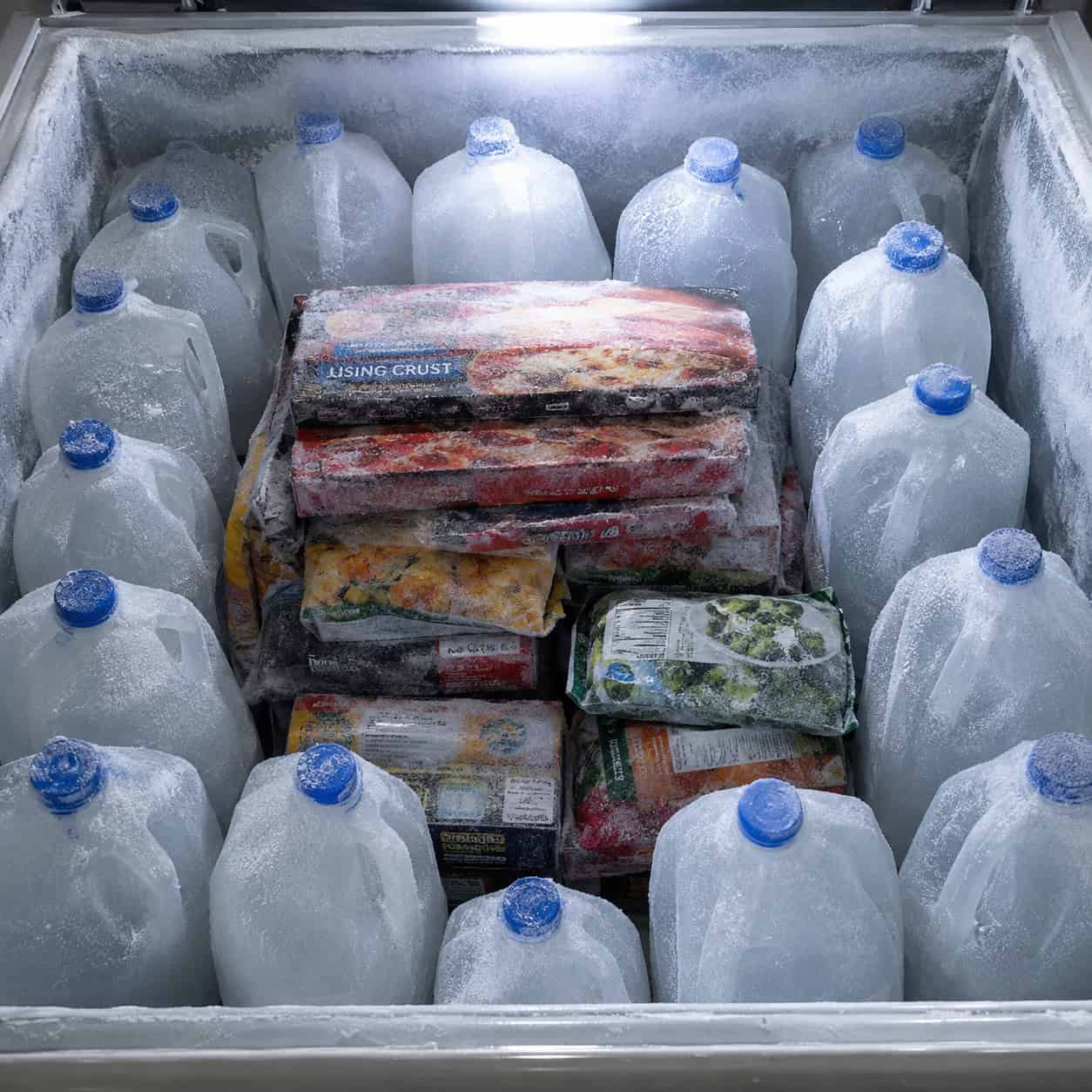
Do this before the storm. It’s useless during one.
A packed freezer holds cold roughly twice as long as a half-empty one, because frozen mass is thermal ballast. Fill the dead space with gallon jugs of water — leave headspace so they don’t split — and the freezer becomes its own ice chest.
Then group everything into one tight block in the center. Loose packages with air between them warm fast.
The jugs pay off twice. When it’s over, you’ve got drinking water.
17. Cooked Pasta, Rice, and Baked Potatoes

The sleeper hazard.
Cooked rice and pasta carry Bacillus cereus spores that survive boiling completely. As the food sits in the danger zone, those spores germinate and pump out a toxin that’s famously heat-stable — reheating your fried rice does nothing.
Baked potatoes sit on the same line. So does anything you cooked and cooled slowly in a covered container.
18. Whole Fruit, Raw Vegetables, Fresh Herbs, and Mushrooms

Breathe. Most of the produce drawer stays.
Whole fresh fruit, raw vegetables, fresh mushrooms, herbs, spices, plus raisins, dates and dried fruit all hold up. They came from a field, not a refrigerator, and their skins are still intact.
Discard only what’s turned slimy, grown mold, or smells yeasty and fermented.
19. Leftover Pizza — Any Topping

The most-argued item in American kitchens, and the federal chart doesn’t blink: pizza with any topping is a discard.
Plain cheese included. Yes, even though people have eaten counter pizza for breakfast since 1965 without incident.
The stacking is the problem — cooked dough, dairy, and cured meat are three separate risk categories on one slice, held together by a moisture-trapping layer of sauce.
20. A Cooler, Block Ice, and Dry Ice

Hour four is when you move, not hour ten.
Once the fridge hits its limit, transfer the perishables you actually care about into a cooler packed with ice and hold it at 40°F or below. Check it with a thermometer, not a hand. This single action is the difference between losing the fridge and losing the fridge and the freezer.
Block ice beats cubed ice by a wide margin — less surface area means slower melt, and it doesn’t flood the cooler in six hours. Buy it before the storm if you can, because ice is the first thing gone from every store within twenty miles of a forecast.
Dry ice is the heavy artillery. Roughly 50 pounds will hold an 18-cubic-foot freezer cold for about two days, according to USDA. Set it on cardboard on top of the food, never directly against packages, and never touch it with bare hands — it’s −109°F and causes instant tissue damage. Wear gloves, use tongs, and crack a window while it sublimates, because it’s releasing CO₂ into a closed room.
Don’t put dry ice in a sealed cooler with a gasket lid. Pressure has to go somewhere.
21. The Opened Jar of Spaghetti Sauce

Ketchup survives. Marinara doesn’t. This one catches everybody.
An opened jar of spaghetti or tomato sauce is a federal discard, because it’s a lower-acid formula thinned with oil, meat, onions and peppers. All of that drags the pH up out of the protective range and adds nutrients that ketchup simply doesn’t have.
Same jar, same tomato, different answer.
22. Thawed Freezer Meat With No Ice Crystals Left

The ice-crystal test is the most useful rule in the freezer.
Food that still holds ice crystals, or reads 40°F or below on a thermometer, can be refrozen safely. You’ll lose some texture and moisture — steaks get a little weepy, berries get mushy — but it’s safe.
Fully thawed and warmer than 40°F is a discard, and the price of the brisket doesn’t enter into it. FoodSafety.gov keeps the full chart if you want to check individual items.
Check package by package. The outer edges of a freezer thaw first.
23. Bread, Bagels, Tortillas, and Fruit Pies

People bin these for no reason every single storm.
Bread, rolls, muffins, quick breads, tortillas, waffles, pancakes, bagels and fruit pies are all fine at room temperature for several days. That’s how they were sold to you in the first place.
Look for mold, smell for anything off, and carry on.
24. Refrigerator Biscuits, Crescent Rolls, and Cookie Dough

Nobody expects the pop-open tube to be the dangerous thing in the fridge.
It’s an explicit discard. Raw dough carries flour-borne pathogens — E. coli in raw flour has caused multiple national recalls — and refrigerated doughs also contain dairy.
Toss the whole tube. Don’t bake it off “just to be safe.”
25. Generators, Carbon Monoxide, and the Open-Garage-Door Myth
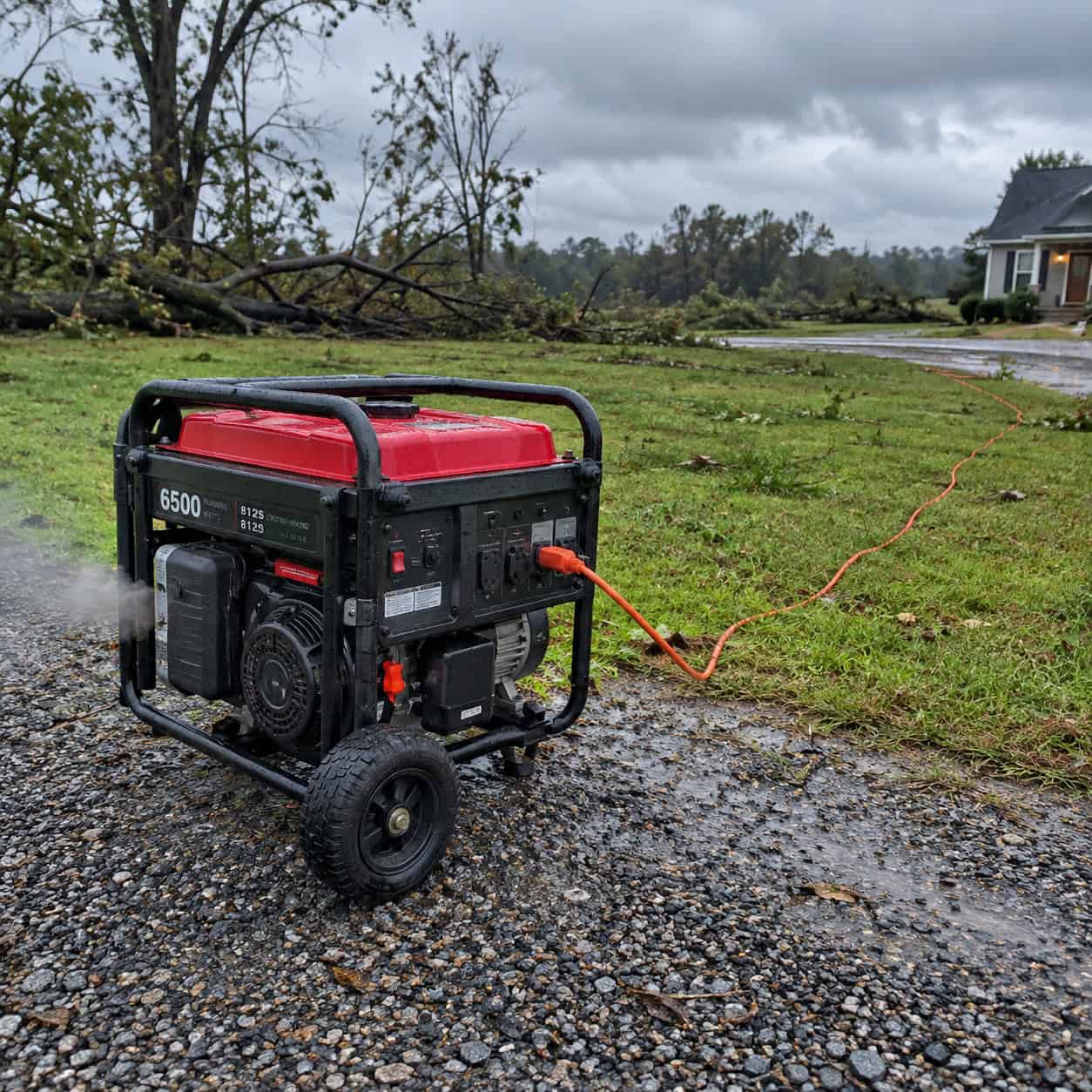
This is the entry that matters most, and it has nothing to do with food.
Portable generators kill people after storms, not during them. Every major outage produces the same headlines a day or two later, and the circumstances repeat almost word for word: a generator running in an attached garage with the door wide open, or on a covered porch, or in a basement, or six feet outside a bedroom window.
An open garage door does not make a garage safe. Carbon monoxide is slightly lighter than air, invisible, odorless, and it accumulates faster than passive ventilation clears it. A single portable generator can produce as much CO as hundreds of idling cars.
Run it outdoors only. At least 20 feet from the house. Point the exhaust away from doors, windows, and vents — including your neighbor’s.
Never in a garage, carport, crawlspace, shed, basement, or under an overhang. There is no version of indoors that works.
Get battery-powered CO alarms and put one on every level of the house, especially outside the bedrooms. Hardwired detectors go dead in an outage, which is precisely the window when you need them. A ten-year sealed-battery CO alarm runs about $25 and doesn’t ask anything of you again.
Symptoms read like the flu — headache, dizziness, nausea, weakness. If more than one person in the house feels that way at the same time, get everyone outside first and ask questions from the yard.
A battery power station sidesteps this entirely. That’s not a small part of the argument for owning one.
26. Cheesecake, Cream Pies, Custard, and Quiche

The dessert casualty list is long.
Cheesecake, cream-filled pastries, custard pies, chiffon pies, cheese-filled pies and quiche all go. Eggs and dairy baked into a dense, moist matrix that cools slowly and stays warm at the center — that’s the whole problem in one sentence.
Fruit pies stay. Anything with egg or dairy in the filling doesn’t.
27. Fish Sauce and Oyster Sauce

A deep cut for anyone with a stocked pantry.
Soy sauce, hoisin, barbecue sauce and Worcestershire are all Keep on the federal chart. Fish sauce and oyster sauce are explicit Discards.
Fermented anchovy and oyster extract sound like they should be indestructible. They aren’t — the pH and protein load land them on the wrong side of the line.
28. Cooked Vegetables, Tofu, and Opened Vegetable Juice

Raw vegetables survive. Cooked ones don’t.
Cooking breaks down the cell walls and natural acids that kept raw produce stable, then hands the bacteria a sterile, nutrient-rich medium with no competition. Tofu and opened bottles of vegetable juice cross over for the same reason.
A vegetarian fridge takes just as big a hit as anyone else’s. The casualties are just different.
29. Dirty Condenser Coils and a Failing Door Gasket

Your neighbor’s fridge held cold for six hours. Yours was warm in two. This is usually why.
The four-hour federal estimate assumes a refrigerator in reasonable working order — decent insulation, a sealing door, and a compressor that isn’t fighting for its life. Neglect erodes all three.
Condenser coils are the black grille on the back or underneath, and they shed heat. Caked in dust, pet hair and kitchen grease, they can’t, so the compressor runs longer and hotter to hit the same setpoint. Clean them twice a year with a coil brush and a vacuum. If you own a shedding dog, make it three.
Then test the gasket with a dollar bill. Close the door on it, leave half sticking out, and pull. Firm resistance means the seal is gripping. If it slides out easily, that spot is leaking cold air around the clock. Work your way around all four sides — gaskets usually fail at the hinge corners first.
Clean the gasket with warm soapy water while you’re there. Sticky residue and crumbs keep it from seating, and a dried-out rubber seal sometimes softens back up with a thin wipe of petroleum jelly.
Call a tech when the compressor runs nonstop, the fridge can’t hold 40°F on a normal day, or you hear the fan making noise it didn’t used to. A $150 service call on a five-year-old unit is worth it. On a twenty-year-old one, put the money toward the replacement.
Also check that your fridge isn’t wedged tight against the wall. Most need two to three inches of clearance to breathe.
30. Opened Canned Ham and Opened Canned Meat or Fish

“Canned” stopped meaning anything the moment you opened it.
An opened can of tuna, chicken, or salmon is refrigerated leftovers now, and it follows the same two-hour rule as anything else. Pitch it.
And that canned ham labeled “Keep Refrigerated” was never shelf-stable to begin with — it’s a cured, cooked ham that happens to come in a can. Discard it.
31. Anything Raw Meat Juices Dripped Onto

Most outage guides skip this one entirely, and it’s how people get sick after doing everything else right.
As freezer packages thaw, they leak. That liquid runs down through the shelves onto whatever’s below — the bread bag, the bagged greens, the container of cut watermelon you were about to declare fine.
USDA FSIS says to discard anything contaminated by juices from raw meat, poultry or fish. Full stop.
It’s also the argument for keeping raw meat on a rimmed tray on the bottom shelf permanently — outage or not. Then wash the shelves with hot soapy water before you restock, and if it got into the drain channel at the back, flush that too.
32. Opened Baby Formula and Expressed Breast Milk

No gray area anywhere on this one.
Opened baby formula is a flat Discard on the federal chart. So is expressed breast milk that spent more than a few hours above 40°F.
Infants have the smallest margin of anyone in the house — less body mass, an immature immune system, and no way to tell you something’s wrong until it’s serious.
Throw it out and open a new container.
33. Anything That Smells, Looks, or Feels Wrong — and Never Taste It

Never taste food to decide whether it’s safe. Every federal agency repeats this, and they repeat it because people keep doing it.
The organisms that cause the worst illness leave food looking, smelling and tasting completely normal. Listeria, Salmonella and pathogenic E. coli don’t announce themselves. A single bite is enough.
When it’s ambiguous, it’s a discard. That’s the whole decision tree.
A fridge full of replacement groceries costs a few hundred dollars. One emergency room visit doesn’t.
34. Fresh Pasta and Refrigerated Tortellini

Dry pasta in the pantry is essentially immortal. Fresh pasta is not.
Refrigerated tortellini, ravioli, fettuccine and gnocchi contain egg, often cheese, and a lot of water. Two hours above 40°F and they’re discards.
The vacuum-sealed package doesn’t change it. That seal was engineered around refrigeration.
35. Opened Vinegar-Based vs. Creamy Salad Dressings

The dressing shelf splits cleanly down the middle.
Opened vinaigrettes, Italian, balsamic and anything else built on vinegar and oil are Keep — the acid holds the line at room temperature.
Opened ranch, blue cheese, Caesar, Thousand Island and Green Goddess are Discards. Buttermilk, sour cream and egg dragged them across.
Read the first three ingredients. That’s your answer.
Once you’ve cleared the fridge, run the whole thing down with hot soapy water and dry it before restocking — and if anything leaked into the drain line, that’s worth clearing out before the smell sets in.
An outage is a test you take twice: once for the food, and once for whether you’re ready for the next one. Most people pass the first part and fail the second, then buy ice at a gas station eighteen months later in the dark.
Put thermometers in both compartments this week. Freeze the cup with the quarter. Clean the coils.
And if you want the version where you skip this entire list — enough battery on the shelf to keep the compressor running until the crews show up.
The milk survives. That’s the whole goal.