

Walk into a kitchen in 1975 and you’d hear it before you saw it. The whirr of an under-cabinet can opener. The gurgle of a Mr. Coffee finishing its cycle. A wall phone ringing, its cord already tangled around a chair leg.
Then the color hit you. Warm yellow, mossy green, and a brown you can only describe as bronze — all at once, on every surface.
This was the decade that traded ’50s pastels for earth tones and turned the kitchen into the busiest, coziest, loudest room in the house. Faux wood climbed the walls. Ferns dangled from knotted jute. And every counter held some gadget that promised to change dinner forever.
Some of it aged badly. Some of it now sells for hundreds on eBay.
Here are 32 things every 1970s kitchen had — harvest gold and all.
1. Harvest Gold Everything
Start with the color that named the decade.
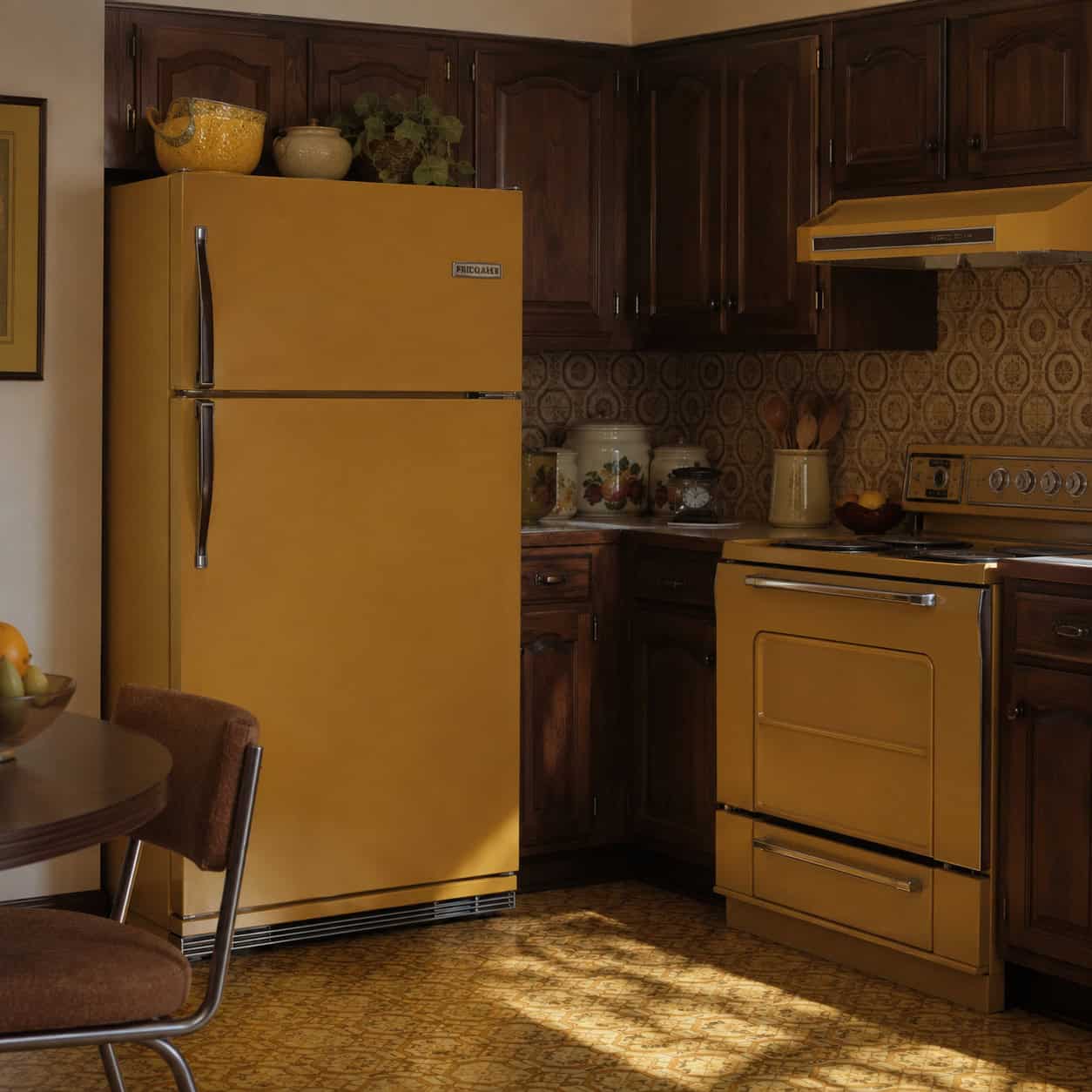
Harvest gold was a warm, muted yellow — not quite mustard, not quite butterscotch — and it coated everything. Stoves, refrigerators, dishwashers, toasters, canisters. If it plugged in or opened, it came in gold.
The look leaned on contrast. Gold appliances against dark stained wood cabinets, with a stripe of stainless or chrome trim to tie it together.
Appliance makers ran the shade hard through the mid-to-late ’70s, and it became so standard that buying white almost felt like a statement. As Homesteady documents, gold sat at the center of the era’s appliance palette.
You didn’t decorate around harvest gold. You surrendered to it.
2. The Avocado Green Refrigerator
Close your eyes and picture a ’70s kitchen. There’s a good chance the fridge is green.
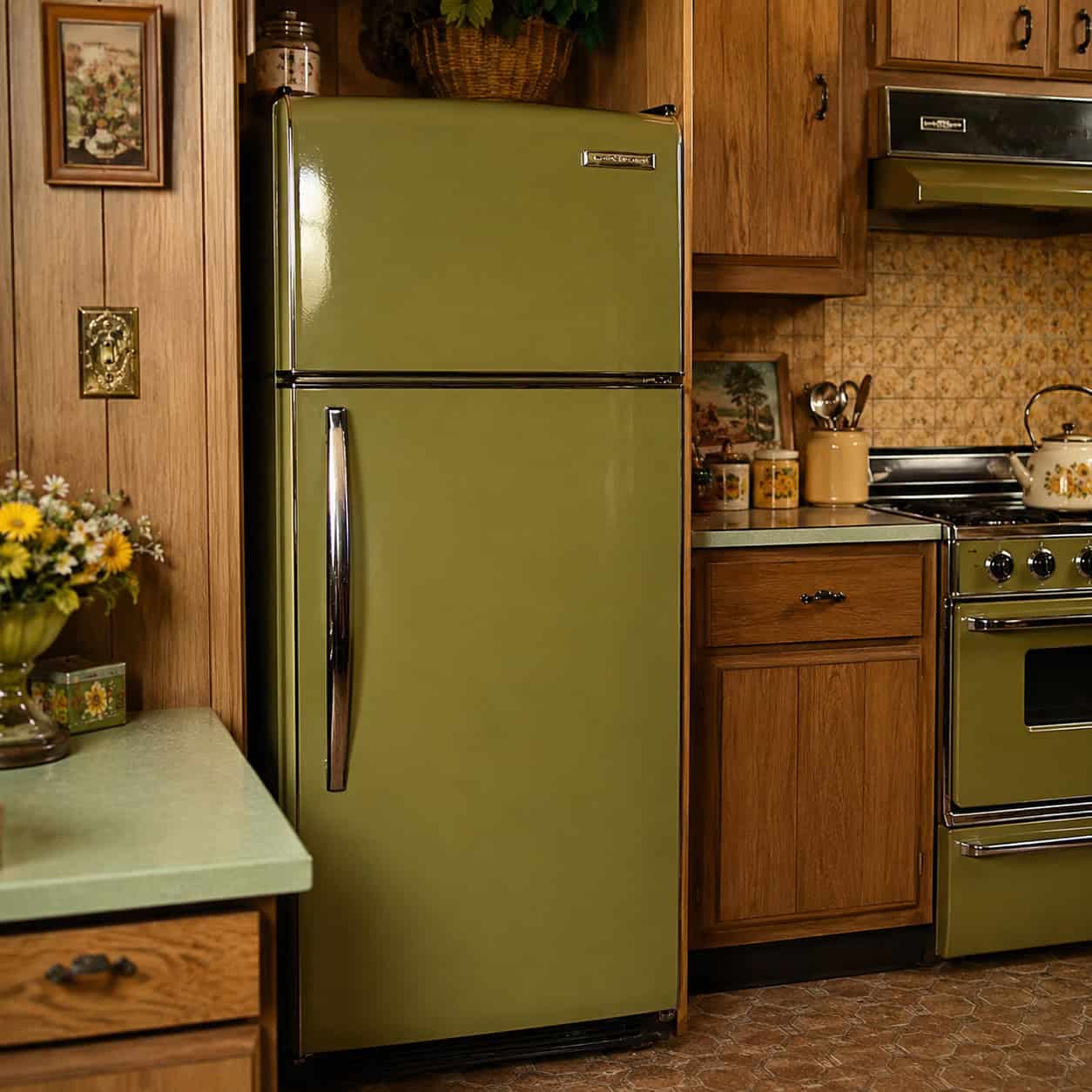
Avocado was the color people remember first, and the refrigerator was its proudest showcase — a big, glossy slab of muted green anchoring one wall.
Kohler’s records date its “fresh green” shade to exactly 1971 through 1979, which lines up neatly with the color’s full flower. It arrived as part of a hippie-era swerve toward “natural” tones, away from the pink and turquoise of the previous decade.
The fridge was only the beginning. Avocado spread to the range, the sink, the countertop trim.
Nothing dates a photo faster.
3. Burnt Orange Accents
The third member of the warm-tone royal family.
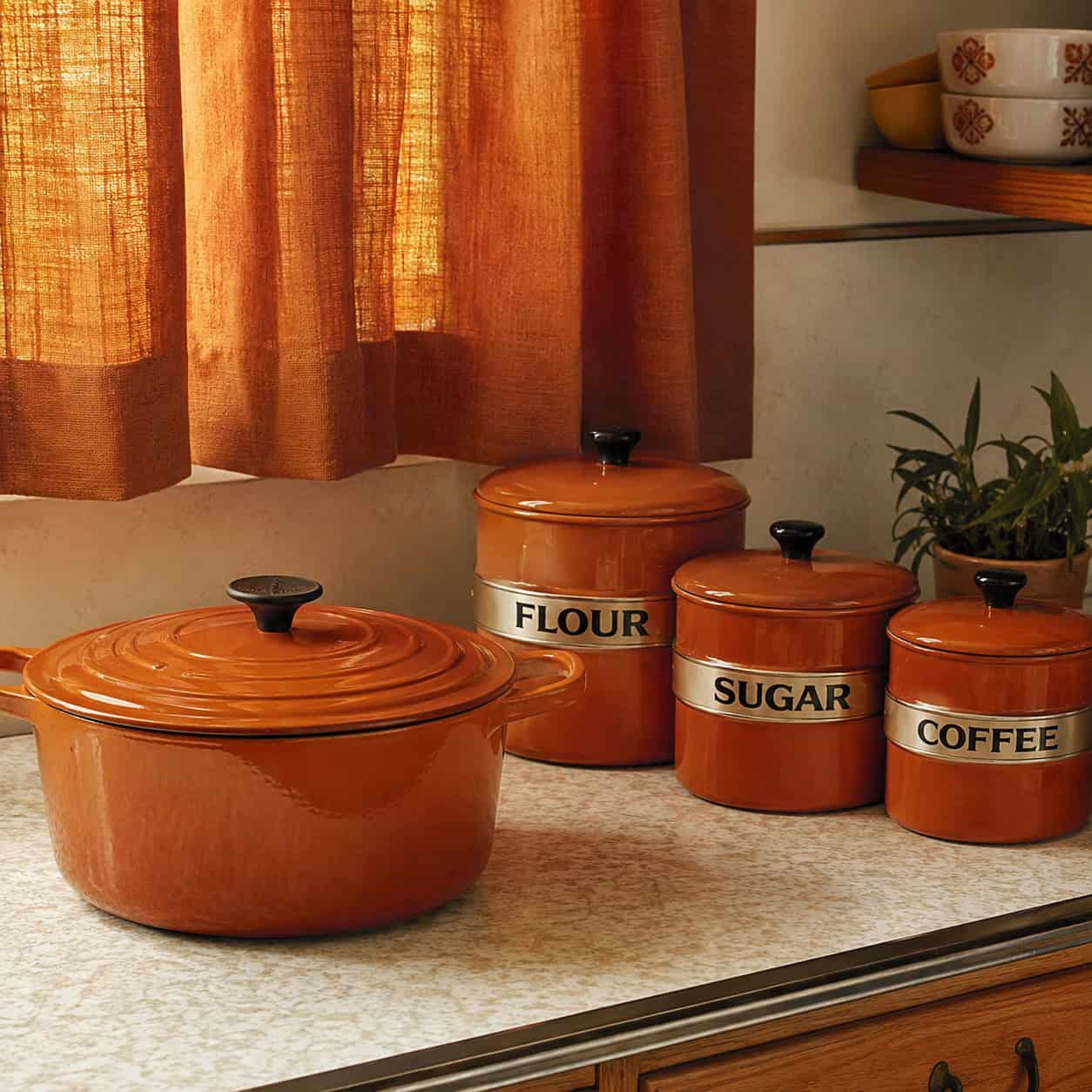
Burnt orange carried over from the late ’60s and burned brightest in the early-to-mid ’70s. Kohler called its version “sunflower” and produced it from 1974 to 1984.
It showed up less on big appliances than gold or avocado. You were more likely to find it on canisters, a blender base, a set of café curtains, or an enameled Dutch oven.
Used right, it warmed a room up. Used everywhere at once, it started to feel like a sunset that wouldn’t quit.
4. Coppertone Brown Appliances
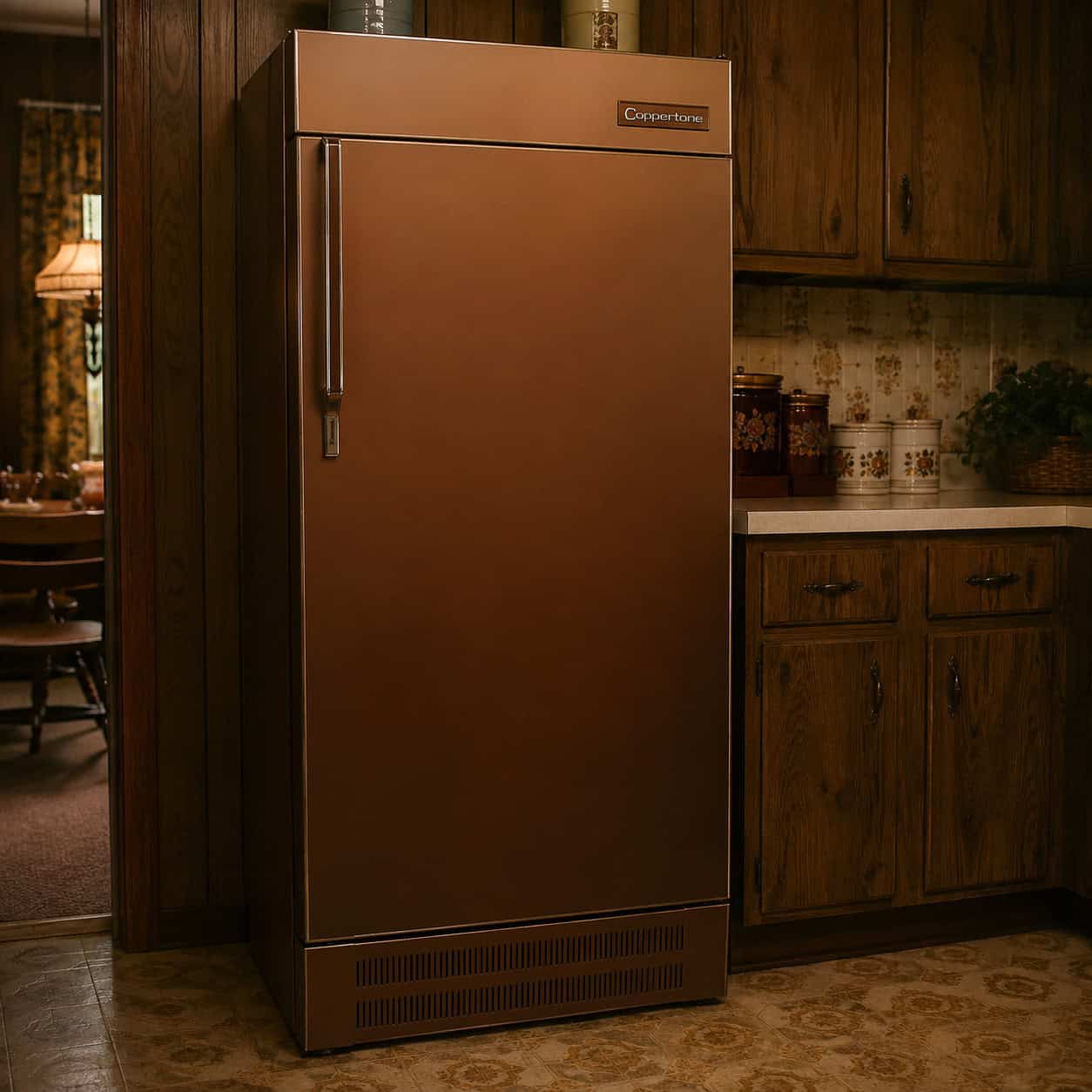
The forgotten fourth color.
Most people summon gold and avocado instantly, then draw a blank. Then you say “the brown fridge,” and it all comes back.
Coppertone was a graduated bronze-brown — darker toward the bottom, lighter as it climbed. That subtle shading gave refrigerator and oven doors a depth the flat colors never had.
It read as rich and earthy, the appliance equivalent of dark wood paneling. Late-’60s in origin, it held its ground right through the ’70s.
5. Formica Laminate Countertops
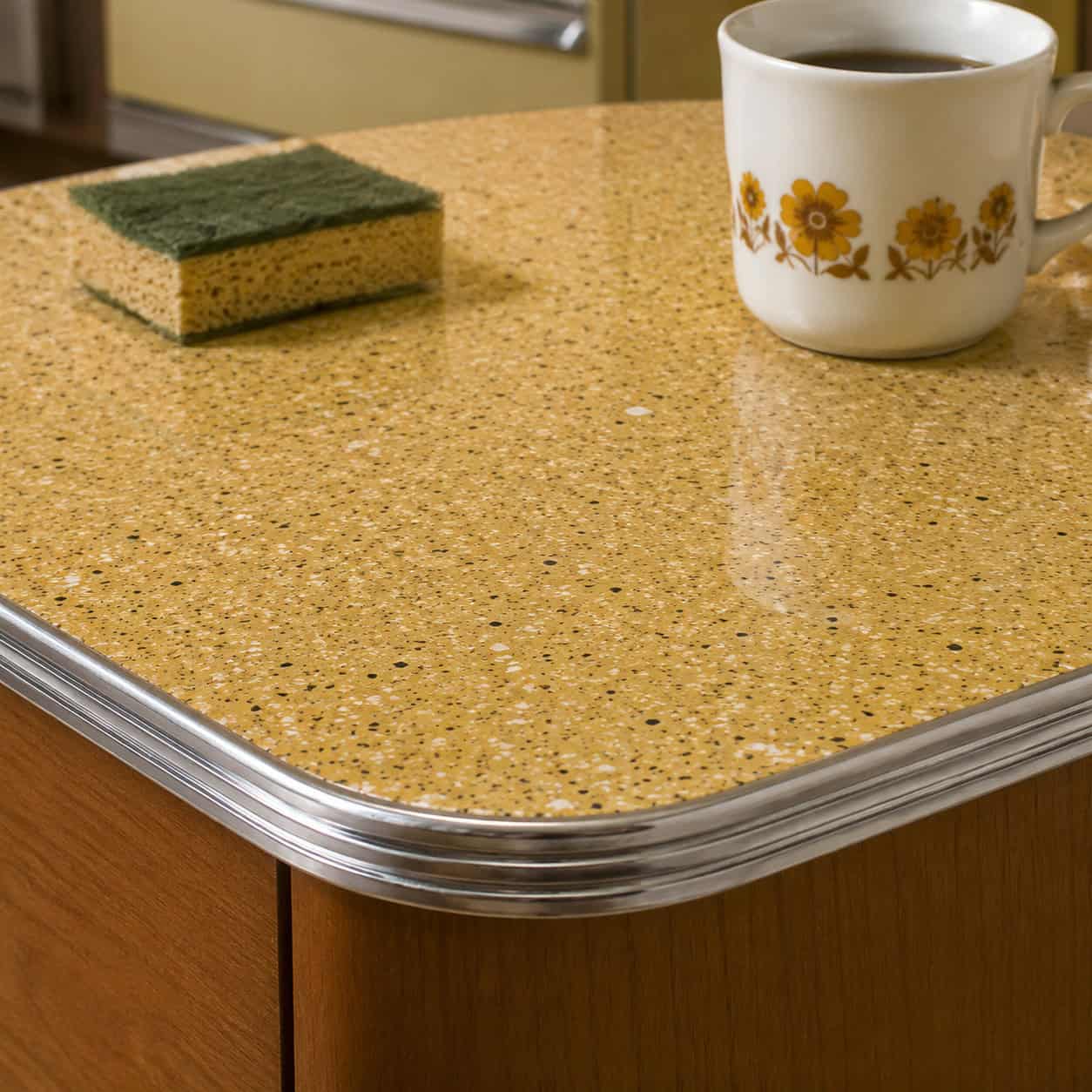
The brand name became the material. Nobody said “plastic laminate.” They said Formica.
It covered nearly every counter, peninsula, and snack bar in America, and for good reason. It was cheap, wiped clean with a sponge, and shrugged off a set-down cigarette without scorching.
Color choice was endless — gold, avocado, orange, speckled patterns meant to hide crumbs. As Food Republic notes, it was the surface a whole generation grew up eating breakfast on.
Durable, affordable, everywhere. The counter that defined the room.
6. Woodgrain & Butcher-Block Laminate
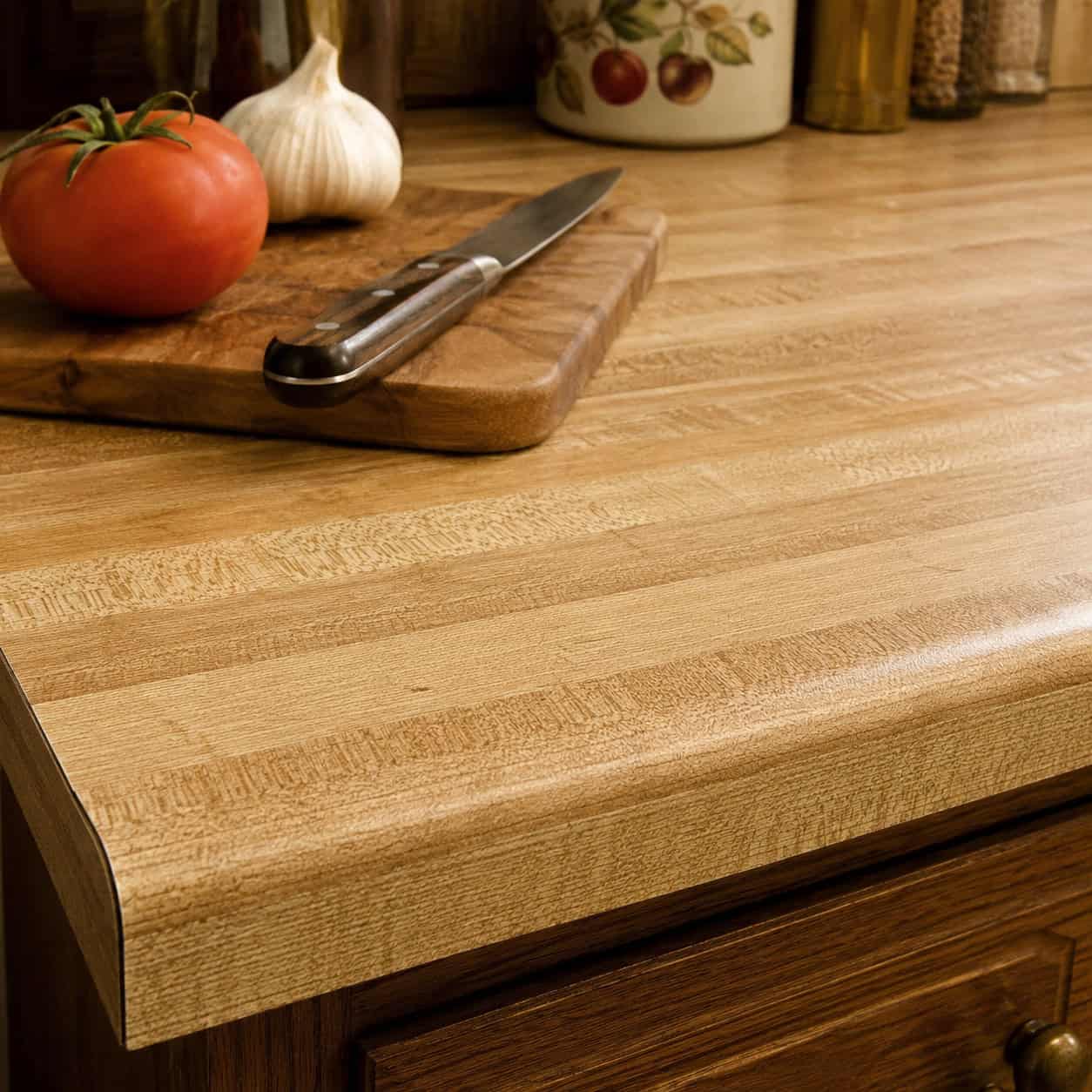
As the decade’s back-to-nature mood set in, the laminate itself went woodsy.
Dark faux-woodgrain and printed butcher-block patterns became a statement counter — the look of real wood at a fraction of the price and none of the upkeep.
Formica’s maple butcher-block laminate has run continuously since 1972, which makes it a reliable dating clue. Spot it in a listing photo and you’re likely looking at a kitchen untouched since Nixon.
It never fooled anyone up close. But from across the room, printed butcher block did its job.
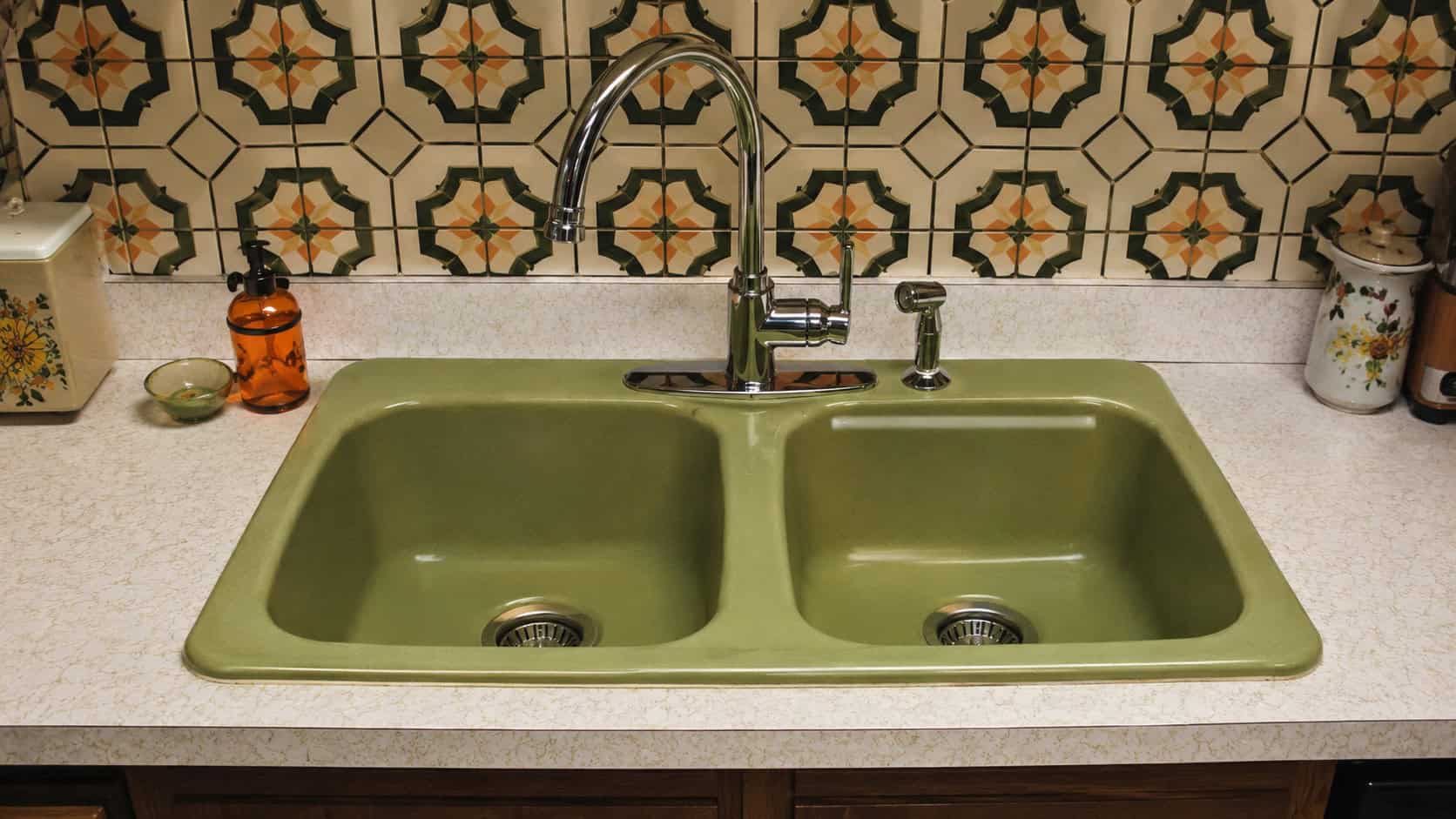
7. A Color-Matched Sink and Side-Spray Faucet
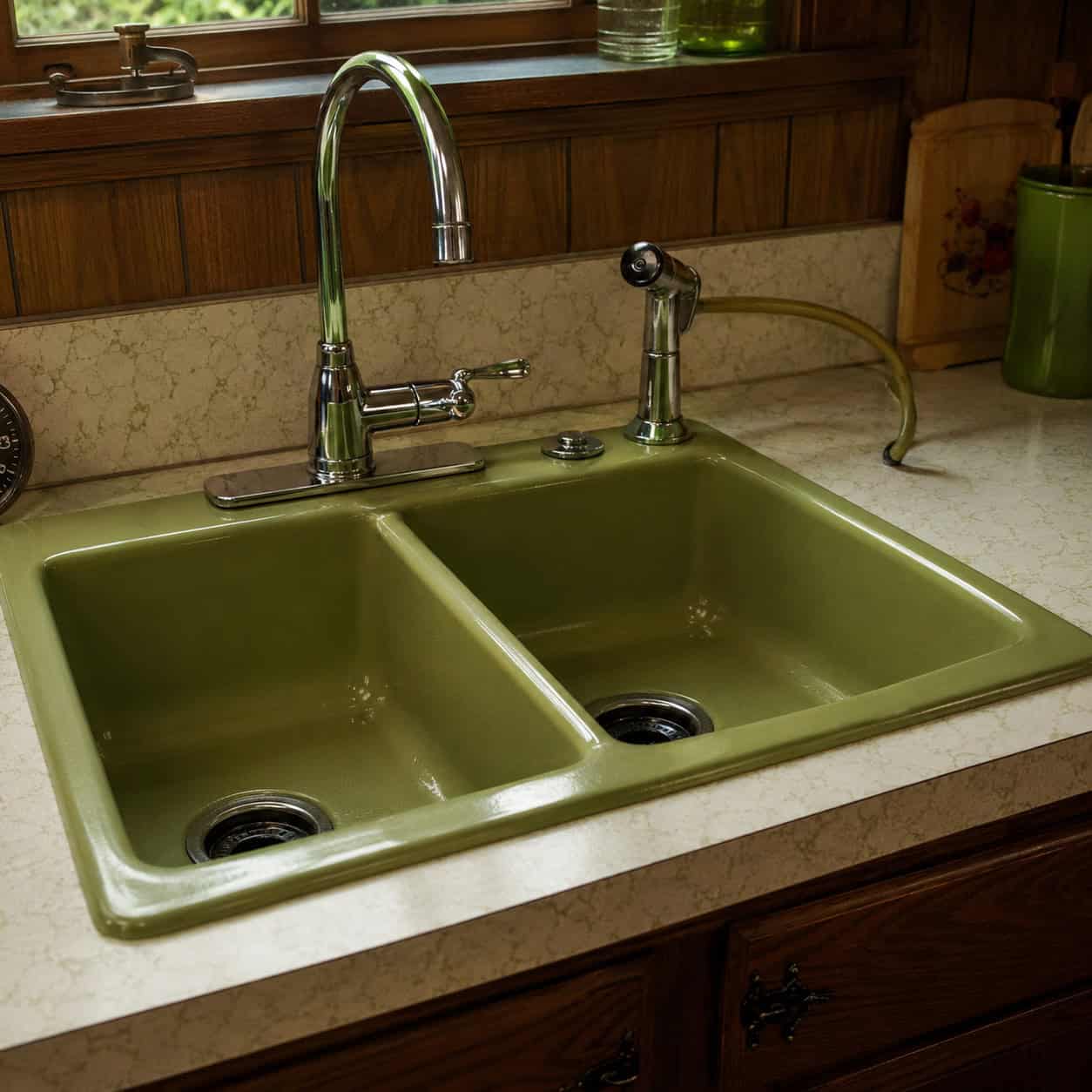
Here’s where the ’70s kitchen got truly committed. The sink matched the appliances.
Enameled cast iron and porcelain sinks came in avocado, harvest gold, and coppertone, so the basin could echo the fridge across the room. A white sink in an avocado kitchen looked like a mistake.
The standard setup was a double basin — one side for washing, one for rinsing or stacking — dropped into that Formica counter. Cast iron gave it heft. The porcelain enamel gave it that glossy, colored shine.
Above it sat a chrome high-arc or gooseneck faucet. Tall, curved, and single-lever or two-handle depending on the budget, it arched high enough to fill a stockpot.
Then the detail that dates it instantly: the separate side spray. A push-button sprayer on its own flexible hose, mounted in its own hole to the right of the faucet.
You pressed the button and water diverted from the main spout to the sprayer head. Let go and it snapped back. That hose kinked, cracked, and clogged with mineral buildup more than any other part of the setup — which is exactly why so many got replaced with a single pull-down faucet decades later.
Colored porcelain sinks chip if you drop a heavy pot, and the color options vanished by the ’80s as white and stainless took over. But an intact avocado double basin with its original side spray is now a genuine period find.
Match the sink to the fridge. That was the rule.
8. Patterned Linoleum & Vinyl Floors
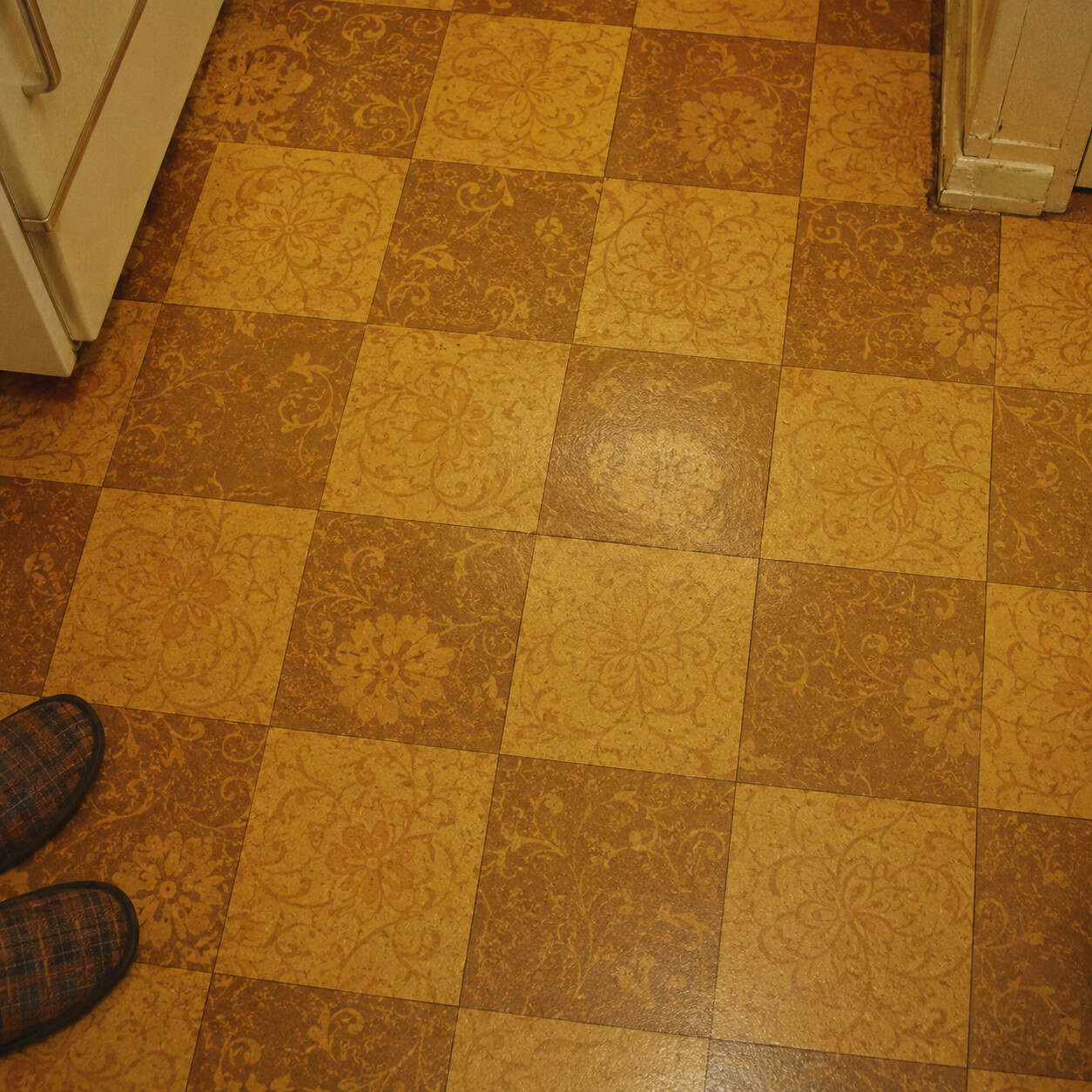
The floor was never quiet.
Big hexagons. Swirling florals. Chunky mustard-and-brown checkerboards that could give you a headache under fluorescent light.
Most people called it linoleum, but it was usually sheet vinyl — inexpensive, and easy to mop a dropped casserole off without a second thought.
The bold pattern wasn’t an accident. A busy floor hid dirt, scuffs, and the occasional Kool-Aid spill. Practical camouflage, dressed up as design.
9. Dark-Stained Oak Cabinets
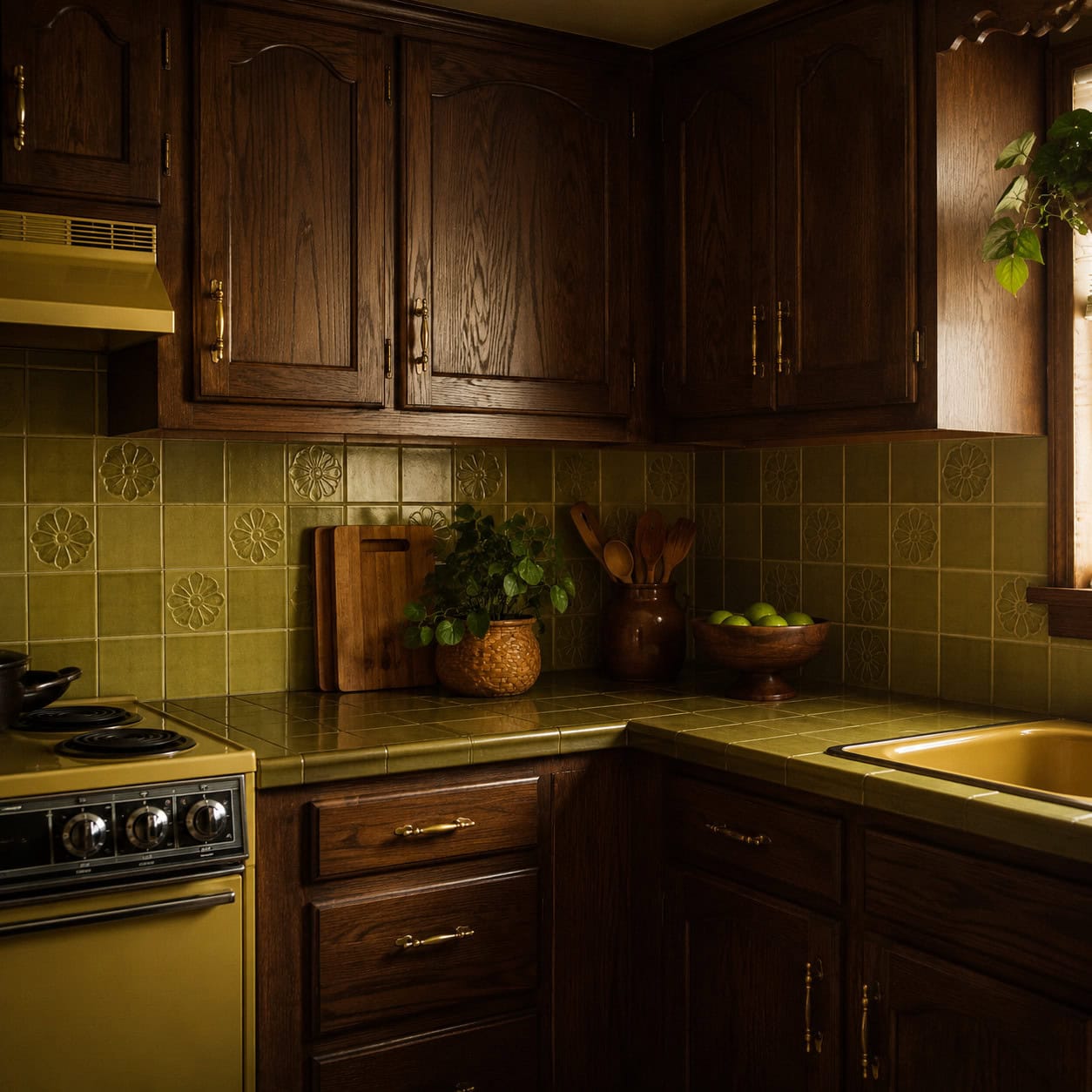
Deep walnut and chocolate tones ran wall to wall.
Cabinet fronts often had textured grain or routed detailing, sometimes with a decorative iron or brass pull. The wood was meant to look substantial, warm, and a little rustic.
Pair those cabinets with avocado tile and orange wallpaper and the kitchen turned into a warm, moody cave. Cozy in winter, dim in July.
It’s the exact opposite of today’s bright white shaker. Which is why, every few years, someone declares it’s coming back.
10. Wood-Paneled Walls
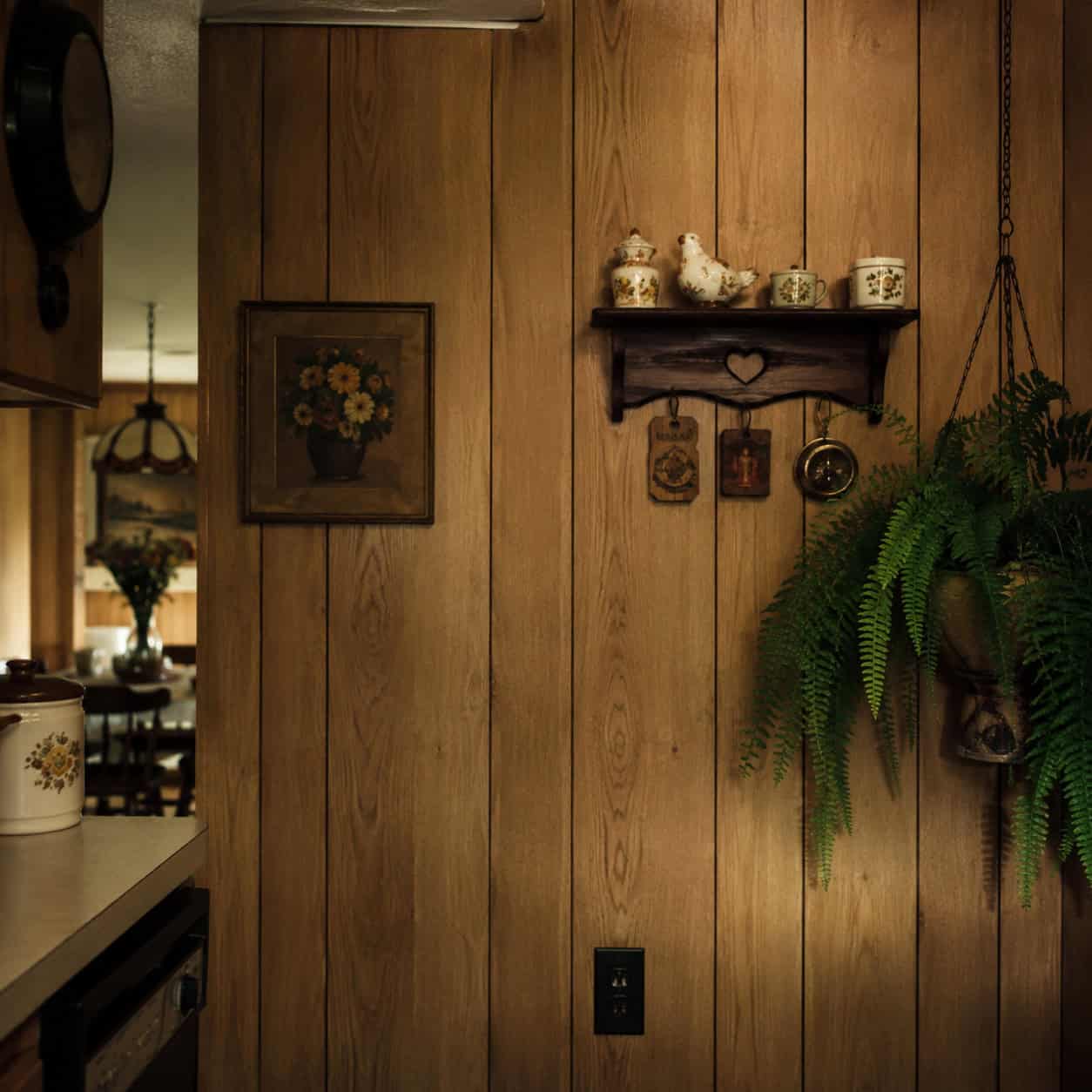
Wood didn’t stop at the cabinets. It climbed the walls.
Faux and real paneling covered whole rooms, sometimes creeping up onto the ceiling. It delivered the warm, lived-in feel the decade craved.
The paneling coordinated with everything else in the house — the shag carpet, the macrame, the earth-tone furniture. The kitchen was part of a bigger brown mood.
Cheap sheets of grooved plywood paneling made it a weekend project any homeowner could tackle. Which is why it ended up nearly everywhere.
11. A Wallpapered Ceiling
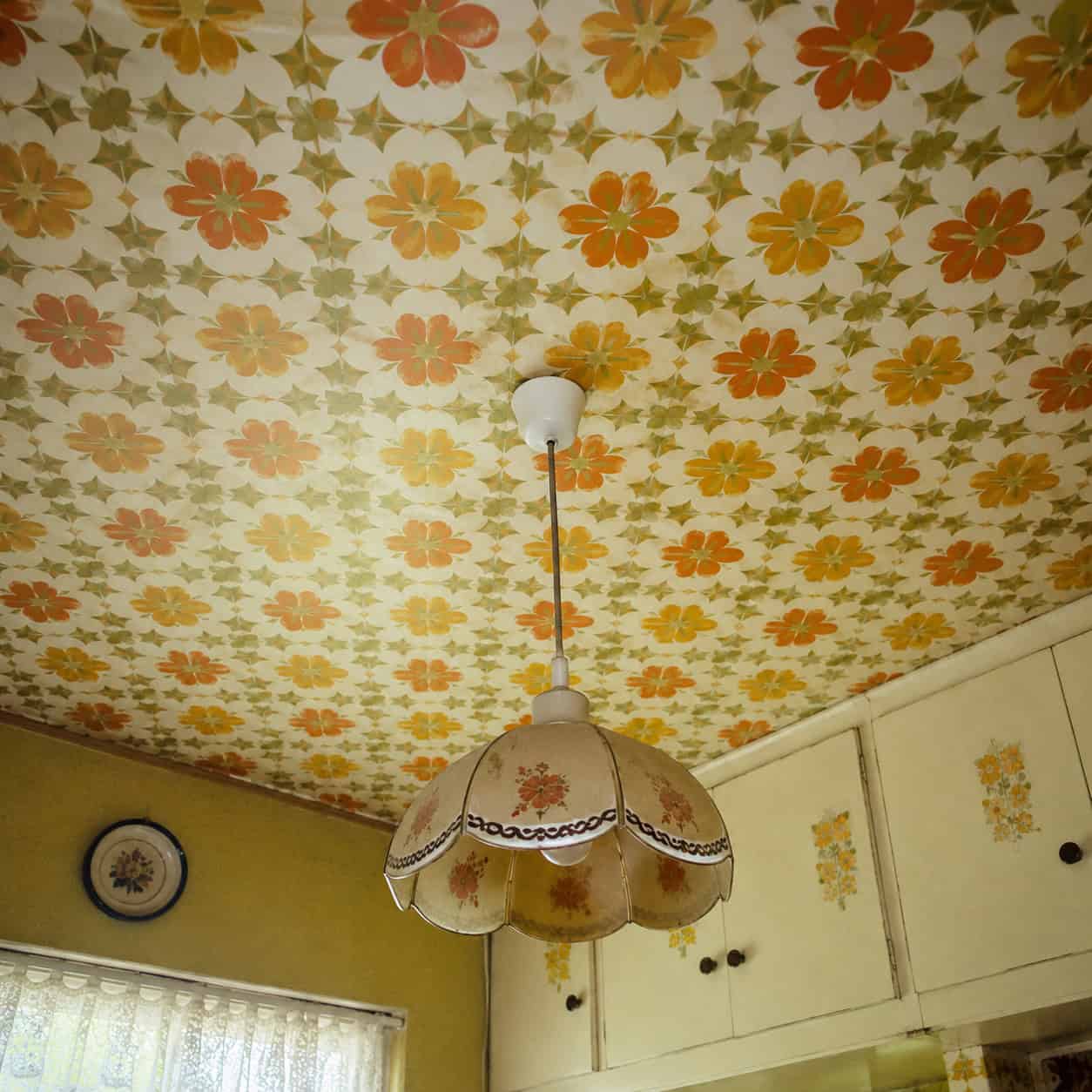
The ceiling got treated as a fifth wall.
Bright florals, tight geometric prints, even faux woodgrain — all looking straight down at the dinner table.
On a low ceiling it made the room feel cozy and enclosed, like the inside of a hatbox. On a tall one it just made you dizzy.
Nobody does this anymore, which is what makes it such a perfect period tell. Look up in a vintage photo and the whole decade is right there.
12. A Bold Geometric Tile Backsplash
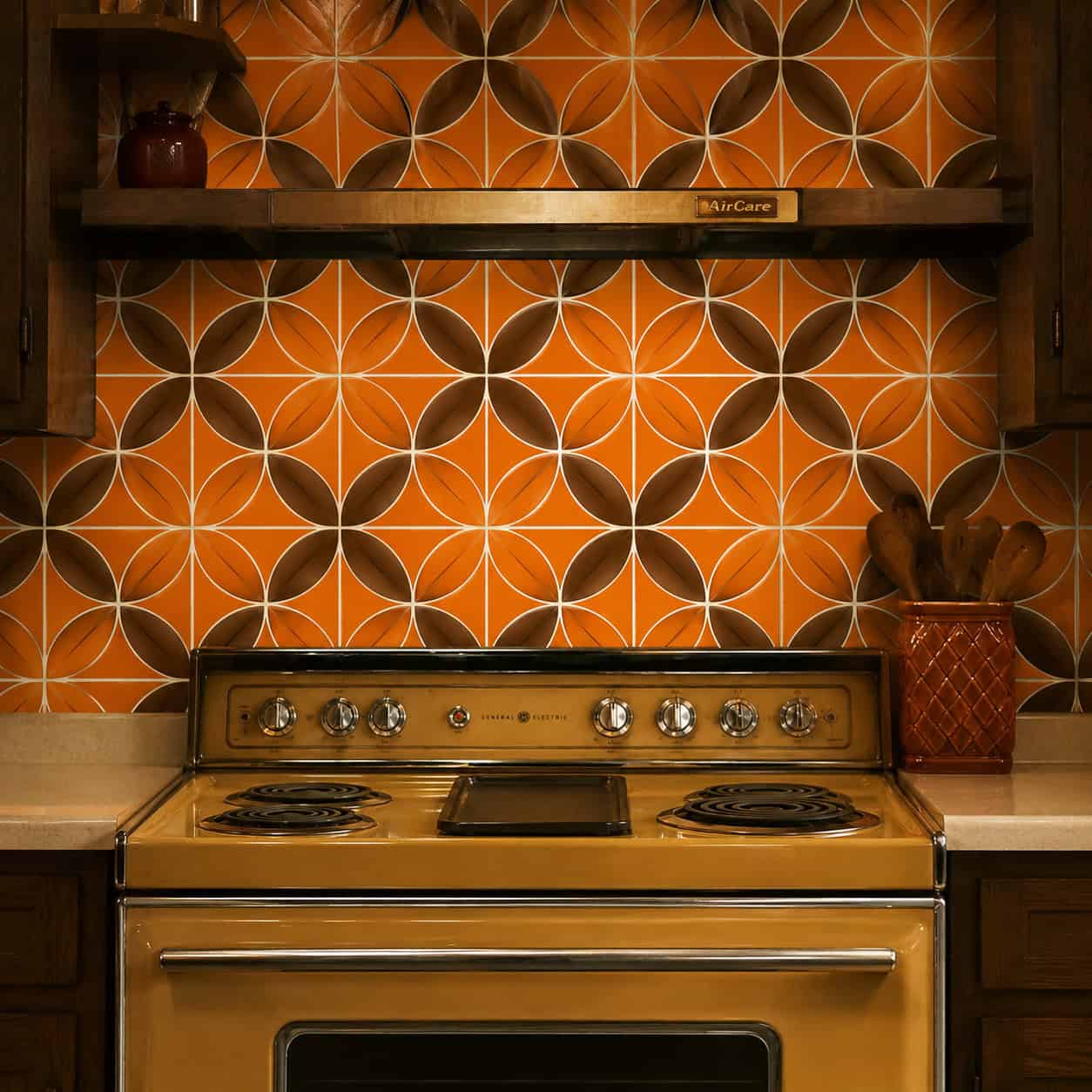
Forget understated subway tile. That was decades away.
The ’70s backsplash was geometric, colorful, and loud — bright squares, diamonds, and repeating prints stacked behind the range.
As Yahoo points out, this tile carried straight into the graphic patterns of the early ’80s. It wasn’t a background element. It was a focal point.
Grout in a contrasting color only made it louder. Which was the whole idea.
13. The Amana Radarange on a Rolling Cart
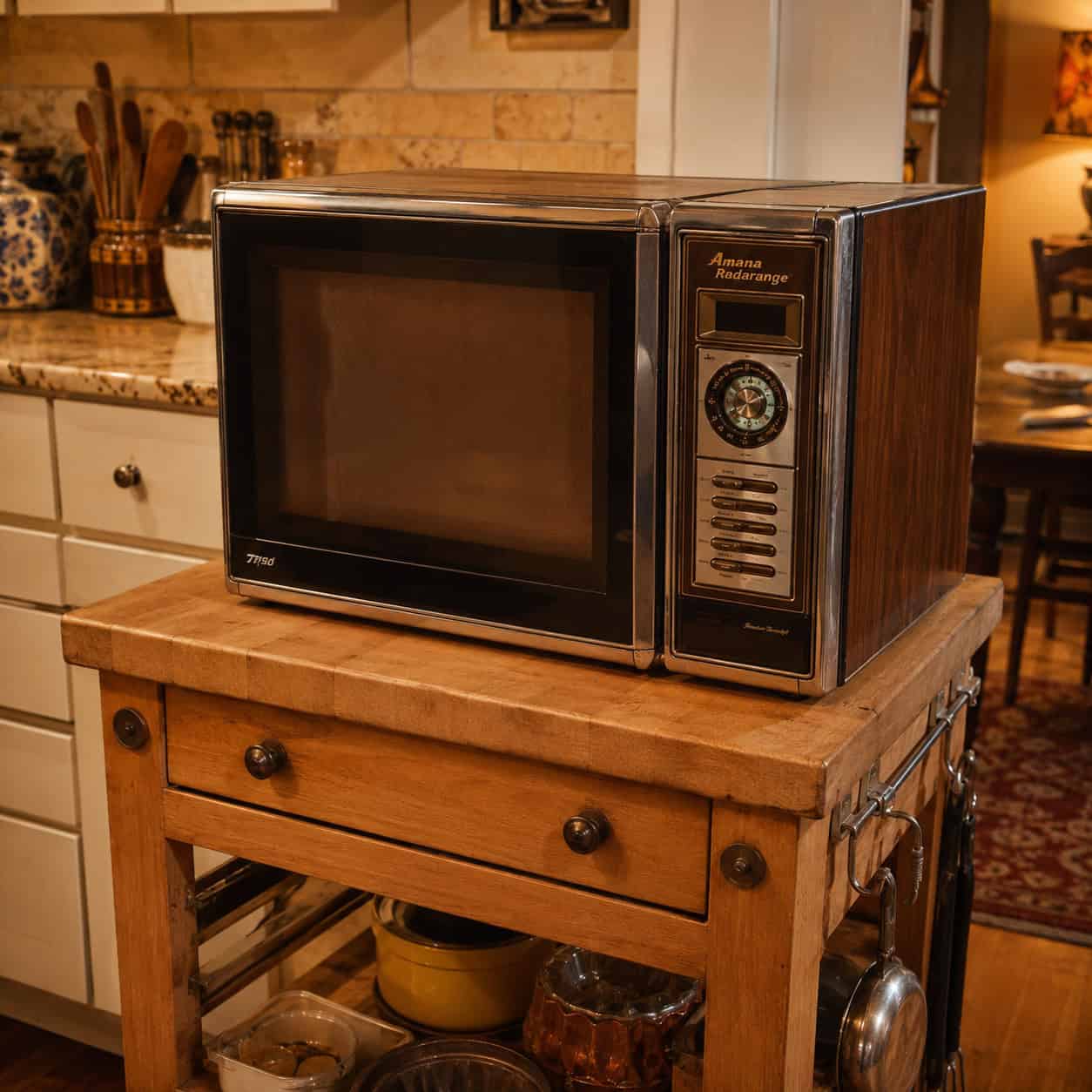
The microwave had arrived, and it needed its own furniture.
Amana’s Radarange existed by 1967, but only in the ’70s did prices drop far enough to make it a real household purchase rather than a restaurant curiosity.
It was new, exciting, and enormous — far too big to fit in any cabinet. So it lived on a dedicated butcher-block cart, parked at the end of the counter like a small appliance throne.
People were half-thrilled and half-suspicious. It cooked a potato in minutes, but rumors about the radiation ran wild at every dinner party.
That rolling cart is a dead giveaway. If a kitchen had one, it was proudly showing off the future.
14. A Built-In Trash Compactor
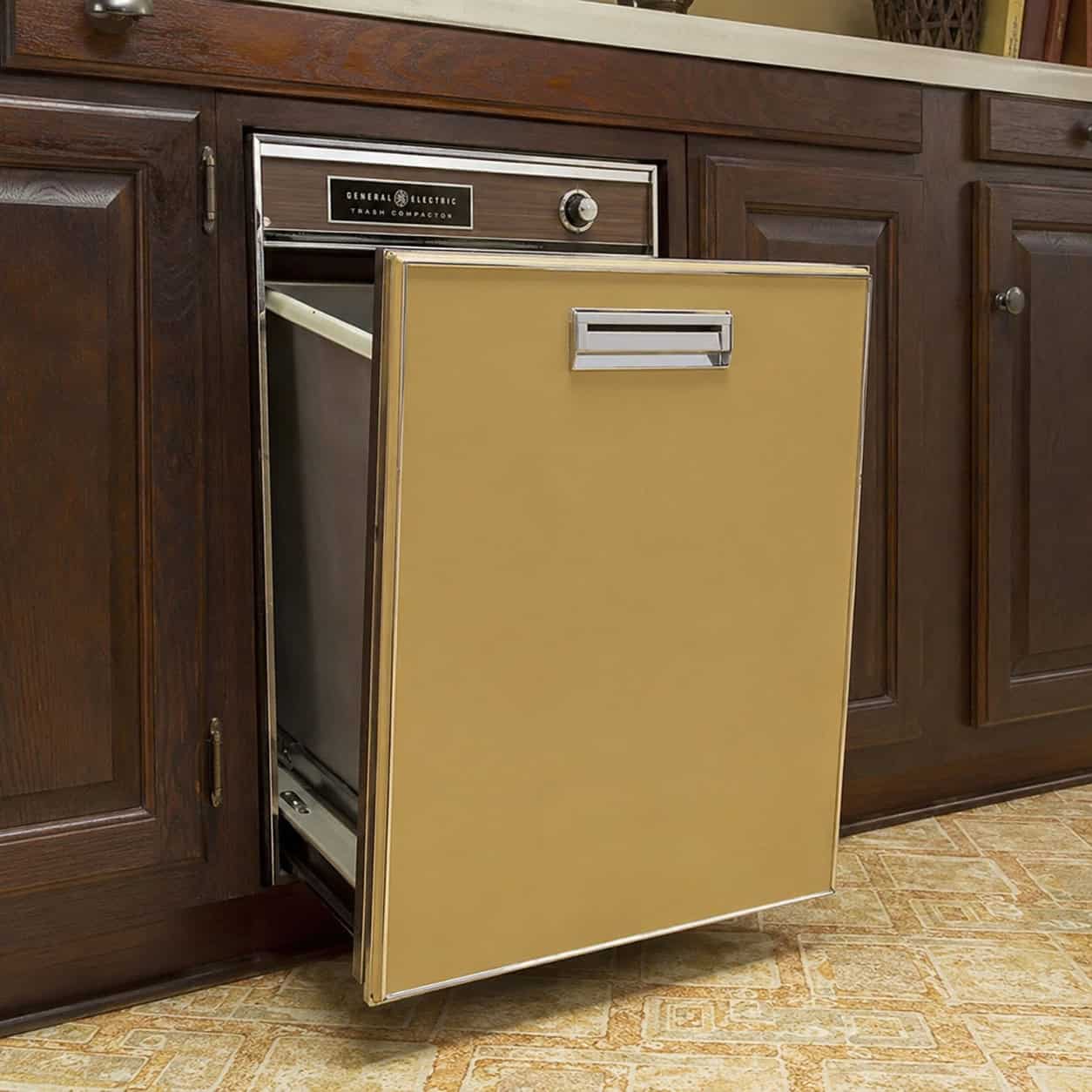
The last genuinely new major-appliance category, and a real status symbol.
Whirlpool launched its Trash Masher in 1969, and by the mid-’70s GE, KitchenAid, and Tappan had all followed with compactors of their own. This was the appliance that said your kitchen was up to date.
The pitch was simple. It crushed a week of garbage down to about a quarter of its volume, so you took the trash out far less often. You slid open a drawer, dropped in your cans and cartons, and let a motor-driven ram do the rest.
It slotted right into the cabinet run, usually 15 inches wide, finished to match the color scheme — gold, avocado, or coppertone front panels available to order. As Click Americana catalogs, it was marketed hard as a modern convenience.
The problem showed up fast. Compacting your trash didn’t make it disappear — it made a dense, heavy brick that smelled worse the longer it sat, and the bags cost extra. Recycling changed the math further, since crushing everything together defeated the point of sorting it.
So it quietly vanished. Most people who had one used it as a bin and forgot the motor existed.
15. Double Wall Ovens
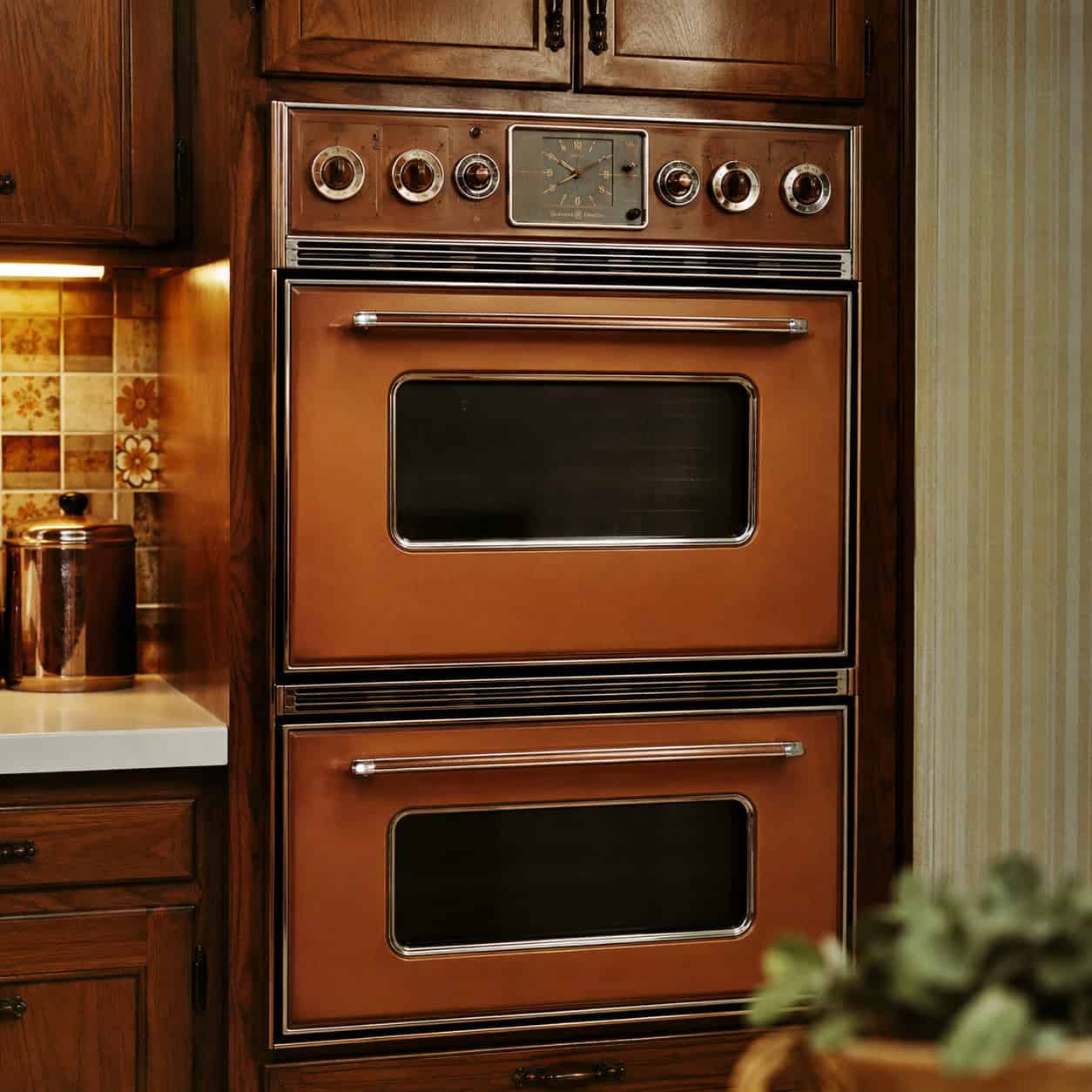
For the serious host, nothing said arrived like a built-in double wall oven.
Stacked one above the other and set into the cabinetry — often in coppertone or gold — the double oven separated the baking from the cooktop, which fit perfectly with the new open-plan kitchen where the range moved to an island or peninsula.
The extra capacity earned its keep in an era of committee cooking. Casseroles, roasts, dinner rolls, and a Jell-O mold could all be in motion at once when the relatives came over.
It was aspirational hardware. A single freestanding range did the job for most families, so two built-in ovens signaled a kitchen someone had planned and paid for.
Many carried early self-cleaning cycles, a genuine selling point when the alternative was a can of oven cleaner and an afternoon on your knees. The controls were chrome dials and push buttons, sometimes with a clock timer built into the center panel.
Find a pair still working in their original color and you’ve found a kitchen that was somebody’s pride.
16. The Under-Cabinet Electric Can Opener
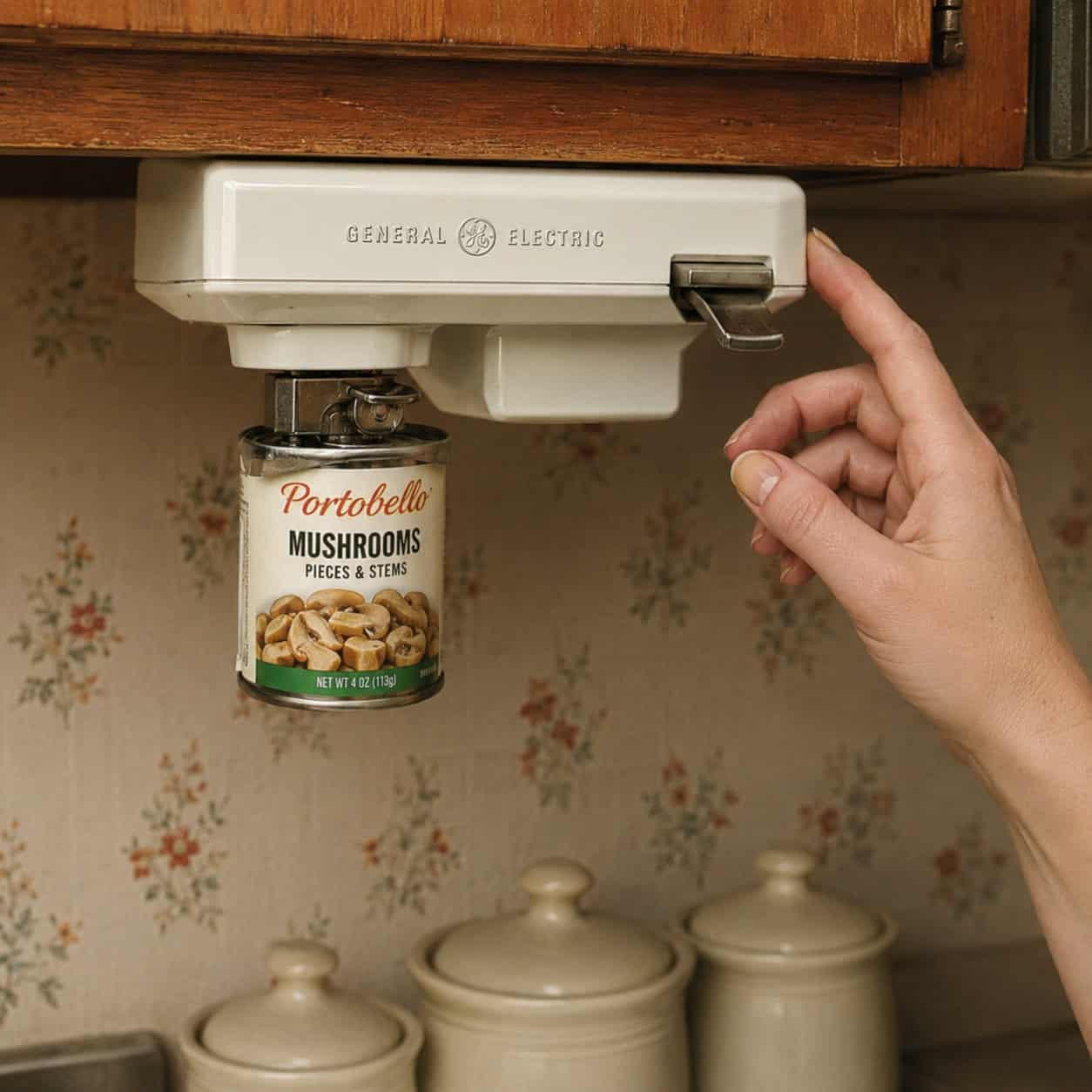
Convenience food ran the decade, and convenience food came in cans.
Soups, vegetables, tuna, fruit cocktail — dinner often started with a can, so the electric opener earned permanent counter rights. To reclaim the space, manufacturers built models that mounted underneath the upper cabinet.
You’d swing the can up into the magnetic grip, press the lever, and listen to that gentle grinding whirr. It was one of the small sounds that meant food was coming.
The cordless handheld opener eventually killed it off. Smaller, cheaper, no mounting required.
17. The Crock-Pot
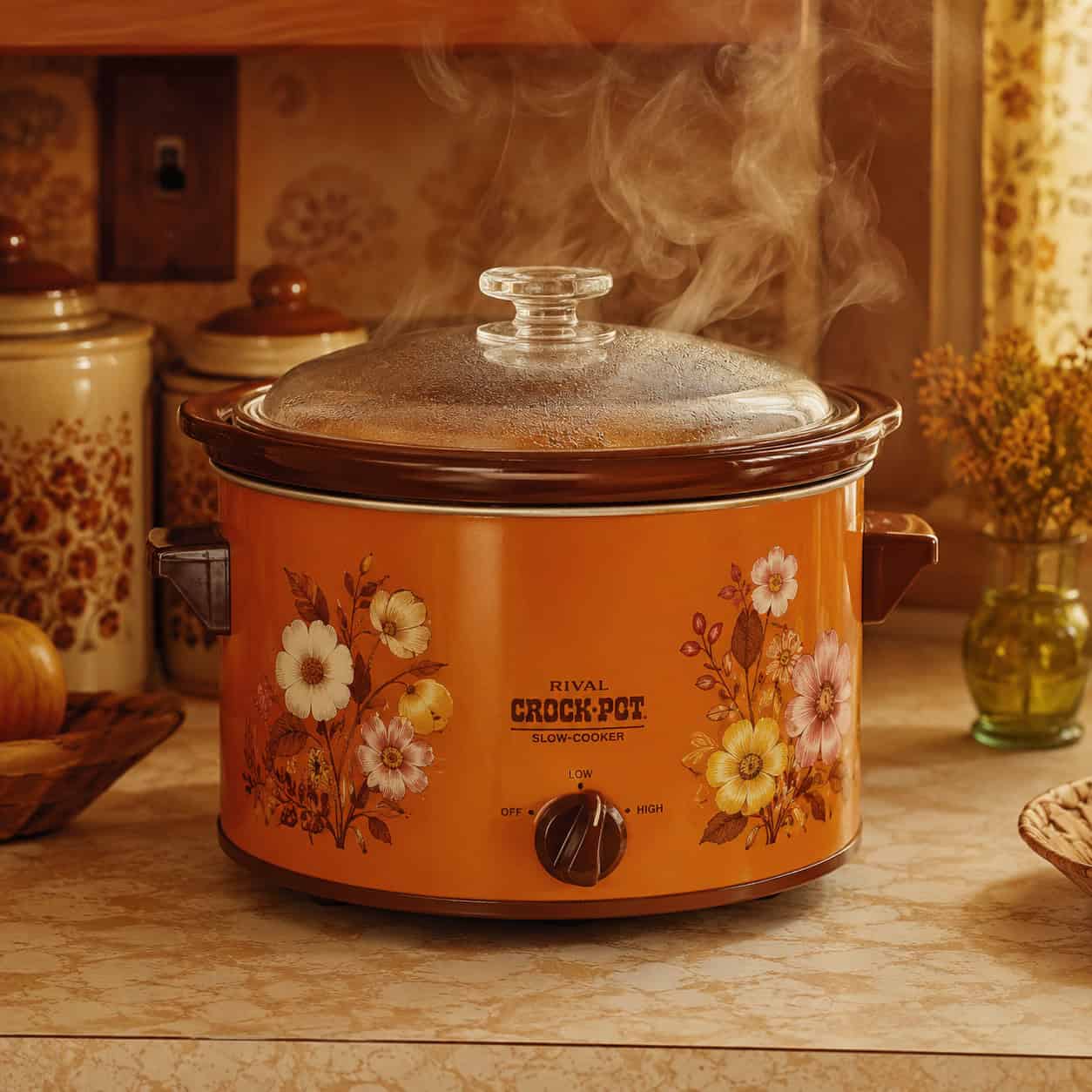
Rival launched the Crock-Pot in 1970, and it rewired the American weeknight.
The timing was perfect. More women were working outside the home, and a pot you could load in the morning and leave alone all day was a small revolution.
Sales hit $93 million by 1975. Pot roast, chili, and beef stew practically cooked themselves while nobody watched.
The name stuck so hard that people still call every slow cooker a Crock-Pot, regardless of who made it. That’s brand dominance you can’t buy.
18. The Fondue Set
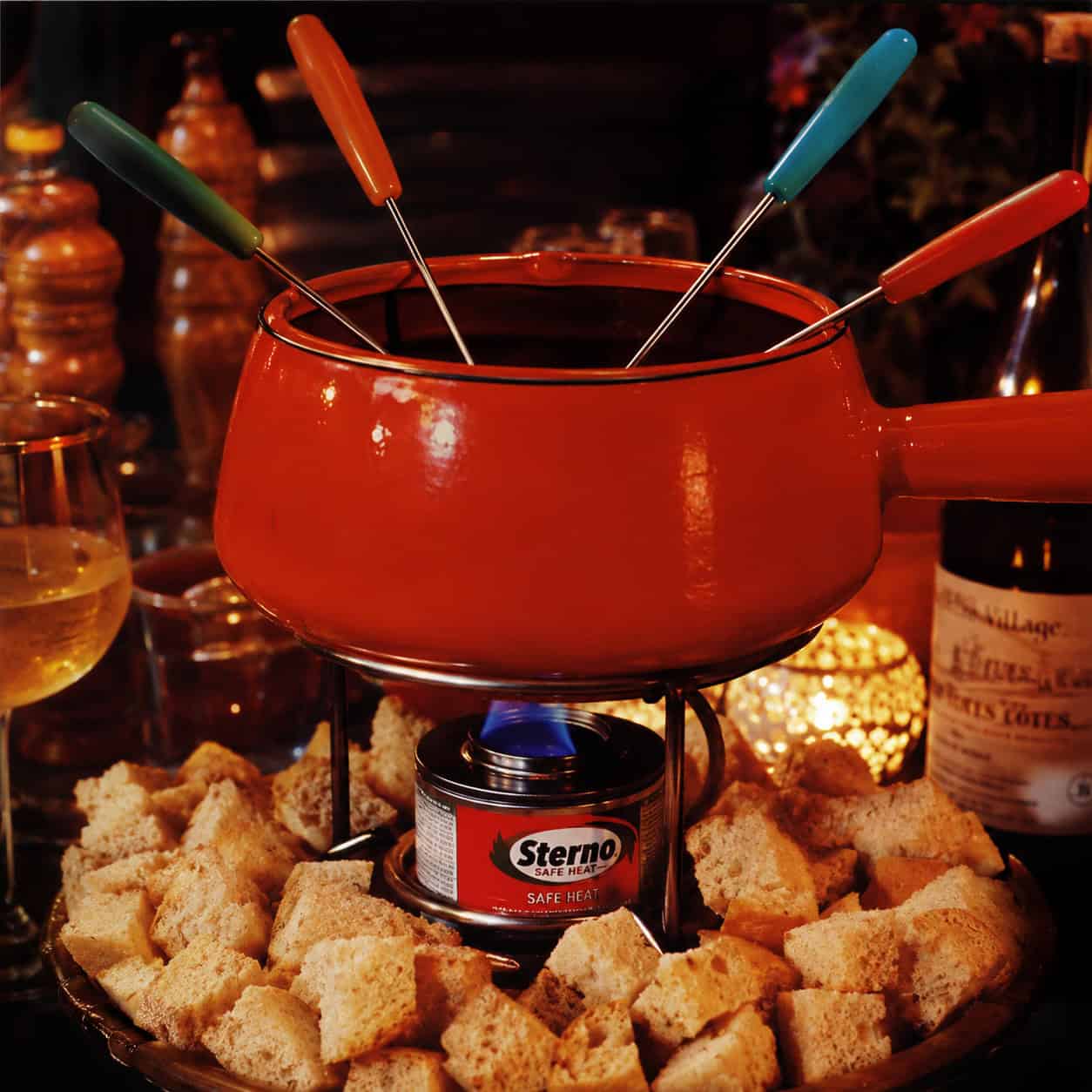
No single object screams ’70s louder.
An enamel-over-steel pot in a bold color, a Sterno or electric burner underneath, and a ring of long forks with color-coded tips so guests could tell whose was whose.
The fondue party was the era’s signature form of entertaining — melted cheese, cubes of bread, a bottle of wine, and everyone leaning over the same bubbling pot. Chocolate fondue closed the night.
Then it went straight into the closet for twenty years. Most sets got exactly one memorable evening before gathering dust.
19. The Mr. Coffee Machine
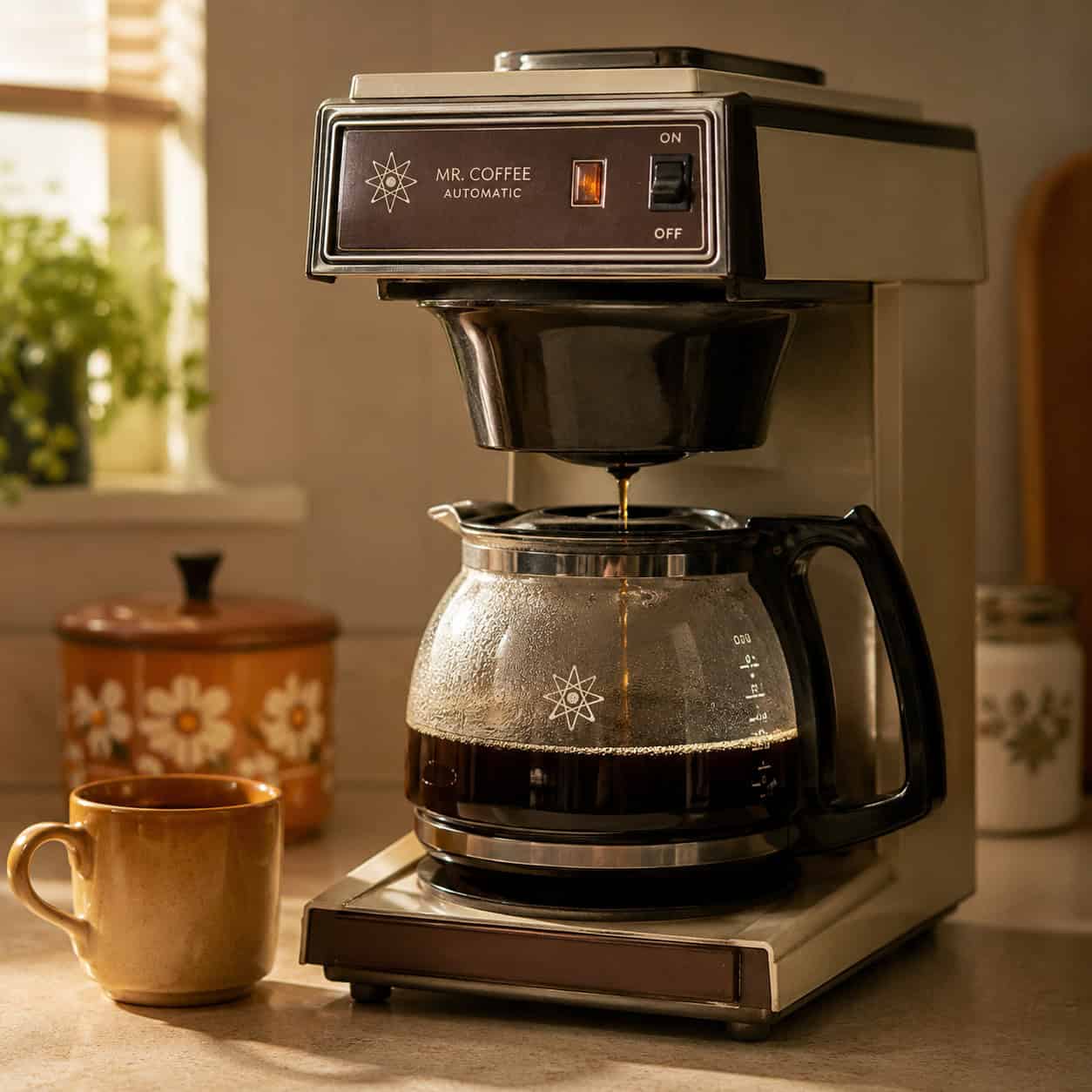
Mr. Coffee put automatic drip on the American counter, and mornings were never the same.
Before it, coffee meant a percolator that could turn bitter in a blink. The drip maker was cleaner, faster, and more forgiving — pour water in the top, and fresh coffee filled the carafe below.
It gave the morning kitchen a ritual centerpiece. The click of the switch, the drip, the smell.
A genuinely new fixture, and one that never left.
20. The Countertop Blender
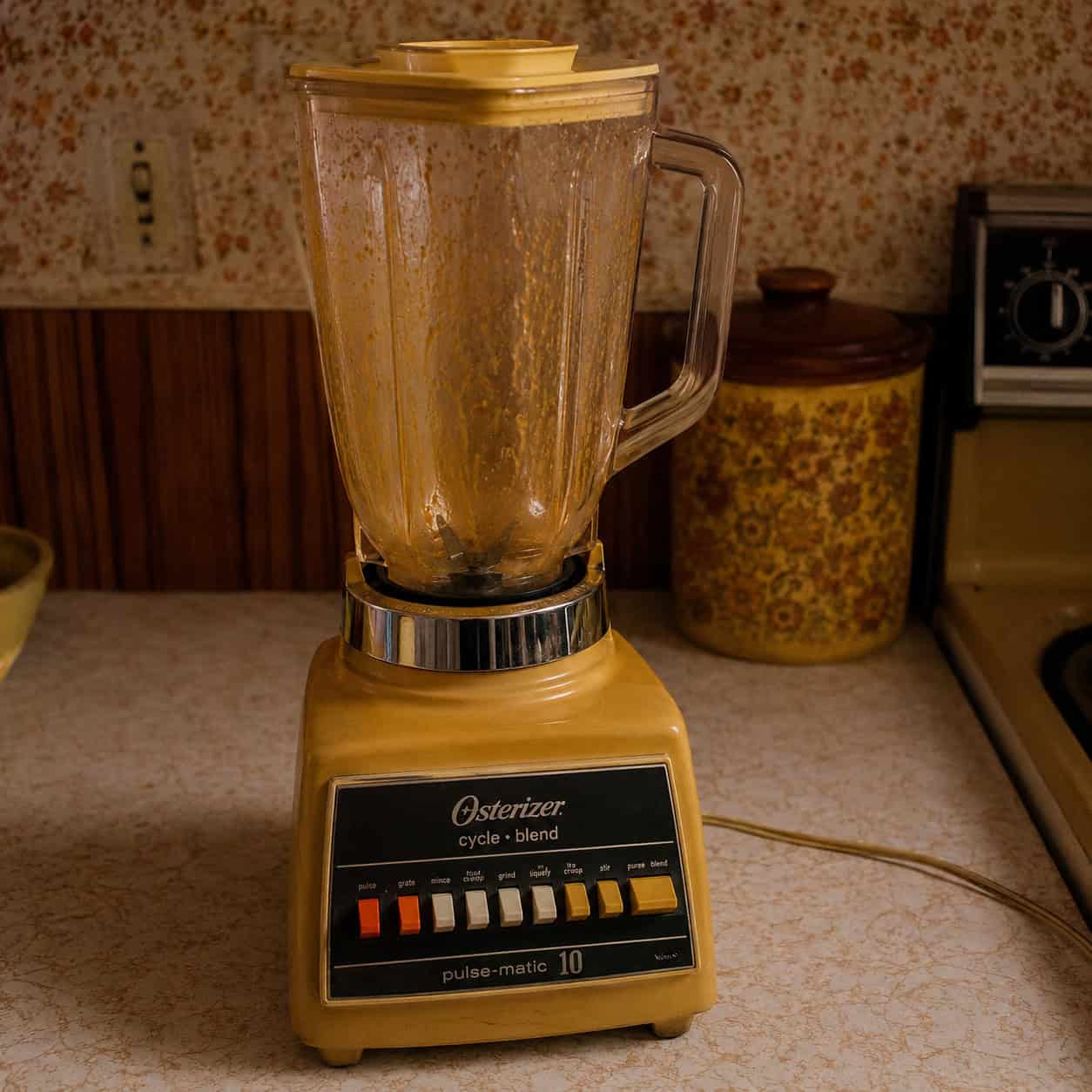
The blender wasn’t invented in the ’70s. But the decade put it to work.
Hamilton Beach and Oster models multiplied across counters, their translucent pitchers slowly stained faint orange from years of frozen daiquiri duty.
It handled milkshakes, soups, baby food, and every cocktail a dinner party demanded. Push-button banks with a dozen speeds nobody could tell apart were a point of pride.
A harvest gold blender on a Formica counter is the entire decade in one image.
21. The Hot-Air Popcorn Popper
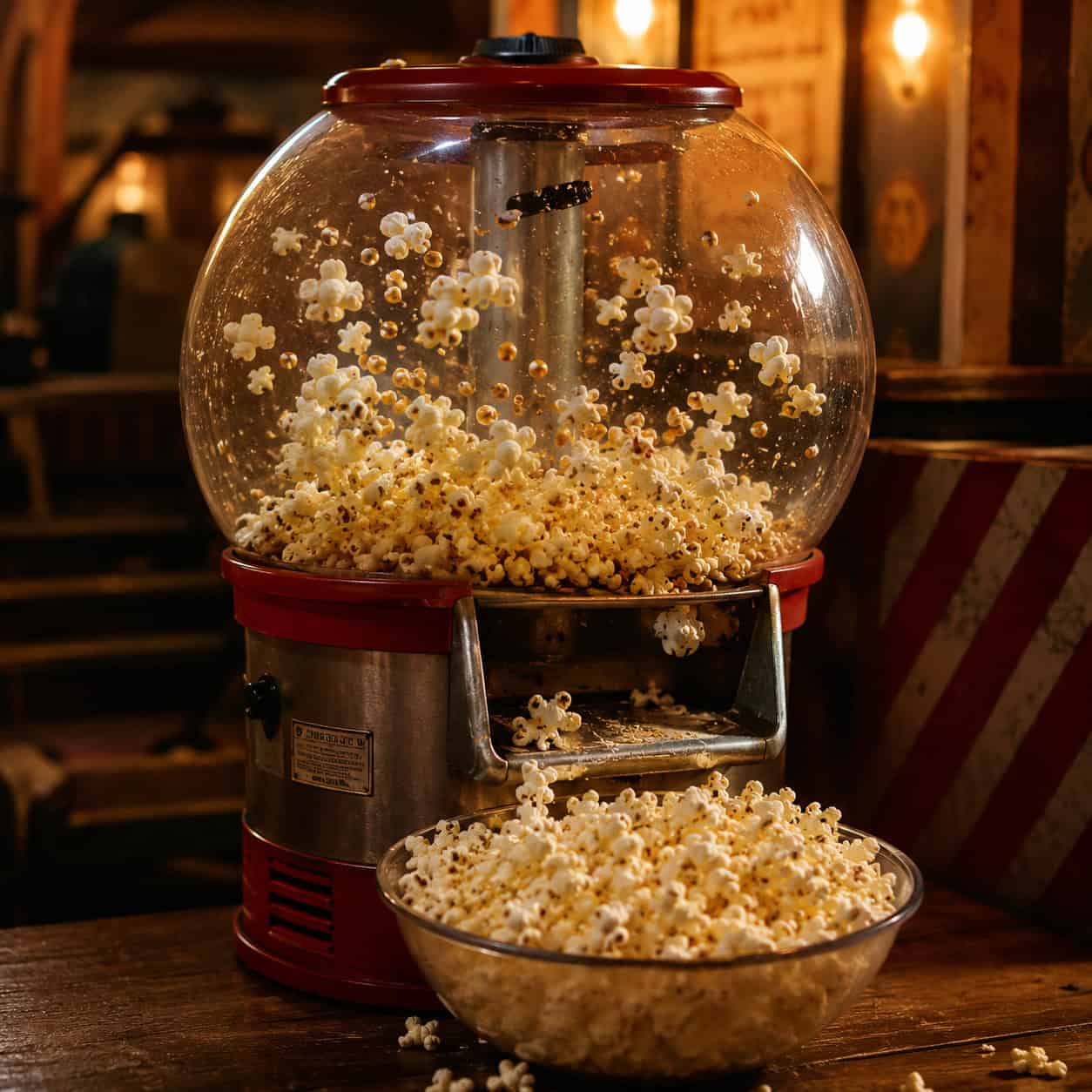
Before microwave popcorn took over, there was the hot-air popper.
Kernels swirled and burst under a clear plastic dome while the family watched like it was television. No oil, no scorched pan, just a blast of hot air and a bowl filling up fast.
Some models leaned on star power — Hamilton Beach sold one endorsed by quarterback Joe Namath. Snack time got a celebrity.
It was cheap theater and a decent snack in one appliance. Very specific, very ’70s.
22. Tupperware Nesting Canisters
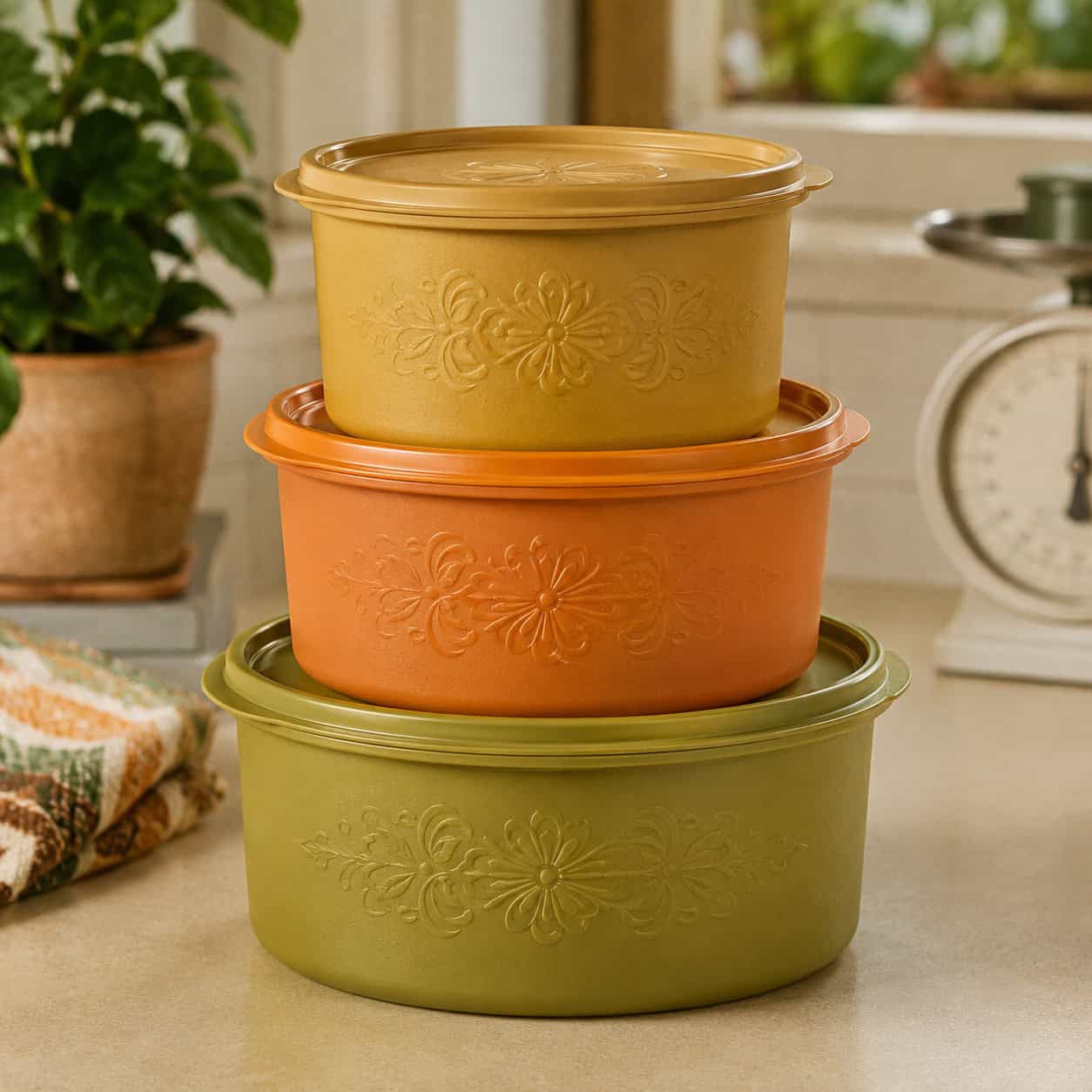
Bright, embossed, and stacked in a tidy nesting set, Tupperware canisters were often the most colorful thing on the counter.
The upscale line arrived in 1971 in the decade’s exact palette — gold, orange, avocado — with those airtight burp-seal lids the brand built its name on.
You didn’t buy them at a store. You bought them at a Tupperware party, a whole social institution built around suburban living rooms and a demonstrator with a catalog.
Flour, sugar, coffee, and cookies each got their own labeled tub. Half storage, half status.
23. CorningWare & Pyrex Casseroles
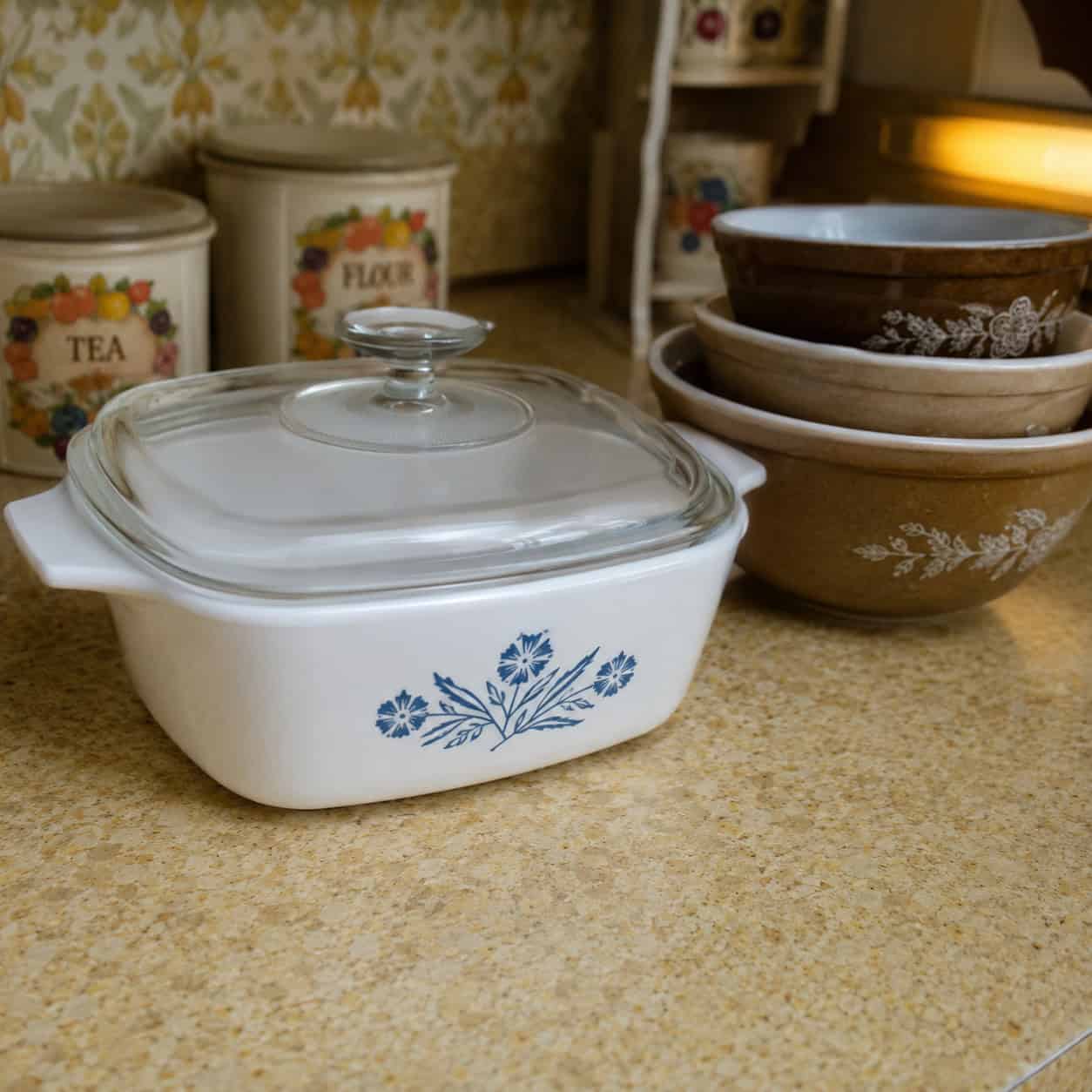
Every cabinet held at least one, and probably a nested set.
The freezer-to-oven Pyroceram casserole — in Blue Cornflower or the Spice of Life pattern that debuted in 1972 — went from freezer to oven to table without cracking. Pyrex bowls in matching earth tones sat right beside them.
They were workhorses. Tuna casserole on Tuesday, leftovers Wednesday, the same dish scrubbed and refilled by Friday.
The then-and-now twist is real. As DDD Near Me reports, the same dishes families once bought cheap now fetch hundreds from collectors. The one you gave away at a yard sale might’ve been worth real money.
24. Corelle Dinnerware
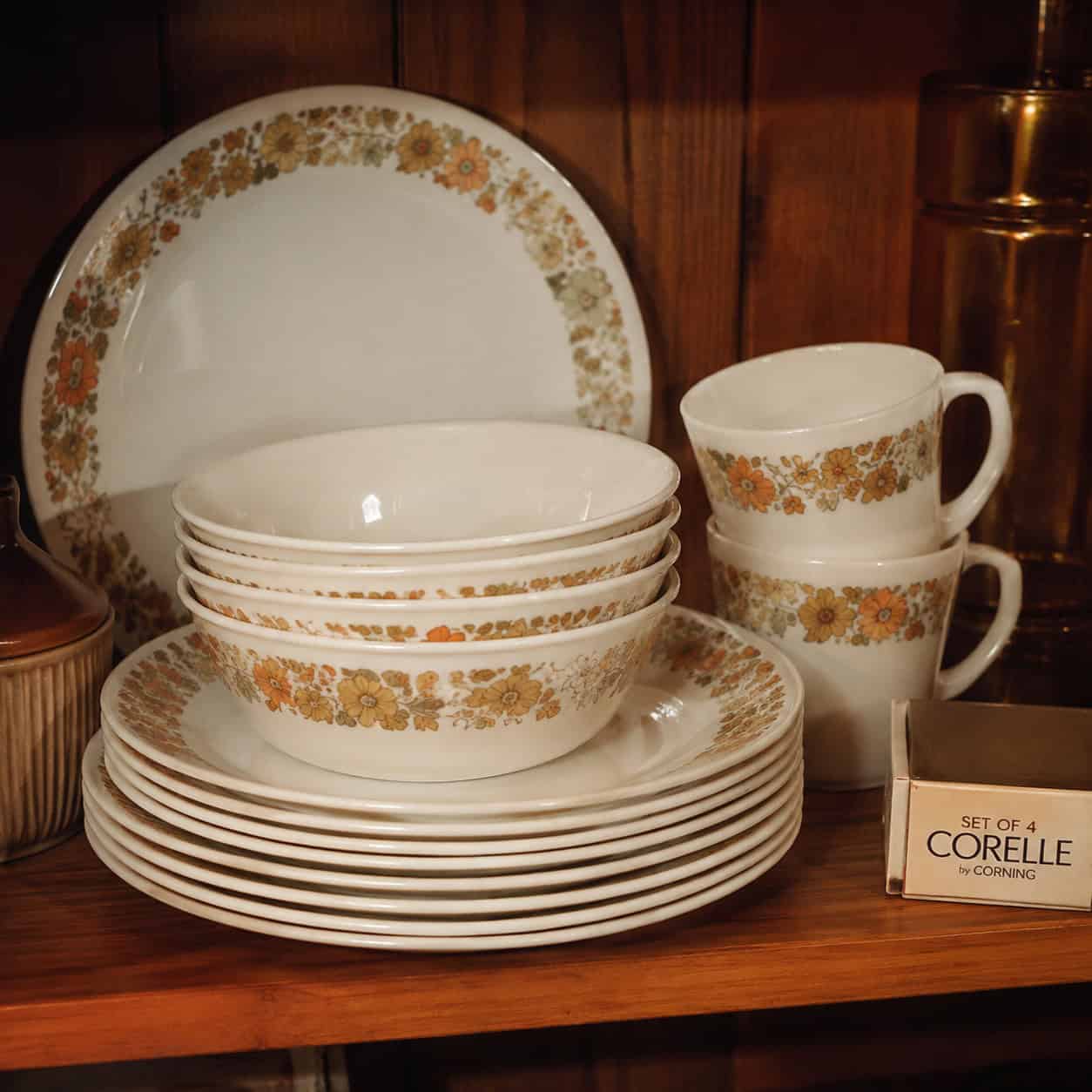
Lightweight, near-unbreakable, and impossible to escape.
Corelle was brand-new and everywhere, made of a layered glass that bounced off the floor more often than it shattered. Parents loved it for exactly that reason.
The patterns matched the mood — earthy florals, autumnal borders, that same Spice of Life vibe running across the plates. Decorative and durable at once.
It’s booming again on the resale market. The pattern you ate off as a kid probably has a fan base now.
25. Macrame Plant Hangers
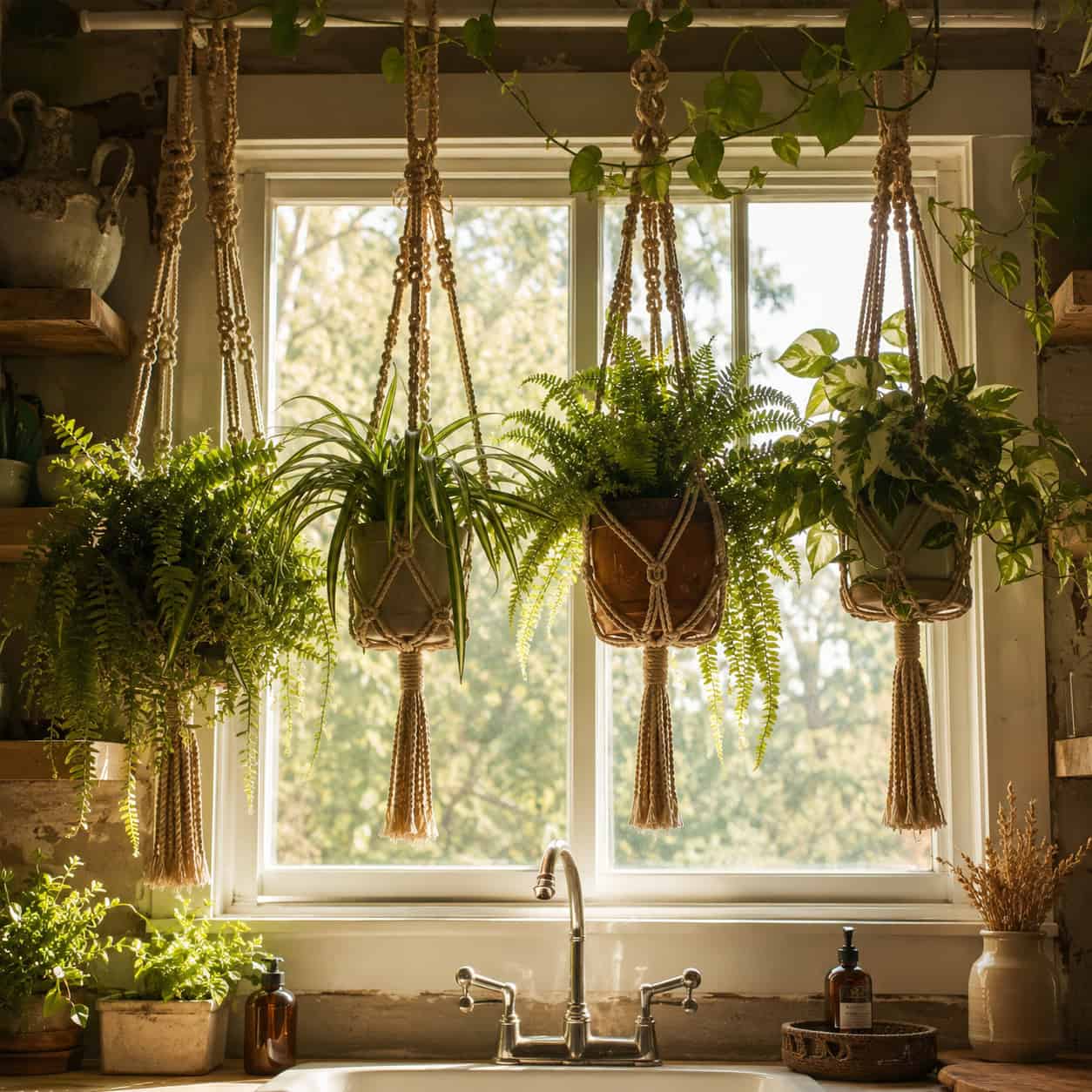
No kitchen was complete without at least one.
Knotted jute dangling a spider plant or a fern near a sunny window — bonus points for a full row of six across the glass, each dripping greenery at a different height.
The square knot and clove hitch were near-universal skills. People made these by the dozen at the kitchen table while the Crock-Pot did dinner.
It fit the whole back-to-nature program. Plants everywhere, held up by rope you tied yourself.
26. Mushroom-Motif Canisters
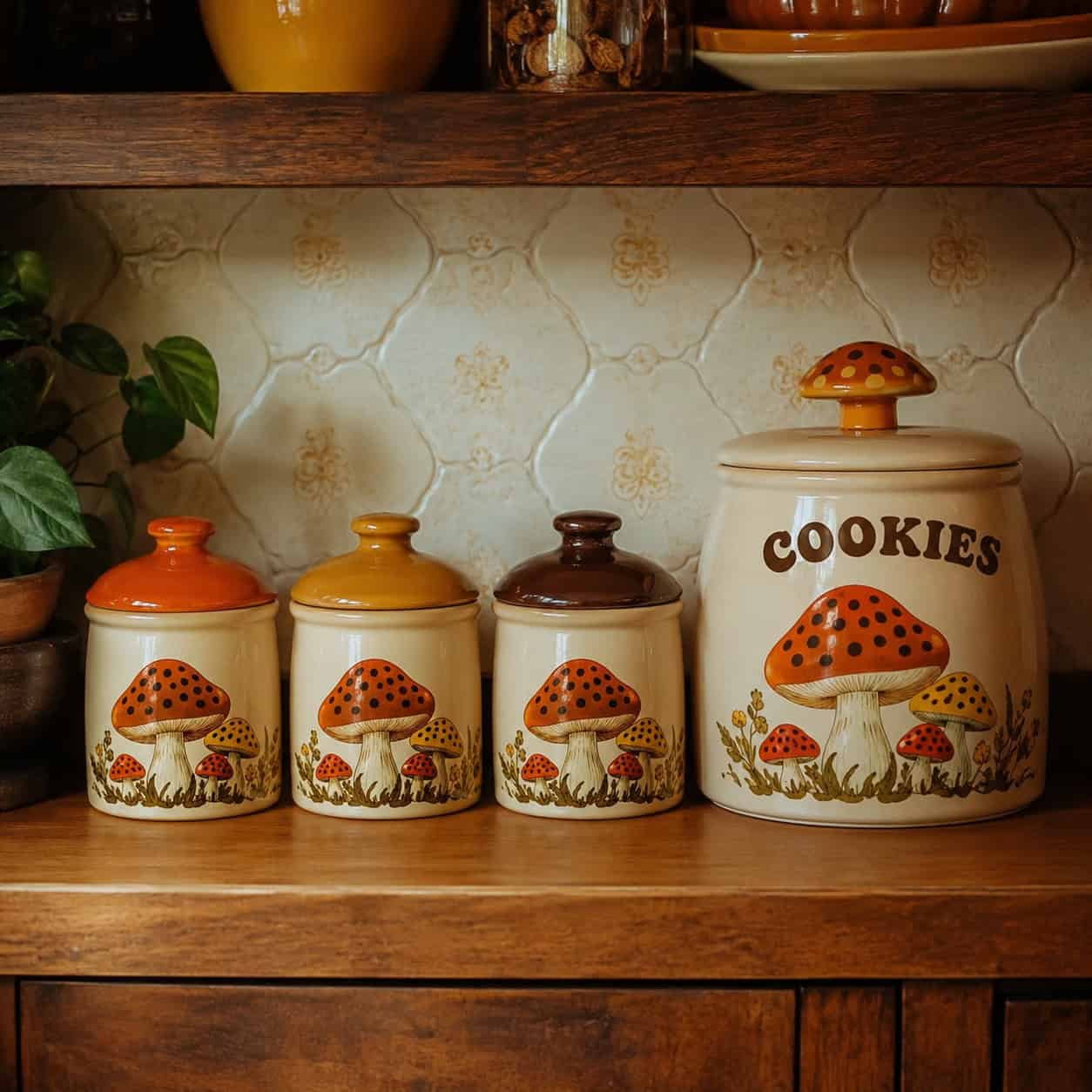
Friendly cartoon mushrooms, and they multiplied.
Orange, gold, brown, and green toadstools covered canisters, cookie jars, salt and pepper shakers, wall clocks, and dish towels. Once one landed in the kitchen, the whole set followed.
It was quintessential woodsy kitsch, tied straight to the era’s nature obsession. Somewhere between charming and completely unhinged, depending on how many you owned.
The mushrooms faded in the early ’80s. But for a decade, they were everywhere you looked.
27. Owl Everything
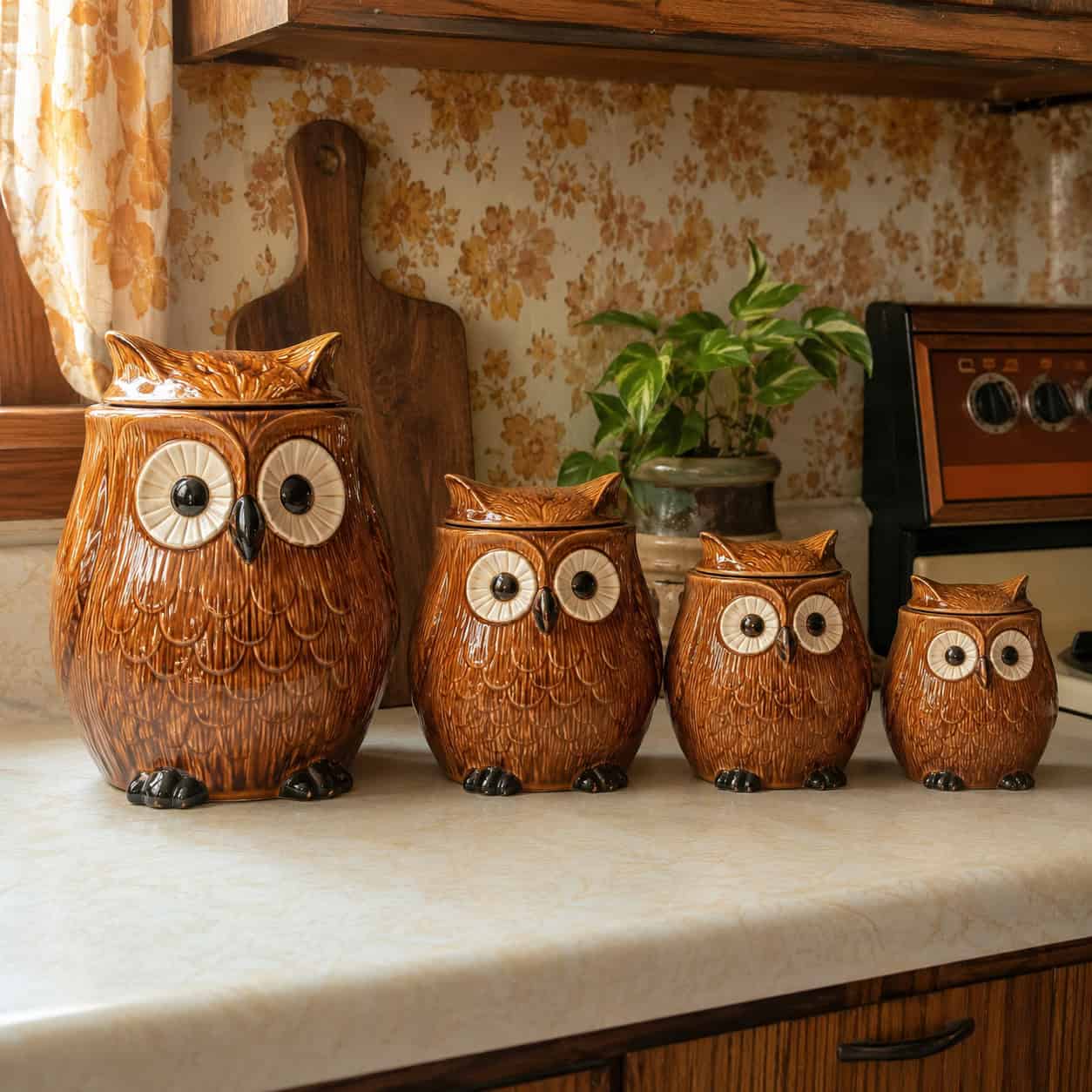
They called it the decade of the owl for a reason.
The owl was the unofficial mascot of the ’70s home, riding in on the environmental movement as a symbol of nature and wisdom. It perched on every available surface.
Owl cookie jars, owl coffee canisters, owl sugar-and-flour sets. Treasure Craft’s woodgrain owl line was especially common, all warm brown ceramic and big round eyes.
Big-eyed and slightly stern, watching over the toast. Then it flew off into the ’80s and mostly didn’t come back — until vintage collectors dragged it home again.
28. The Sunburst Wall Clock
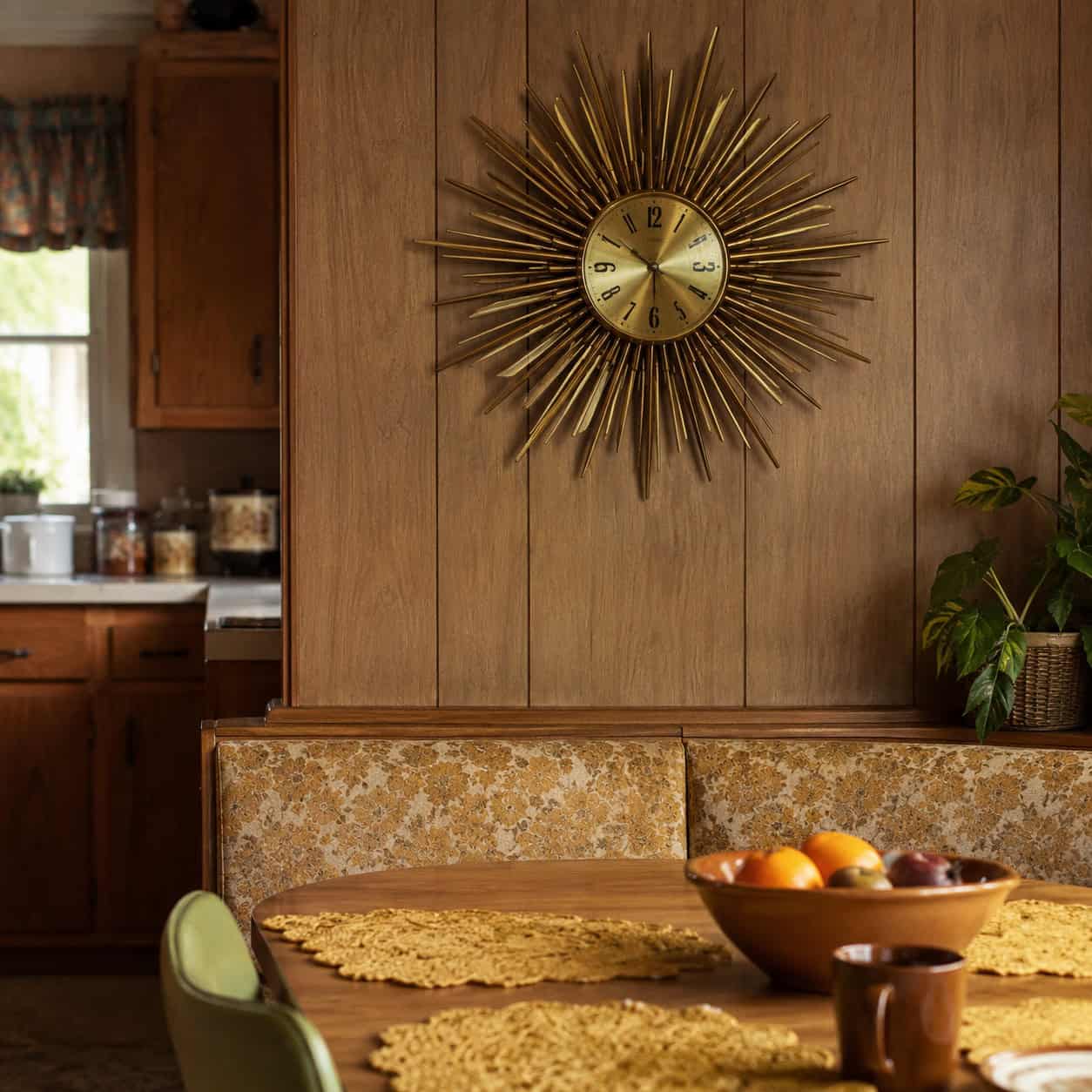
Above the table, radiating spokes in every direction.
The sunburst — or starburst — clock was born in 1949, but its popularity ran deep into the ’70s. Brass or gold-toned rays fanned out from a small central face, turning a clock into wall art.
It gave the room a focal point and matched the era’s restless energy. Mid-century in origin, but by the ’70s it read as pure atmosphere.
You didn’t check it for the time so much as let it fill the empty wall. It did that job beautifully.
29. The Wall-Mounted Phone with the Mile-Long Cord
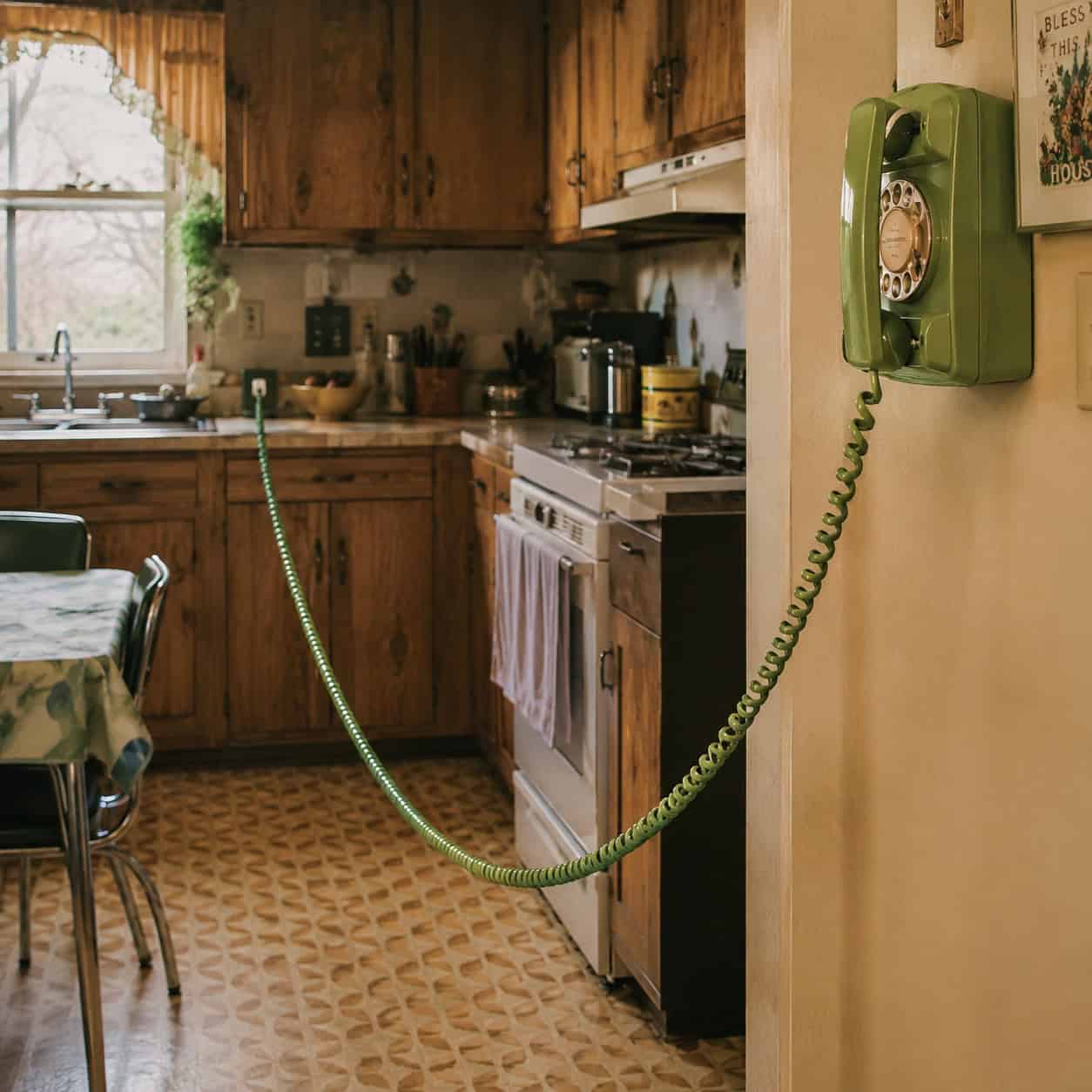
Bright, plastic, and bolted to the kitchen wall.
The coiled cord stretched — improbably, gloriously — long enough to reach into the next room. You could stir a pot, wipe the counter, and gossip for an hour without ever hanging up.
This cemented the kitchen as the home’s communication hub. Every call, every check-in, every argument passed through that one spot on the wall.
It offered zero privacy to any teenager hoping for a quiet conversation. You dragged the cord as far as it would go, around the corner, and hoped nobody was listening in the hall.
They always were.
30. Amber Glassware
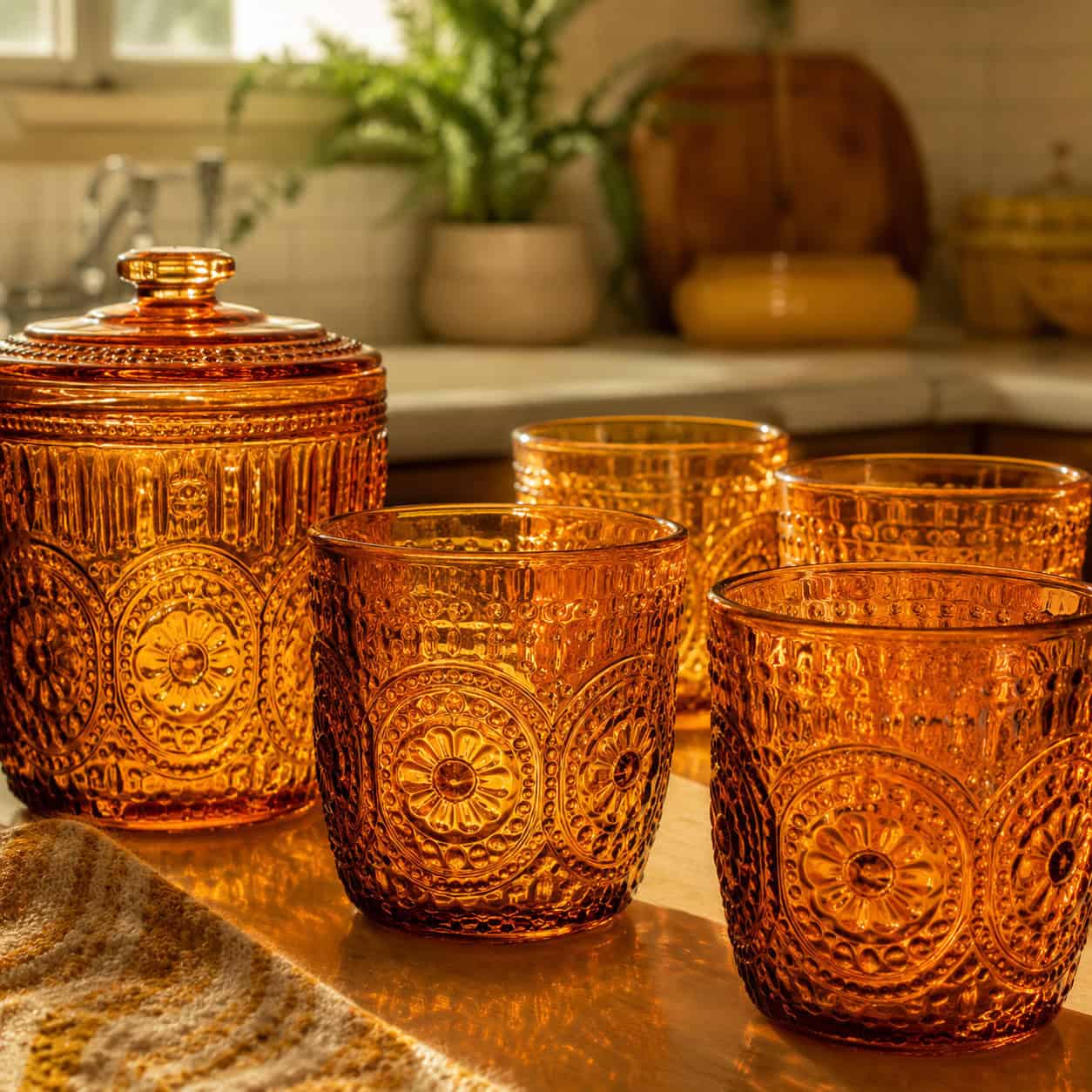
Honey-brown glass caught the light like nothing else.
Pressed-glass tumblers, canisters, and serving pieces in warm amber sat on open shelves and dinner tables, glowing faintly whenever the sun crossed the room.
It matched the earthy palette perfectly — a color that felt lit from within even in a dim, wood-paneled kitchen. Iced tea in an amber tumbler is a summer memory for a whole generation.
A tell-tale sign of the decade, and cheap enough that most families owned a set.
31. Burlap & Gingham Café Curtains
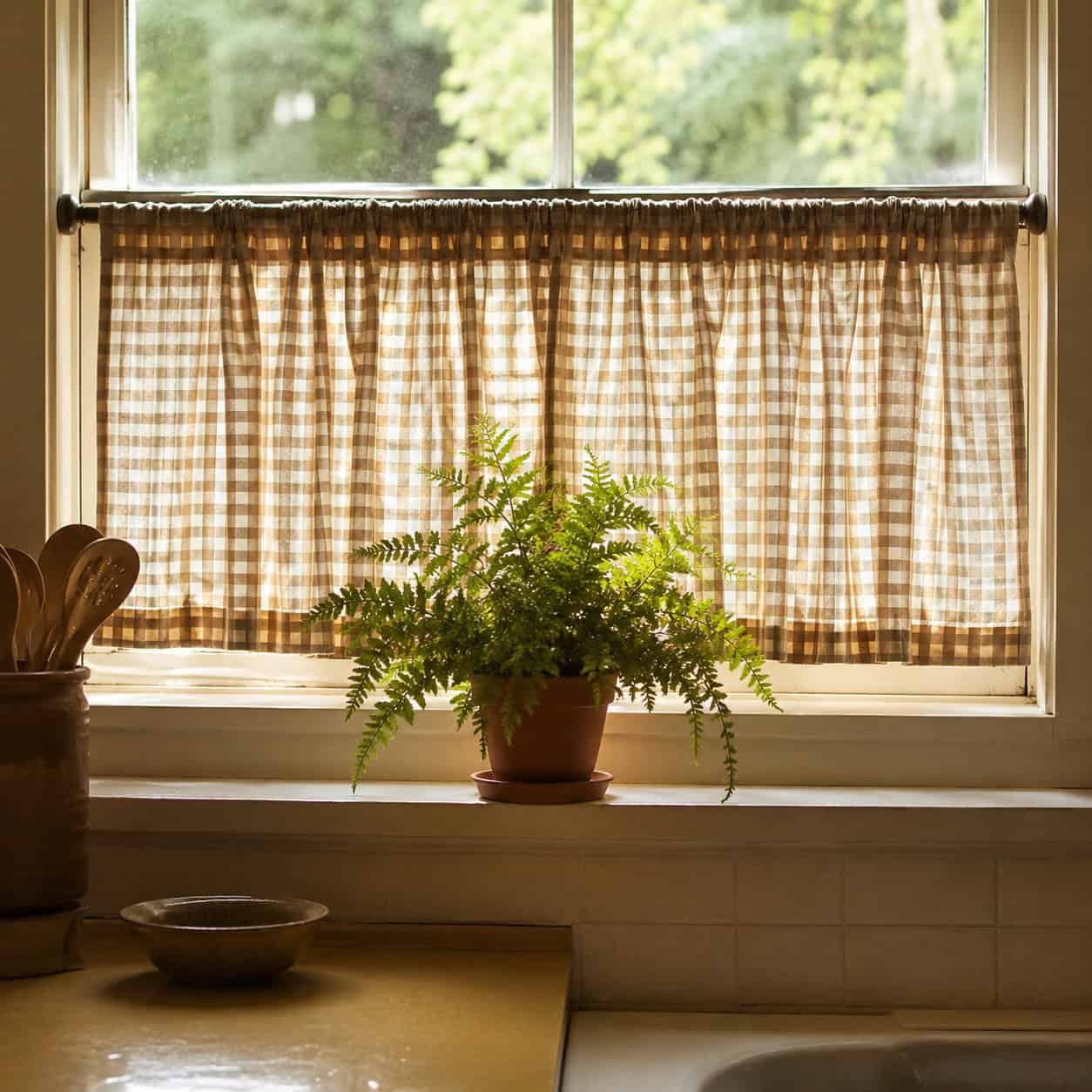
Covering the lower half of nearly every window, just enough for privacy without blocking the light.
Natural-fiber café curtains — burlap for the earthy crowd, gingham checks for the country look — matched the macrame and the wood tones perfectly.
They hung on a simple tension rod across the middle of the window, leaving the top open for a fern or two. Practical, homey, and firmly of their time.
Nothing fussy. Just a bit of woven texture between the kitchen and the backyard.
32. The Electric Carving Knife
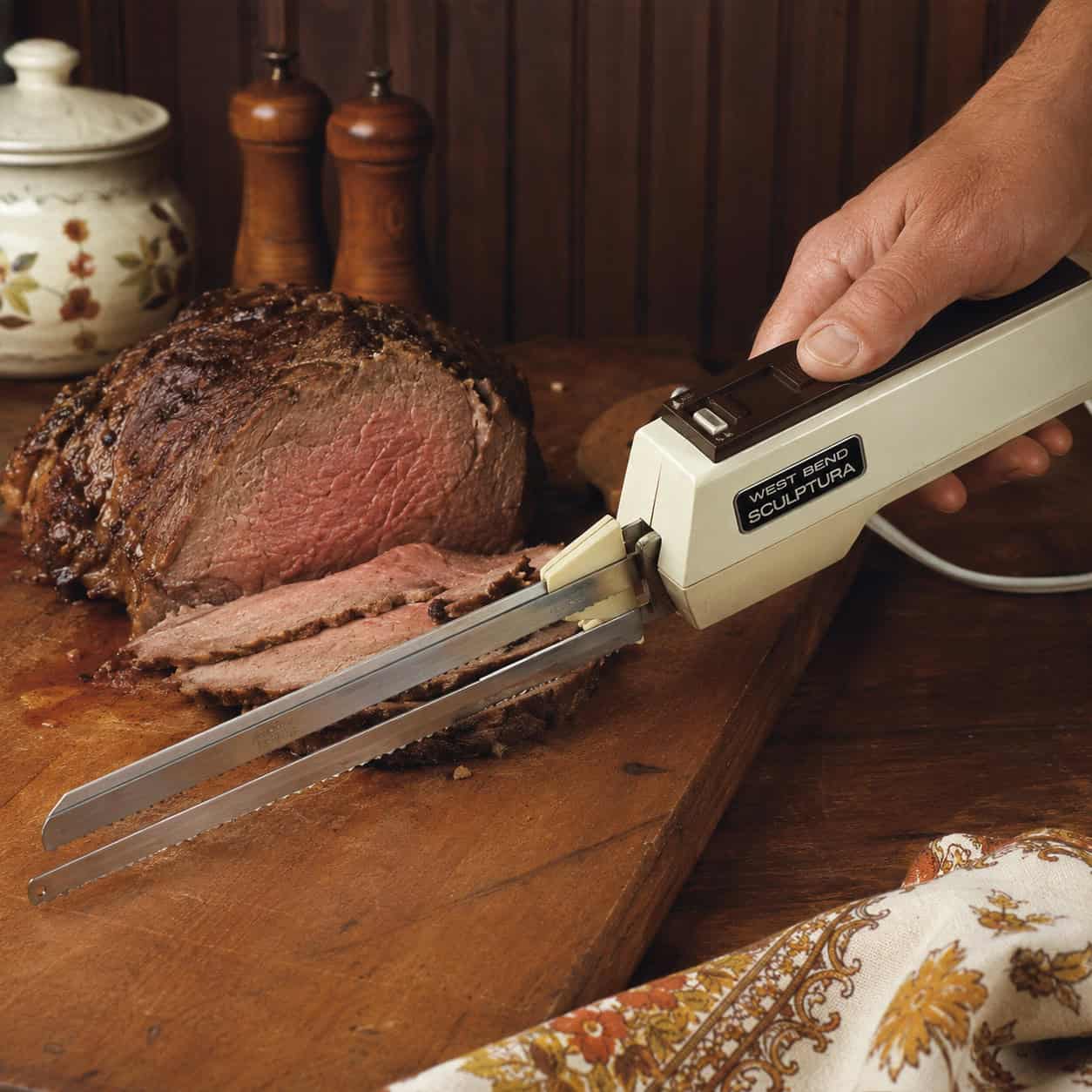
A wedding-registry staple, and a countertop workhorse for holidays.
Two serrated blades buzzed back and forth, gliding through a Thanksgiving turkey or a Sunday roast while the whole table watched. It felt a little dangerous and a lot impressive.
Most families used it a handful of times a year, then tucked it in a drawer with the cord wound around the handle. It never quite died — plenty of boomers still keep theirs.
Overkill for most meals. Perfect for the ones that mattered.
The Kitchen That Refused to Whisper
The ’70s kitchen didn’t do subtle. It layered gold on green on brown on woodgrain and dared you to look away.
Some of it we buried gladly — the trash compactor, the wallpapered ceiling, the color-matched avocado sink. Some of it we quietly kept, or paid a fortune to buy back once the casserole dishes turned collectible.
What tied it all together was warmth. Every surface, every gadget, every knotted plant hanger pointed toward the same idea: the kitchen was where the family actually lived.
Loud as it was, it knew exactly what it wanted to be.
I love all of the styles.